Fixed-Rate vs. Adjustable-Rate Mortgage: Which Should I Choose?
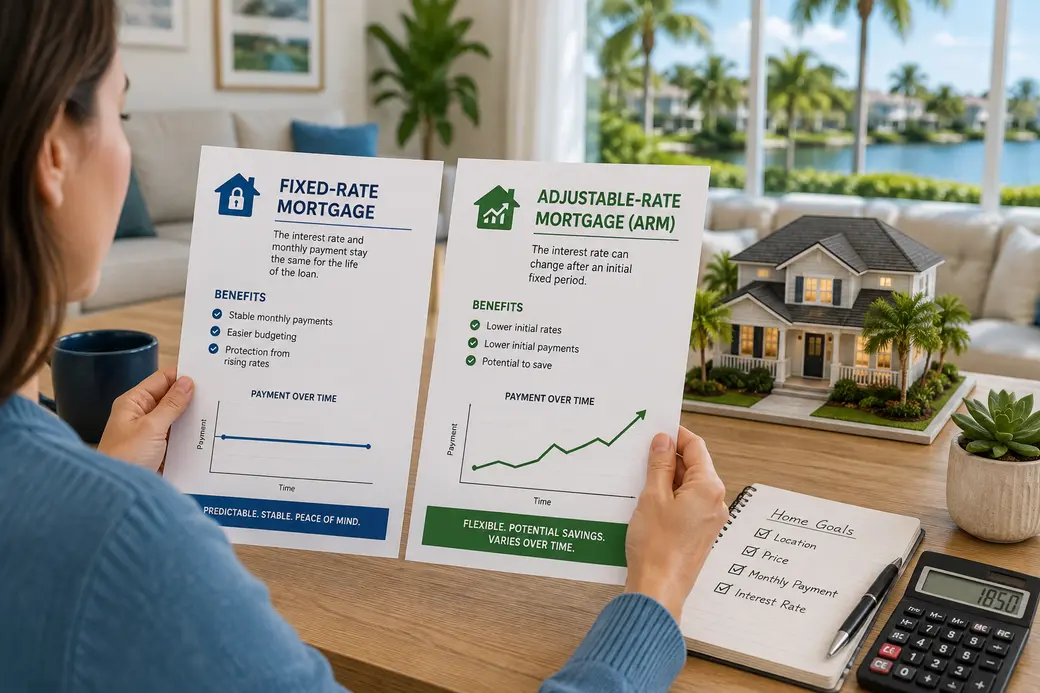
A fixed-rate mortgage provides a predictable interest rate for the life of the loan, while an adjustable-rate mortgage, or ARM, can change after an initial period. Neither option is automatically better for every home buyer. A fixed rate may appeal to buyers who value long-term payment stability, while an ARM may be worth comparing when its initial terms are attractive and the borrower understands the possibility of higher future payments. The right choice depends on the actual loan offers, how long you expect to own the home, your budget, your tolerance for payment changes, and the specific ARM terms offered by the lender.
Quick Answers About Fixed-Rate vs. Adjustable-Rate Mortgages
What Is a Fixed-Rate Mortgage?
A fixed-rate mortgage has an interest rate that is established when the loan is originated and does not change during the loan term. The monthly principal-and-interest payment therefore remains predictable, although the total housing payment can still change because of property taxes, homeowners insurance, mortgage insurance, association expenses, or other costs.
What Is an Adjustable-Rate Mortgage?
An adjustable-rate mortgage has an interest rate that can change according to the loan's terms. Most ARMs begin with a period during which the rate is fixed, followed by periodic adjustments based on an index and margin, subject to the loan's rate caps.
Is an ARM Always Cheaper Than a Fixed-Rate Mortgage?
No. ARMs may offer a lower initial interest rate than comparable fixed-rate loans, but that is not guaranteed, and the rate can later increase. Buyers should compare actual lender offers, including the interest rate, APR, points, lender credits, closing costs, ARM terms, and projected payments.
Can My Payment Change With a Fixed-Rate Mortgage?
Yes, even though the interest rate and scheduled principal-and-interest payment remain fixed. Property taxes, homeowners insurance, flood insurance, mortgage insurance, and other housing expenses can change, which can cause the amount collected through an escrowed monthly payment to increase or decrease.
What Does a 5/1 ARM Mean?
Traditionally, a 5/1 ARM describes a loan with an interest rate fixed for the first five years and adjustments once per year afterward. ARM products can use other structures and adjustment intervals, so buyers should rely on the actual loan disclosures rather than assuming every ARM with a similar name works identically.
Can an ARM Rate Go Down?
It can, depending on movements in the applicable index and the loan's contractual terms. Buyers should not choose an ARM based on an assumption that rates will decline, because future interest rates cannot be known in advance.
Which Mortgage Is Better for Me?
That depends on your finances, expected ownership period, available loan offers, and ability to handle future payment changes. A qualified mortgage professional can provide borrower-specific options, and comparing multiple Loan Estimates can help you evaluate the actual costs and risks rather than choosing based only on the advertised interest rate.
How Does a Fixed-Rate Mortgage Work?
With a fixed-rate mortgage, the interest rate is established at the beginning of the loan and remains unchanged for its term. That makes the principal-and-interest portion of the monthly payment predictable.
For example, if a borrower closes on a qualifying 30-year fixed-rate mortgage, changing market interest rates do not cause the contractual mortgage rate to rise or fall. The borrower continues paying according to the original loan terms unless the loan is later paid off, refinanced, modified, or otherwise changed.
That predictability is the primary attraction. A homeowner does not need to monitor an index or prepare for scheduled interest-rate resets.
What Does "Fixed" Actually Mean?
Fixed refers to the mortgage interest rate, not every component of the homeowner's monthly housing expense.
The Consumer Financial Protection Bureau explains that the interest rate and monthly principal-and-interest payment stay the same on a fixed-rate loan. Other costs can still change.
- Property taxes can change.
- Homeowners insurance premiums can change.
- Flood insurance costs can change when applicable.
- Mortgage insurance can affect the total payment when applicable.
- Condominium and homeowners association expenses are separate from the mortgage and may change.
For Gulf Coast buyers in particular, it is important to evaluate the complete cost of ownership rather than equating a fixed mortgage rate with a completely fixed housing budget.
How Does an Adjustable-Rate Mortgage Work?
An adjustable-rate mortgage introduces another variable. The interest rate is typically fixed during an introductory period and can then adjust at specified intervals.
According to the CFPB's fixed-rate and ARM guidance, many ARMs begin with a lower rate than fixed-rate mortgages, but the introductory period eventually ends. After that point, the interest rate can change according to the loan's adjustment schedule.
An ARM is therefore not simply a mortgage with a temporary discount. It is a loan whose future interest rate and payment may respond to changing market conditions according to contractual rules established when the borrower takes out the loan.
Understanding ARM Names: 5/1, 7/1, 10/1 and Other Structures
ARM names are designed to communicate when the loan can begin adjusting and how frequently adjustments occur, but buyers should read the actual disclosures carefully because available products vary.
The CFPB uses a 5/1 ARM as an example. In that structure, the "5" represents five years during which the initial interest rate remains fixed, and the "1" represents an adjustment once each year after the initial period.
Modern ARM products may use different reset schedules. For example, certain conventional SOFR-based ARM programs use six-month adjustment periods after their initial fixed-rate periods. Buyers should therefore ask the lender exactly when the first adjustment occurs and how frequently adjustments can occur afterward.
What Are the Index and Margin on an ARM?
Two terms are essential to understanding an adjustable-rate mortgage: index and margin.
The CFPB explains ARM indexes and margins this way: the index is an interest-rate measure that fluctuates with market conditions, while the margin is a number established by the lender and specified in the loan agreement.
After the introductory rate expires, the lender generally uses the applicable index plus the loan's margin to determine the adjusted interest rate, subject to the contractual rate caps.
Index + margin = fully indexed rate, subject to the loan's applicable terms and caps.
This is why comparing ARMs requires more than looking at the initial rate. Two loans with similar introductory rates can have different margins, caps, indexes, adjustment schedules, fees, and long-term risk.
What Are ARM Rate Caps?
Rate caps limit how much an adjustable mortgage rate can change under specified circumstances. Understanding those caps is one of the most important steps in evaluating an ARM.
The CFPB identifies three common types of ARM rate caps:
- Initial adjustment cap: Limits how much the rate can change at the first adjustment after the introductory fixed period.
- Subsequent adjustment cap: Limits how much the rate can change during later adjustment periods.
- Lifetime adjustment cap: Limits the total increase permitted over the life of the loan.
The actual caps depend on the mortgage. Buyers should ask the lender to show the highest rate and payment permitted under the loan terms rather than assuming that a cap makes a future payment increase insignificant.
Fixed-Rate vs. ARM: Side-by-Side Comparison
| Feature | Fixed-Rate Mortgage | Adjustable-Rate Mortgage |
|---|---|---|
| Interest rate | Does not change during the loan term | Can change after the initial fixed period |
| Principal and interest payment | Predictable under the loan terms | Can increase or decrease after adjustments begin |
| Initial rate | Depends on lender and market | May initially be lower than a comparable fixed rate |
| Exposure to future rate increases | No change to the contractual interest rate | Yes, subject to the loan's adjustment terms and caps |
| Potential benefit if market rates fall | Existing rate does not automatically decline | Rate may decline depending on index movement and loan terms |
| Budget predictability | Higher for principal and interest | Lower after the adjustment period begins |
| Important terms to compare | Rate, APR, points, fees, term, monthly payment | All fixed-rate factors plus index, margin, caps, first adjustment date, and adjustment frequency |
When Might a Fixed-Rate Mortgage Be Worth Considering?
The primary reason to consider a fixed-rate mortgage is predictability. The borrower knows the contractual interest rate and scheduled principal-and-interest payment from the beginning of the loan.
A fixed rate may deserve particular consideration when:
- You expect to own the home for a long time.
- Predictable principal-and-interest payments are important to your budget.
- You do not want exposure to future mortgage-rate adjustments.
- The difference between the fixed-rate and ARM offers available to you is relatively small.
- A substantial ARM payment increase would create financial strain.
- You prefer certainty rather than making assumptions about future interest rates or refinancing.
Those are considerations rather than lending recommendations. Borrowers should compare their actual options with a qualified mortgage professional who can evaluate income, credit, assets, debt, loan program eligibility, and other borrower-specific factors.
When Might an Adjustable-Rate Mortgage Be Worth Comparing?
An ARM can be worth evaluating when its initial pricing creates a meaningful advantage and the borrower understands and can accommodate the future risk.
Situations in which a buyer might ask a lender to compare an ARM include:
- The ARM offers a materially lower initial cost than available fixed-rate alternatives.
- The buyer expects to own the property for a shorter period, while recognizing that plans can change.
- The borrower has sufficient financial capacity to handle the payment if the rate increases.
- The initial fixed period is long enough to fit the buyer's expected ownership horizon.
- The borrower fully understands the index, margin, adjustment frequency, and caps.
- The borrower has compared the ARM against fixed-rate alternatives using actual lender disclosures.
An expected move can be part of the analysis, but it should not be treated as a guarantee that the ARM will be paid off before it adjusts.
The Biggest ARM Mistake: Assuming You Can Just Refinance Later
One of the most important cautions from federal consumer guidance is not to base an ARM decision entirely on the assumption that refinancing will solve the problem before the rate changes.
The CFPB Consumer Handbook on Adjustable-Rate Mortgages warns borrowers that future refinancing may not be available. Home values can change, financial circumstances can change, lending standards can change, and future interest rates are unknown.
A safer comparison is to ask whether the ARM remains financially manageable under the adjustment scenarios permitted by the loan, even if refinancing does not occur.
Should You Choose an ARM Because You Think Rates Will Fall?
Predicting interest rates is not the same as comparing mortgage terms. Future rates can move differently from forecasts, and a mortgage decision can have consequences for many years.
An ARM can potentially benefit from declining rates after adjustments begin, subject to the loan's terms. It can also produce higher payments if the relevant index rises.
Instead of trying to predict the market perfectly, buyers can ask a more useful question: Does this mortgage still work for my finances if rates do not move the way I hope?
How Much Could My ARM Payment Increase?
There is no universal answer because the maximum payment depends on the loan amount, initial rate, remaining balance, index, margin, rate caps, adjustment schedule, loan term, and other contractual provisions.
This is a calculation buyers should request from the lender before selecting an ARM. Ask for the potential payment after the first adjustment and the payment associated with the maximum rate permitted under the loan.
The CFPB specifically recommends understanding how high the interest rate and monthly payment can go, how frequently adjustments can occur, when the first increase could happen, and whether the borrower could afford the maximum payment allowed under the contract.
Compare the Loan Estimate, Not Just the Advertised Rate
An advertised mortgage rate is only one component of a loan offer. Buyers should compare the standardized Loan Estimates they receive from lenders.
The CFPB's Loan Estimate guidance explains where borrowers can identify whether the interest rate is adjustable and where additional ARM information appears on the disclosure.
When comparing fixed-rate and adjustable-rate offers, review:
- Interest rate
- Annual percentage rate, or APR
- Monthly principal and interest
- Projected total payment
- Loan term
- Mortgage insurance when applicable
- Discount points
- Lender credits
- Origination charges
- Other closing costs
- Whether the rate is locked
- Prepayment penalties, if any
- For an ARM, the index, margin, adjustment schedule, and caps
The CFPB also provides guidance for comparing multiple Loan Estimates, including interest and fees over a defined period. That can provide a more meaningful comparison than focusing on a single headline rate.
Questions to Ask a Lender Before Choosing an ARM
Adjustable-rate mortgages have more moving parts than fixed-rate loans. Before choosing one, buyers should understand the answers to questions such as:
- How long is the initial rate fixed?
- When is the first adjustment?
- How frequently can the rate adjust after that?
- Which index does the loan use?
- What is the margin?
- What is the initial adjustment cap?
- What is the subsequent adjustment cap?
- What is the lifetime cap?
- Is there a minimum rate or floor?
- What could my payment become at the first adjustment?
- What is the highest rate and payment permitted under the loan?
- How does this offer compare with your fixed-rate options?
- Are points or lender credits affecting the apparent rate difference?
- Does the loan have a prepayment penalty or other feature I should understand?
The CFPB's ARM fine-print guidance provides additional questions borrowers can use when discussing an adjustable-rate loan with a lender.
Questions to Ask Yourself Before Choosing
The mortgage structure should fit more than today's payment. Consider how the loan would interact with your broader financial and homeownership plans.
- How long might I realistically own this home?
- How important is a predictable principal-and-interest payment?
- Could I comfortably handle the ARM's potential higher payment?
- Am I choosing an ARM because the actual terms are attractive, or because I am predicting future rates?
- Would my plan still work if I could not refinance?
- How much cash will I have left after the down payment and closing?
- Have I budgeted for insurance, taxes, maintenance, association expenses, and other ownership costs?
- Have I compared more than one lender and loan structure?
Why the Mortgage Payment Is Only Part of a Gulf Coast Home Budget
For Sarasota and Florida Gulf Coast buyers, mortgage structure is important, but it should be evaluated alongside the other costs associated with the specific property.
A condominium buyer may need to budget for association fees and potential assessments. A waterfront buyer may have additional considerations involving flood insurance, seawalls, docks, and other waterfront improvements. A single-family homeowner may need to evaluate roof condition, wind mitigation features, insurance availability, and ongoing maintenance.
Hunt Brothers Realty's buyer's guide to waterfront homes on Florida's Gulf Coast provides additional information for buyers considering waterfront property. Buyers can also review what $500K, $1M, or $2M can buy in Sarasota when evaluating how financing fits into the broader home search.
Insurance availability, coverage, and premiums can vary substantially by property. Buyers should obtain property-specific insurance quotes and review coverage with a qualified insurance professional before making a purchasing decision.
Should You Pick the Mortgage Before You Pick the House?
Buyers can benefit from discussing financing early because the loan structure affects the price range and monthly costs they may be able to consider. However, the final financing analysis also depends on the property.
Property taxes, insurance, condominium or homeowners association fees, flood considerations, and other expenses can vary considerably from one home to another. A mortgage payment that looks comfortable in isolation may produce a different total housing budget after property-specific expenses are included.
A licensed real estate professional can help buyers identify property-related costs and characteristics during the home search, while a qualified mortgage professional should determine loan eligibility, financing terms, payment calculations, and borrower-specific mortgage options.
Fixed-Rate or ARM: A Practical Decision Framework
Instead of asking which mortgage type is universally better, compare how each actual loan offer performs under several possible scenarios.
| Question | Why It Matters |
|---|---|
| What if I own the home much longer than expected? | An ARM may begin adjusting while you still own the property. |
| What if rates rise? | A fixed rate remains unchanged, while an ARM can adjust upward within its contractual limits. |
| What if rates fall? | An ARM may adjust downward depending on its terms, while changing a fixed-rate loan would generally require another transaction such as refinancing. |
| What if I cannot refinance? | The original mortgage needs to remain financially workable. |
| How large is the initial ARM advantage? | A small initial difference may not justify the additional rate uncertainty for every borrower. |
| Can I afford the maximum permitted ARM payment? | This tests whether the loan remains manageable if rates move against you. |
Ask the lender to provide the numbers needed to make these comparisons. Mortgage decisions should be based on actual loan terms and borrower-specific qualification rather than hypothetical rates alone.
So, Which Should You Choose?
A fixed-rate mortgage offers the simpler tradeoff: the contractual interest rate does not change, providing predictable principal-and-interest payments for the loan term.
An adjustable-rate mortgage introduces more uncertainty but may offer attractive initial terms in some lending environments. Evaluating one properly requires understanding not only today's payment but also the index, margin, caps, adjustment schedule, and potential future payments.
For many buyers, the most useful next step is to request comparable fixed-rate and ARM Loan Estimates from qualified lenders and evaluate both against the same purchase price, down payment, loan term, and expected ownership period. That turns an abstract question about which mortgage is "better" into a comparison of real financing choices.
Planning a Gulf Coast Home Purchase?
Hunt Brothers Realty helps buyers evaluate homes, condominiums, waterfront properties, and communities throughout Sarasota and Florida's Gulf Coast. While mortgage qualification and loan recommendations should come from qualified lending professionals, understanding property-specific costs can help buyers make more informed housing decisions.
You can explore Gulf Coast communities with Hunt Brothers Realty, review what different budgets can buy in Sarasota, or learn about the additional due diligence involved in buying waterfront property on Florida's Gulf Coast.
Informational notice: This article is provided for general informational and educational purposes only and is not individualized mortgage, lending, financial, tax, legal, insurance, or investment advice. Mortgage rates, APRs, qualification requirements, loan programs, fees, ARM terms, and borrower eligibility vary by lender and individual circumstances. Buyers should review actual Loan Estimates and discuss borrower-specific financing choices with qualified mortgage professionals. Tax and legal questions should be directed to the appropriate qualified tax or legal professionals, and property-specific insurance costs and coverage should be reviewed with a qualified insurance professional.
Sources
- Consumer Financial Protection Bureau, Fixed-Rate vs. Adjustable-Rate Mortgages
- Consumer Financial Protection Bureau, Understanding Different Kinds of Mortgage Loans
- Consumer Financial Protection Bureau, Adjustable-Rate Mortgage Resources
- Consumer Financial Protection Bureau, ARM Index and Margin
- Consumer Financial Protection Bureau, ARM Rate Caps
- Consumer Financial Protection Bureau, ARM Fine-Print Questions
- Consumer Financial Protection Bureau, Consumer Handbook on Adjustable-Rate Mortgages
- Consumer Financial Protection Bureau, Loan Estimate Explainer
- Consumer Financial Protection Bureau, Comparing Loan Estimates
- Fannie Mae, Adjustable-Rate Mortgages
- Hunt Brothers Realty, A Buyer's Guide to Waterfront Homes on Florida's Gulf Coast
- Hunt Brothers Realty, Explore Gulf Coast Communities
Contact Hunt Brothers Realty
46 N. Washington Blvd, Ste 3, Sarasota, FL 34236
Phone: (941) 388-7017
Email: info@huntbrothersrealty.com
Website: HuntBrothersRealty.com
Categories
- All Blogs 2050
- Anna Maria Island 86
- Bird Key 4
- Bradenton 236
- Buying a Home 1111
- Casey Key 2
- Clearwater 11
- Condos & HOA Living 1029
- Ellenton 5
- Englewood 11
- First Time Homebuyers 1220
- Foreclosures 3
- Home Selling 3
- Homeownership 1243
- Lakewood Ranch 25
- Lido Key 28
- Longboat Key 80
- Luxury/Waterfront Properties 1184
- Market Updates & Trends 711
- Mortgages & Financing 42
- Move-Up Buyers 21
- Neighborhood Guides 825
- New Construction 34
- Palmetto 3
- Parrish 6
- Port Charlotte 10
- Punta Gorda 17
- Real Estate Investing 1101
- Relocation to Florida 1143
- Safety Harbor 2
- Sarasota 77
- Sarasota - Downtown 162
- Selling a Home 144
- Siesta Key 91
- St. Petersburg 8
- Tierra Verde 5
- Vacation & Second Homes 1293
- Venice 155
- Wellen Park 16
Recent Posts