How to Find New Florida Home Listings Fast | 2026 Guide
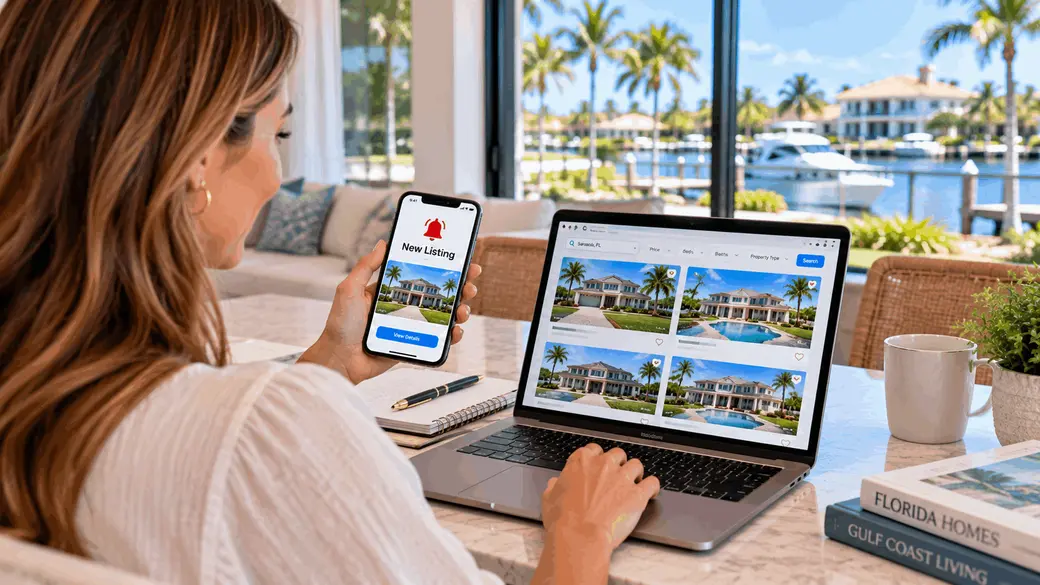
The most practical way to find new Florida home listings quickly is to have a focused MLS-connected search set up before the right property appears. Ask your real estate professional to create a search using your actual price range, locations, property type and essential features, then use listing alerts to monitor new inventory. You can supplement those alerts with major real estate websites, builder inventory and legitimate coming-soon opportunities. Speed matters most when it is paired with preparation. If you already understand your budget, financing and priorities, you can evaluate a new listing quickly without allowing urgency to replace careful property research.
Buyers searching Florida's Gulf Coast can start with Hunt Brothers Realty and explore individual locations through the Florida Gulf Coast community directory.
Quick Answers About Finding New Home Listings
How can I find a house as soon as it is listed?
Set up a focused MLS-connected search with listing alerts and keep your search criteria current. A real estate professional can help refine the search so that new properties matching your priorities are easier to identify instead of being buried among hundreds of irrelevant listings.
Are MLS listings faster than real estate websites?
MLS systems are a primary source through which participating real estate professionals share local listing information. Many brokerage and consumer websites receive listing information through MLS-related data distribution, including IDX. Display timing can vary by platform, so serious buyers should not rely on repeatedly refreshing only one consumer website.
Can my Realtor alert me when a new home is listed?
Yes. A real estate professional can establish a property search using available listing resources and help you monitor homes matching your criteria. Ask how listing notifications are delivered and how quickly you should contact the agent when you want to investigate a property.
Should I use more than one home-search website?
You can use several websites for research, but duplicating alerts from many sites can create unnecessary noise. A focused MLS-connected search can serve as the core of your serious home search, with other websites used for additional browsing and research.
What is the difference between new and coming-soon listings?
A newly active listing is generally available under its current active status, subject to the seller's showing instructions. A coming-soon or other pre-marketing status can involve a property that is not yet available for normal active-market showings. Local MLS rules and seller instructions determine how those statuses operate.
Should I get pre-approved before setting up listing alerts?
You can browse before obtaining mortgage pre-approval, but financed buyers who are ready to act on a new listing should consider completing financing preparation before serious shopping. A new listing is less useful if you discover afterward that your financing assumptions need substantial work.
Do I need to make an offer immediately when a good home appears?
No. Responding quickly does not mean making an uninformed decision. Market conditions, seller instructions and competition vary. Your real estate professional can help you gather available information, arrange a showing and evaluate the property before you decide whether an offer makes sense.
Why Start With an MLS-Connected Property Search?
The National Association of REALTORS® describes the MLS as a collaborative system through which real estate professionals share local property listing data and help connect buyers and sellers.
MLS listing information can also be distributed online through systems such as Internet Data Exchange, commonly called IDX. IDX allows participating brokers to display eligible listings from other participants on brokerage-controlled websites and applications according to applicable MLS rules.
For an active buyer, the important point is not memorizing how the technology works. It is having a search in place before new inventory appears.
How Should I Set Up My New-Listing Search?
A fast alert is only useful if the search behind it is accurate. If your criteria return 150 properties you would never buy, receiving the results sooner does not solve the problem.
Start with the criteria that materially affect whether you would consider a property:
- Target price range
- Cities, communities or neighborhoods
- Property type
- Minimum bedrooms and bathrooms
- Approximate home size
- Garage requirements
- Pool preferences
- Waterfront characteristics when relevant
- New construction versus resale
- Other objective property features that are important to your search
The Hunt Brothers Realty guide to what a Florida buyer's agent actually does explains how a real estate professional can help turn buyer priorities into a more useful property search.
Should I Make My Search Narrow or Broad?
Usually, you want the search narrow enough to eliminate properties you clearly would not consider but broad enough to avoid accidentally excluding a good candidate.
For example, if your ideal budget is $500,000, deciding whether you would consider a home slightly above that price after negotiation is more useful than choosing an arbitrary search ceiling without thinking through the consequences.
Similarly, do not automatically exclude a property because one database field is blank or a feature has been described differently than expected. Your real estate professional can help determine which search filters are reliable for the property type and local market you are considering.
Create More Than One Saved Search When Your Priorities Differ
Trying to fit every possible home into one search can produce an overwhelming stream of alerts. Multiple targeted searches can be easier to evaluate.
For example, a Gulf Coast buyer might maintain separate searches for:
- Single-family homes in an established neighborhood
- Maintenance-oriented villas in selected communities
- Condominiums closer to the coast
- Newer homes in master-planned communities
- Waterfront properties meeting specific boating requirements
This makes it easier to understand why each property triggered an alert and compare similar homes with one another.
How Quickly Should I Review a New-Listing Alert?
If you are actively buying and a listing appears to match your important criteria, review it when reasonably practical rather than automatically saving everything for the weekend.
A first review can focus on basic questions:
- Is the location correct?
- Does the property type work?
- Does the asking price fit the search?
- Does the layout appear workable?
- Are the major features you require present?
- Are there obvious association or ownership-cost questions?
- Is there anything in the listing that requires immediate clarification?
If the property survives that initial review, contact your real estate professional and decide what information should be investigated before scheduling or completing a showing.
What Can a Buyer’s Agent Check Before I Tour the Home?
Depending on available listing and market information, your real estate professional may be able to help identify questions involving:
- Listing history
- Prior sales information
- Comparable recent sales
- Current competing listings
- Seller disclosures when available
- Association fees when disclosed
- Known assessments when disclosed
- Property characteristics that require further investigation
- Showing instructions and availability
The purpose is not to complete every piece of due diligence before seeing a home. It is to determine whether the property deserves your time and what questions should follow if you remain interested.
Why Should I Get Pre-Approved Before Watching New Listings?
If you plan to finance your purchase, mortgage preparation can make your listing alerts much more useful.
Imagine receiving an alert for a property you want to pursue and only then beginning to investigate whether you qualify for financing, how much cash you need and what loan program may work. You may have created avoidable work at the exact moment you want to focus on evaluating the property.
Hunt Brothers Realty explains this preparation in Should I Get Pre-Approved Before Looking at Homes in Florida?
Pre-approval is preliminary and does not guarantee final financing or mean every property in the approved price range will qualify. Buyers should verify current loan options, qualification and property-specific financing requirements with a qualified mortgage professional.
Know Your Real Budget Before the Alert Arrives
Your search price should not be based only on the maximum mortgage amount a lender may consider.
Florida ownership costs can differ substantially between properties with similar asking prices because of:
- Property taxes
- Homeowners insurance
- Flood insurance when applicable
- Condominium or HOA assessments
- CDD assessments when applicable
- Property condition
- Pool and landscaping expenses
- Maintenance and anticipated repairs
A $500,000 home is not automatically financially interchangeable with every other $500,000 home. Property-specific costs should be investigated before deciding what you are comfortable spending.
What Is a Coming-Soon Listing?
A coming-soon or other locally authorized pre-marketing status can provide notice that a property may become available while operating under specific seller instructions and MLS rules.
Do not assume that learning about a property early means you are allowed to tour it immediately. Showing permissions depend on the listing status, seller instructions and applicable local rules.
Early notice can still be useful. It may give you time to research the community, review your financing preparation and be ready to evaluate the property when showings are permitted.
Does Every Home Appear Publicly the Moment It Is Available?
Not necessarily. Listing distribution and marketing can depend on the seller's chosen strategy, the listing agreement and applicable MLS rules.
Under the National Association of REALTORS® Clear Cooperation Policy, applicable listings generally must be submitted to the MLS for cooperation with other MLS participants within one business day after the property is marketed publicly.
Current policy also recognizes seller-directed listing and pre-marketing options subject to applicable requirements and local implementation. The practical takeaway for buyers is that MLS-connected alerts should be a central part of the search, while legitimate pre-market opportunities can supplement that search when available.
Should I Also Monitor Major Real Estate Websites?
Yes, if you find them useful. Consumer real estate websites can be helpful for browsing maps, photographs and new inventory.
The problem comes when a buyer spends the day manually refreshing multiple websites because they are afraid of missing a listing. A properly configured alert system should reduce that burden.
Use consumer websites as complementary tools while maintaining a focused property search and communication plan with your real estate professional.
Do New-Construction Homes Require a Different Search?
They can. If new construction is part of your search, do not assume every builder opportunity will appear through the same listing feed at the same time.
Depending on the community and builder, availability may include:
- Completed inventory homes
- Homes currently under construction
- Future homesites
- To-be-built floor plans
- Future neighborhood or phase releases
- Resale homes within the same new-home community
If you want your own real estate professional involved in a new-construction purchase, investigate the builder's current registration and representation policies before your first sales-center visit. Builder policies vary and should be confirmed directly.
How Do I Know Whether a New Listing Is Worth Seeing?
Do not let the “new” label become the reason you like the house. Evaluate it against the same criteria you would use if it had been listed for a week.
Before scheduling a showing, ask whether the home appears to satisfy your important requirements involving location, layout, property type, price and features. Then identify the unanswered questions.
For a Florida property, those questions may involve roof age, HVAC, insurance, flood information, condominium or HOA obligations, assessments, permits, waterfront features or other property-specific issues.
Does Being the First Buyer to See a Home Matter?
It can be useful to see a desirable property promptly, but being the first person through the door does not create an automatic right to purchase it.
A seller may receive multiple showings or offers, establish an offer-review process or choose among offers based on several terms. Market conditions also vary significantly by property, price range and location.
Your goal should be to become an informed buyer quickly, not simply the fastest buyer.
What Should I Have Ready Before the Right Listing Appears?
Preparation can make the difference between calmly evaluating a new property and scrambling to answer basic questions after you find one.
Before serious shopping, consider having the following organized:
- A clearly defined target budget
- Current financing preparation if using a mortgage
- Proof-of-funds documentation when appropriate for a cash purchase
- Your preferred communities and backup locations
- A short list of essential property features
- A separate list of features you are willing to compromise on
- A communication plan with your real estate professional
- An understanding of the written buyer agreement and brokerage relationship applicable to your search
Preparation does not obligate you to make an offer. It simply puts you in a better position to make a deliberate decision when a suitable property appears.
Do Not Skip Insurance Research Because a Listing Is New
Florida buyers should be particularly careful not to let a fast-moving search push insurance questions until the end of the transaction.
Insurance availability, coverage, premiums and deductibles can vary substantially by property. Factors involving the home, roof, location, construction characteristics, flood considerations and the insurer's underwriting requirements may affect the options available.
Buyers should obtain property-specific quotes and review coverage with a qualified insurance professional before making a purchasing decision based on assumed insurance costs.
Do Not Skip Inspection and Property Due Diligence Either
A house does not become lower risk because you discovered it five minutes after the listing became active.
Depending on the property and transaction, appropriate due diligence may involve:
- Home inspections
- Specialized roof, pool, seawall or other evaluations when appropriate
- Insurance research
- Flood information
- Association documents
- Current fees and assessments
- Title review
- Survey information
- Permit research
- Property-specific financing requirements
Inspection findings should be evaluated with the appropriate licensed inspector, contractor, engineer or other qualified professional. Legal and title questions should be directed to the appropriate attorney or title professional.
Should I Make My Offer Immediately After the Showing?
There is no universal rule that a new listing requires an immediate offer. The appropriate timing depends on the property, seller's instructions, current competition and your own readiness.
Before deciding, your real estate professional can help you review available comparable sales, listing history, competing inventory and relevant transaction information within the scope of real estate brokerage services.
Questions about the legal consequences of contract provisions, contingencies, deadlines or other rights should be reviewed with a qualified Florida real estate attorney when individualized legal guidance is needed.
How Do I Avoid New-Listing Alert Fatigue?
If your phone is constantly notifying you about homes you would never buy, change the search rather than ignoring the alerts.
Tell your real estate professional what is wrong with the results. Perhaps the geographic area is too broad, the property type needs refinement or your priorities have changed after seeing several homes.
A useful search evolves as you learn. The goal is for a new-listing notification to make you want to look at the property, not automatically delete the email.
What Is the Best Strategy for Finding New Florida Listings Quickly?
A practical strategy looks like this:
- Determine your actual purchase and ownership budget.
- Prepare your financing if you plan to use a mortgage.
- Choose the Florida locations you seriously want to consider.
- Define essential property criteria.
- Have an MLS-connected search established.
- Use focused listing alerts rather than relying entirely on manual website searches.
- Review promising new listings promptly.
- Contact your real estate professional when a property deserves investigation.
- Schedule a showing when appropriate.
- Evaluate price, condition, ownership costs and due diligence before deciding whether to offer.
The objective is not to make the fastest decision. It is to eliminate avoidable delays so that you have enough time to make a better-informed decision.
Start a Florida Home Search With Hunt Brothers Realty
If you are actively looking for a home on Florida's Gulf Coast, contact Hunt Brothers Realty to discuss your target locations, budget and property criteria. A focused search can help you identify relevant new inventory without spending every day manually checking multiple real estate websites. You can also explore Florida Gulf Coast communities, learn more about working with a Florida buyer's real estate professional, or browse the Hunt Brothers Realty real estate blog.
Informational notice: This article provides general real estate and educational information only and is not individualized legal, financial, lending, insurance, inspection, engineering, title or other professional advice. Listing availability, status, showing instructions and market conditions can change quickly. Buyers should verify property-specific information and obtain appropriate professional guidance before making a purchasing decision. Financing should be reviewed with a qualified lender, insurance with a qualified insurance professional, property condition with the appropriate licensed inspector, contractor or engineer, and legal or contractual questions with a qualified Florida real estate attorney.
Sources
- National Association of REALTORS®, MLS and Online Listings
- National Association of REALTORS®, Internet Data Exchange
- National Association of REALTORS®, MLS Clear Cooperation Policy
- Hunt Brothers Realty, Florida Gulf Coast Real Estate
- Hunt Brothers Realty, What Does a Florida Buyer’s Agent Actually Do?
- Hunt Brothers Realty, Should I Get Pre-Approved Before Looking at Homes in Florida?
Contact Hunt Brothers Realty
46 N. Washington Blvd, Ste 3, Sarasota, FL 34236
Phone: (941) 388-7017
Email: info@huntbrothersrealty.com
Website: HuntBrothersRealty.com
Categories
- All Blogs 2132
- Anna Maria Island 86
- Bird Key 4
- Bradenton 236
- Buying a Home 1191
- Casey Key 2
- Clearwater 11
- Condos & HOA Living 1108
- Ellenton 6
- Englewood 11
- First Time Homebuyers 1300
- Foreclosures 5
- Home Selling 6
- Homeownership 1324
- Lakewood Ranch 25
- Lido Key 28
- Longboat Key 80
- Luxury/Waterfront Properties 1264
- Market Updates & Trends 785
- Mortgages & Financing 49
- Move-Up Buyers 22
- Neighborhood Guides 899
- New Construction 34
- Palmetto 3
- Parrish 6
- Port Charlotte 10
- Punta Gorda 17
- Real Estate Investing 1180
- Relocation to Florida 1220
- Safety Harbor 3
- Sarasota 81
- Sarasota - Downtown 163
- Selling a Home 146
- Siesta Key 91
- St. Petersburg 8
- Tierra Verde 5
- Vacation & Second Homes 1373
- Venice 205
- Wellen Park 20
Recent Posts