Should I Get a Mold Inspection Before Buying a House?
A separate mold inspection or assessment can be worth considering before buying a house when there are signs of current or previous moisture problems, visible mold, musty odors, roof or plumbing leaks, storm or flood history, suspicious staining, or concerns identified during the general home inspection. It is not automatically necessary for every home, and mold sampling is not the same thing as investigating moisture. The U.S. Environmental Protection Agency and Florida Department of Health both explain that when visible mold is already present, sampling is generally unnecessary. For a home buyer, the more important objective is often identifying moisture, determining its source and extent, and understanding what may be required to correct the underlying problem.
Florida's warm, humid climate makes moisture particularly important during home due diligence. A buyer should not assume that a clean-looking house has no moisture issues, but should also avoid treating every mold test result as proof that a property is unsafe or unsuitable. There are no federal regulatory standards for airborne mold concentrations in homes. The appropriate response depends on the property, the evidence found, and the conclusions of qualified professionals.
Quick Answers About Mold Inspections Before Buying a House
Should every home buyer get a mold inspection?
Not necessarily. A separate mold assessment may be more appropriate when the home has visible mold, musty odors, water stains, previous leaks, storm or flood exposure, unexplained moisture, or other warning signs. Your general home inspector can also identify conditions that justify further evaluation by a qualified mold or moisture professional.
Is mold testing the same as a mold inspection?
No. Laboratory sampling can be one component of an assessment, but investigating a potential mold problem also involves the building's history, visible conditions, moisture sources, water damage, and the location and extent of suspected growth. Testing without investigating moisture can provide an incomplete picture.
Do I need mold testing if I can already see mold?
Usually not simply to establish that mold exists. Both EPA and Florida Department of Health guidance state that sampling is generally unnecessary when visible mold growth is present. A professional evaluation can still be useful for determining the moisture source, extent of the problem, appropriate remediation scope, and whether additional investigation is warranted.
Can a regular home inspection find mold?
A home inspector may identify visible growth, staining, elevated moisture, leaks, damaged materials, or other conditions that warrant further investigation. A standard home inspection, however, should not automatically be treated as a specialized mold assessment. Ask the inspector what is included in the inspection and what qualifications they have for mold and moisture evaluation.
Can mold be hidden inside a house?
Yes. Mold can occur behind wall coverings, under flooring, around plumbing, near HVAC equipment, behind cabinets, or in other locations affected by moisture. The EPA notes that investigating hidden mold can be difficult and may warrant an experienced professional.
Does Florida license mold professionals?
Florida regulates mold assessors and mold remediators under Chapter 468 of the Florida Statutes. The statutory definitions apply to specified mold assessment and remediation work involving mold growth greater than 10 square feet. Buyers should confirm that anyone performing work requiring a Florida license holds the appropriate current credential.
Should mold automatically stop me from buying a house?
No. The significance depends on why mold is present, how extensive the affected area is, whether materials have been damaged, what caused the moisture, whether that cause can be corrected, and the cost and complexity of remediation and repairs. Those questions should be evaluated before the buyer makes a property-specific decision.
Why Is Moisture More Important Than Simply Testing for Mold?
The central principle behind mold investigation is straightforward: mold growth requires moisture. The EPA's guide to mold, moisture and homes states that moisture control is the key to mold control. If mold is cleaned without correcting the water problem that allowed it to grow, the problem is likely to return.
For a home buyer, that means the source can matter as much as the visible growth. Mold around a leaking plumbing connection presents a different property question from widespread moisture caused by a roof failure, chronic exterior water intrusion, HVAC condensation, or previous flooding.
The goal of due diligence should therefore be to understand the moisture pathway. Where is the water coming from? Is the source still active? How long has it existed? Which materials have been affected? Has the source been repaired correctly? Is there evidence that moisture extends beyond what can be seen?
When Should a Buyer Consider a Mold Assessment?
There is no universal rule requiring every buyer to order a separate mold assessment. Certain conditions, however, can make specialized investigation more useful.
Consider discussing additional mold or moisture evaluation with your inspector when you encounter:
- Visible suspected mold growth
- Persistent musty or earthy odors
- Water stains on ceilings, walls, cabinets, or flooring
- Current or previous roof leaks
- Plumbing leaks or water-supply failures
- Past flooding or significant storm-related water intrusion
- Damaged or swollen baseboards, drywall, cabinetry, or flooring
- Moisture detected where materials should normally be dry
- HVAC condensate or drainage problems
- Condensation or persistently high indoor humidity
- Recently replaced finishes in an area with signs of previous water damage
- A seller disclosure or repair history involving water intrusion or mold
- Concerns raised by the general home inspector
None of these conditions proves that there is a serious mold problem. They are reasons to investigate further and determine whether a qualified specialist should evaluate the property.
What Should a General Home Inspection Tell You About Moisture?
A professional home inspection is an important starting point because many potential mold issues first appear as building or moisture defects. Depending on the scope of the inspection and conditions at the property, an inspector may identify roof leaks, plumbing problems, exterior water intrusion, damaged drywall, staining, HVAC drainage issues, deterioration around windows and doors, or other evidence of moisture.
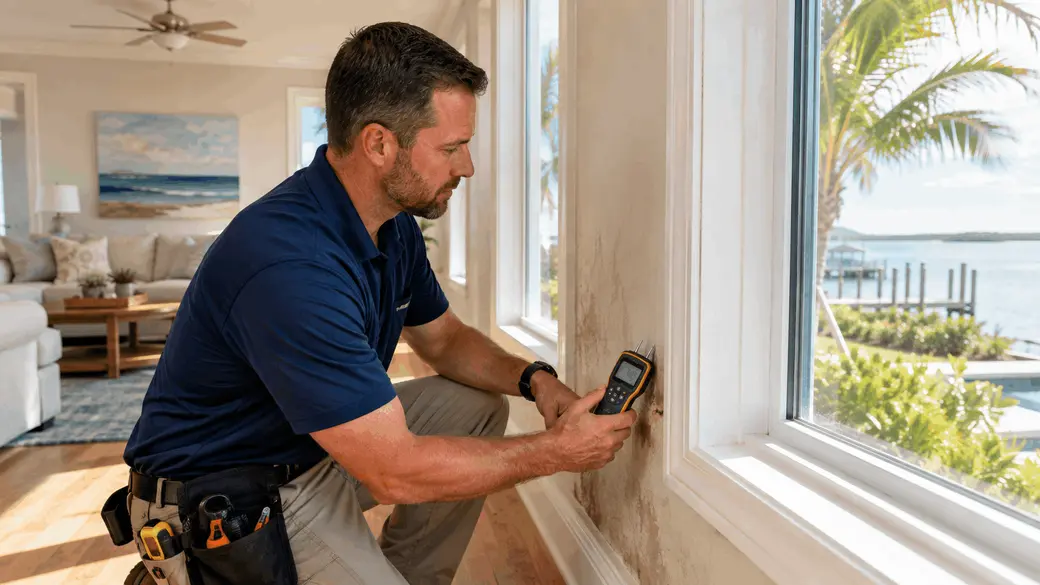
The EPA specifically advises consumers hiring a home or building inspector to investigate a water or mold problem to make sure the professional has experience identifying and locating mold and moisture problems. Specialized tools such as moisture meters can sometimes help identify areas requiring closer evaluation.
A home inspection still has practical limitations. Inspectors generally cannot see through every wall, floor, ceiling, cabinet, or finished surface. Access may also be restricted by furniture, stored belongings, insulation, construction, or safety conditions. Buyers should understand the scope and limitations of the inspection they order.
Is Mold Sampling Always Necessary?
No. This is one of the most important distinctions for home buyers to understand. The EPA states that mold sampling is generally unnecessary when visible mold growth is present. The Florida Department of Health provides similar guidance and does not recommend routine mold sampling merely to determine whether a mold problem exists or which type of mold is present.
One reason is that mold spores naturally exist in indoor and outdoor environments. More importantly, there are no EPA or other federal regulatory limits establishing an acceptable airborne concentration of mold spores for a home. A laboratory result therefore should not be interpreted as a simple regulatory pass-or-fail score.
Sampling can still have legitimate uses in certain circumstances. The EPA notes that surface sampling may sometimes help evaluate whether an area has been adequately cleaned or remediated, and professional sampling can be part of a properly designed investigation. When sampling is warranted, it should be performed and interpreted by professionals with appropriate experience.
What About Hidden Mold?
Hidden mold is one reason a buyer may choose additional evaluation even when there is little visible growth. Moisture can reach areas that are not readily visible during a normal walkthrough.
Potential locations can include:
- Behind drywall or wall coverings
- Under flooring
- Behind baseboards
- Inside sink and vanity cabinets
- Around plumbing penetrations
- Around windows and exterior doors
- Near HVAC air handlers and condensate systems
- Inside attics or other areas affected by roof leakage
- Behind materials affected by previous flooding or water intrusion
The EPA advises that hidden mold investigations can require caution because disturbing contaminated materials may release spores. Buyers who have a credible reason to suspect concealed growth should consider an experienced professional rather than opening walls or disturbing materials themselves.
Why Does Florida's Climate Make Moisture Due Diligence Important?
Florida homes operate in a warm, humid environment where air conditioning, ventilation, drainage, roof performance, plumbing, windows, doors, and exterior waterproofing all contribute to moisture management. Tropical weather and heavy rainfall can add another layer of exposure.
The Florida Department of Health emphasizes keeping homes dry and controlling indoor humidity. Its current guidance recommends keeping indoor relative humidity below 60 percent and checking areas such as air-conditioning equipment, drain pans, drain lines, and locations with signs of condensation or water damage.
For a buyer, this does not mean every Florida house has a mold problem. It means water-management systems deserve attention during inspection, particularly when a property has a history of roof damage, plumbing leaks, storm exposure, prolonged vacancy, HVAC problems, or previous water intrusion.
Should You Be More Careful With a Home That Has Flooded?
A known flood or significant water-intrusion history deserves additional attention because water can affect drywall, insulation, cabinets, flooring, electrical components, HVAC equipment, framing, and other building materials. The important questions are how far the water reached, how long materials remained wet, what was removed, how the structure was dried, and what repairs were completed afterward.
The EPA advises drying water-damaged areas and materials promptly, generally within 24 to 48 hours, to reduce the potential for mold growth. When evaluating a previously flooded home, buyers should not rely solely on new paint or flooring as evidence that the underlying structure was properly dried and repaired.
Ask for available remediation invoices, contractor records, permits, insurance-related documentation, photographs, warranties, and other information that may help establish what happened and how the property was restored. A qualified home inspector, mold assessor, contractor, engineer, electrician, HVAC professional, or other specialist may be appropriate depending on the history and observed conditions.
Who Can Perform a Mold Assessment in Florida?
Florida regulates mold assessment and remediation under Chapter 468 of the Florida Statutes. Florida law defines mold assessment as a process involving physical sampling and detailed evaluation of building-history and inspection information to develop an initial hypothesis about the origin, identity, location, and extent of mold growth greater than 10 square feet.
Florida also separately defines mold remediation involving mold-contaminated matter greater than 10 square feet. Buyers should confirm that professionals performing work subject to Florida licensing requirements hold the appropriate current license and should ask about training, experience, scope of work, sampling methodology when applicable, and reporting procedures.
The EPA itself does not certify mold inspectors or remediation firms. Florida's state licensing requirements therefore matter when evaluating professionals for work within the scope of Florida law.
Should the Same Company Inspect and Remediate the Mold?
Buyers should understand the distinction between assessment and remediation before hiring professionals. Assessment is intended to investigate the problem and its extent. Remediation is the work performed to remove or treat mold-contaminated materials and address the remediation scope.
Florida law contains requirements and restrictions governing mold assessors and mold remediators, including provisions addressing professional independence and conflicts. Because the applicability of those requirements depends on the work and circumstances, buyers should verify licensing and compliance directly rather than assuming any inspection-remediation arrangement is appropriate.
What Should You Ask a Mold Professional?
A useful mold evaluation should help the buyer understand the property, not simply produce laboratory numbers. Before hiring someone, ask what the inspection will include and what questions the final report is designed to answer.
- Are you appropriately licensed for the work you will perform in Florida?
- Will you investigate potential moisture sources?
- Will you inspect areas associated with previous leaks or water damage?
- Will moisture measurements be taken where appropriate?
- Do you recommend sampling, and if so, what question will it answer?
- How will any laboratory results be interpreted?
- Will the report identify suspected moisture sources and affected areas?
- Are any areas inaccessible or outside the scope of the assessment?
- Will additional destructive investigation require seller authorization?
- What additional specialists, if any, should evaluate the underlying defect?
Sampling should have a purpose. If a professional recommends air or surface samples, ask how the results will affect the investigation or remediation plan rather than assuming more samples automatically produce a better inspection.
What If the Mold Inspection Finds a Problem?
A mold finding should lead to more specific questions rather than an immediate assumption about whether to buy the house. First determine what caused the moisture and whether that source remains active. Then evaluate the extent of affected materials and the work required to correct both the moisture source and resulting damage.
Depending on the findings, buyers may need information about:
- The source of moisture
- Whether the source is still active
- The estimated extent of affected materials
- The proposed remediation scope
- Repairs needed after remediation
- Roof, plumbing, HVAC, drainage, window, or exterior repairs
- Permits that may be required
- Estimated remediation and reconstruction costs
- Documentation showing completion of prior work
- Whether post-remediation verification is appropriate
Inspection findings should be evaluated with the appropriate licensed inspector, mold professional, contractor, engineer, roofer, plumber, HVAC contractor, or other qualified professional before the buyer makes a decision. Questions involving contractual inspection rights, repair obligations, credits, cancellation rights, disclosures, or other legal issues should be reviewed with a qualified Florida real estate attorney when legal guidance is needed.
Should You Let the Seller Fix a Mold Problem?
That is a transaction-specific decision rather than a universal rule. The appropriate approach depends on the purchase contract, the nature and extent of the problem, the buyer's preferences, timing, professional recommendations, and what the parties agree to do.
If remediation or repairs are performed before closing, buyers may want documentation describing the work, invoices from qualified professionals, permits when required, and appropriate follow-up evaluation. The underlying water source should also be corrected. Removing visible mold without addressing a leaking roof, pipe, window, HVAC system, or other moisture source does not solve the underlying condition.
Can Mold or Water Damage Affect Homeowners Insurance?
Past water losses, roof condition, plumbing history, existing damage, remediation, and other property characteristics can be relevant when a buyer seeks homeowners insurance. Coverage for mold and water-related losses also depends on the policy, cause of loss, exclusions, limits, endorsements, and other terms.
Buyers should not assume that future mold remediation will be covered by insurance simply because they have a homeowners policy. Insurance availability, coverage, premiums, deductibles, exclusions, and mold-related limitations can vary substantially by property and insurer. Obtain property-specific quotes and review coverage with a qualified insurance professional before making a purchasing decision.
What About Health Concerns Related to Mold?
The Florida Department of Health explains that indoor mold exposure can be associated with allergic and irritant effects, and mold can trigger asthma attacks in people with asthma. Individual responses vary, and certain people may be more sensitive than others.
A real estate professional, home inspector, mold assessor, or remediation contractor should not diagnose whether a property caused or will cause a particular medical condition. Buyers with personal health concerns, allergies, asthma, immune-system concerns, or questions about potential exposure should discuss those issues with an appropriate qualified medical professional.
Can You Tell Whether Mold Is Dangerous by Its Color?
Color alone is not a reliable way for a home buyer to determine the significance of mold growth. Mold can appear in many colors, and terms such as "black mold" are often used in ways that oversimplify the issue.
The Florida Department of Health advises that indoor mold growth should be addressed regardless of the particular type. From a property perspective, buyers should focus on the presence and extent of growth, moisture source, damaged materials, remediation requirements, and repairs rather than attempting to judge a condition by color.
What Should You Review Before Buying a Home With a History of Mold or Water Damage?
A previous mold problem does not automatically mean a house should be rejected. What matters is understanding what happened, whether the source was corrected, what work was performed, and what the property looks like today.
Depending on the history and property, buyers may want to review:
- Seller disclosures and available property history
- General home inspection findings
- Mold assessment or remediation reports
- Moisture readings and investigation findings
- Roof, plumbing, HVAC, window, or drainage repairs
- Remediation and reconstruction invoices
- Permits for work requiring them
- Available warranties
- Evidence of post-remediation evaluation when performed
- Current homeowners insurance options
Documentation can help a buyer understand the history, but it does not replace a current inspection. Conditions can change after previous repairs, and the present condition of the home should be evaluated during the buyer's own due diligence.
Frequently Asked Questions About Mold Inspections for Home Buyers
Is a mold inspection normally included with a home inspection?
Not necessarily. A general home inspector may identify visible mold-like growth, water damage, or moisture concerns, but specialized mold assessment or sampling may be a separate service. Ask what the inspection includes before hiring the inspector.
Can a mold test tell me whether a house is safe?
There is no EPA federal standard establishing a safe or unsafe airborne mold-spore concentration for homes. Sampling results require professional interpretation and should be considered with visible conditions, moisture sources, building history, and the scope of the investigation.
What if I smell mold but cannot see it?
A persistent musty or earthy odor can justify further investigation for moisture and concealed growth. The Florida Department of Health specifically recommends searching areas where mold odors are present. An experienced professional may be appropriate when the suspected area is concealed.
Should I order a mold inspection after a roof leak?
It can be reasonable to investigate further when a roof leak was significant, prolonged, recent, poorly documented, or associated with staining, odors, elevated moisture, or damaged materials. The appropriate scope depends on what the general inspection and property history reveal.
Is buying a house with previous mold remediation automatically a bad idea?
No. A buyer should investigate why the mold occurred, whether the moisture source was corrected, how remediation and repairs were performed, and whether current inspection findings raise additional concerns. Professional documentation can help provide context.
Who should I call if my home inspection identifies suspected mold?
Ask the inspector to explain the observed condition and whether specialized evaluation is recommended. If a Florida mold assessment is appropriate, verify that the professional has the qualifications and any license required for the work. The underlying source may also require a roofer, plumber, HVAC contractor, engineer, or another qualified specialist.
So, Should You Get a Mold Inspection Before Buying a House?
A separate mold assessment is not automatically necessary for every home purchase. It becomes more compelling when the property gives you a reason to investigate, such as visible growth, musty odors, water staining, elevated moisture, previous flooding, roof or plumbing leaks, HVAC moisture problems, or concerns identified during the general home inspection.
The most useful question is not simply whether mold spores can be detected. Mold spores are naturally present in the environment, and there is no federal pass-or-fail airborne mold standard for homes. A buyer's due diligence should focus on whether unwanted indoor mold growth is present, what moisture caused it, how extensive the problem may be, what needs to be repaired, and what qualified professionals recommend before the buyer makes a decision.
Buy a Florida Home With Hunt Brothers Realty
A thorough inspection period can help buyers understand a property before closing. Hunt Brothers Realty can help buyers navigate the real estate side of a Florida purchase, including property searches, transaction due diligence, inspection-related communication, and coordination with the appropriate professionals. To discuss your home search, contact Hunt Brothers Realty.
This article is provided for general informational and educational purposes and is not individualized medical, environmental, legal, insurance, inspection, engineering, construction, or other professional advice. Mold and moisture conditions vary by property, and health considerations vary by individual. Buyers should have property-specific conditions evaluated by appropriately qualified and, where required, licensed inspectors, mold professionals, contractors, engineers, insurance professionals, medical professionals, Florida real estate attorneys, or other specialists before making decisions that depend on those findings.
Sources
- U.S. Environmental Protection Agency, A Brief Guide to Mold, Moisture and Your Home
- U.S. Environmental Protection Agency, Mold Testing or Sampling
- U.S. Environmental Protection Agency, Who Can Test or Remediate a Home for Mold?
- Florida Department of Health, Mold Guidance
- Florida Department of Health, Indoor Air Quality Program
- Florida Legislature, Chapter 468, Mold-Related Services
Contact Hunt Brothers Realty
46 N. Washington Blvd, Ste 3
Sarasota, FL 34236
Phone: (941) 388-7017
Email: info@huntbrothersrealty.com
Website: HuntBrothersRealty.com
Categories
- All Blogs 2050
- Anna Maria Island 86
- Bird Key 4
- Bradenton 236
- Buying a Home 1111
- Casey Key 2
- Clearwater 11
- Condos & HOA Living 1029
- Ellenton 5
- Englewood 11
- First Time Homebuyers 1220
- Foreclosures 3
- Home Selling 3
- Homeownership 1243
- Lakewood Ranch 25
- Lido Key 28
- Longboat Key 80
- Luxury/Waterfront Properties 1184
- Market Updates & Trends 711
- Mortgages & Financing 42
- Move-Up Buyers 21
- Neighborhood Guides 825
- New Construction 34
- Palmetto 3
- Parrish 6
- Port Charlotte 10
- Punta Gorda 17
- Real Estate Investing 1101
- Relocation to Florida 1143
- Safety Harbor 2
- Sarasota 77
- Sarasota - Downtown 162
- Selling a Home 144
- Siesta Key 91
- St. Petersburg 8
- Tierra Verde 5
- Vacation & Second Homes 1293
- Venice 155
- Wellen Park 16
Recent Posts