What Is Earnest Money When Buying a House?
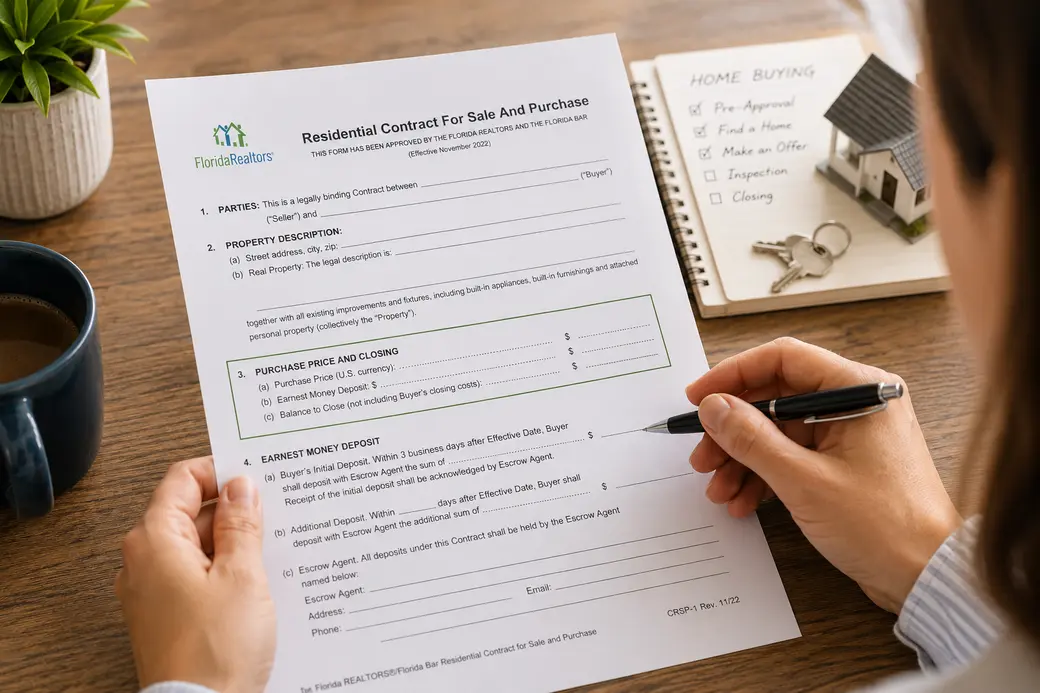
Earnest money is a deposit a home buyer makes in connection with a signed purchase agreement to demonstrate good faith in the transaction. The money is typically held in escrow rather than treated as an immediate payment to the seller. If the purchase closes, the deposit is generally credited toward amounts the buyer owes at closing, such as the down payment or closing costs. If the transaction does not close, who receives the earnest money depends on the purchase contract, applicable contingencies, deadlines, actions of the parties, and other circumstances. Florida buyers should understand those terms before submitting a deposit.
Quick Answers About Earnest Money When Buying a House
What Is Earnest Money?
The Consumer Financial Protection Bureau defines earnest money as a deposit a buyer pays to show good faith on a signed agreement to purchase a home. It is also commonly called a good faith deposit or escrow deposit.
Is Earnest Money the Same as a Down Payment?
No. Earnest money is a deposit associated with the purchase contract, while the down payment is the portion of the purchase price the buyer pays rather than finances. When a transaction closes, the earnest money is generally credited toward the buyer's required funds at closing rather than becoming an additional charge.
How Much Earnest Money Do I Need in Florida?
There is no single earnest money amount that applies to every Florida home purchase. The amount is part of the transaction terms and may be influenced by the property, price, market conditions, negotiating strategy, and other terms of the offer. Buyers should discuss the specific transaction with their real estate professional rather than relying on a universal percentage.
Where Does Earnest Money Go?
The purchase contract identifies who will hold the deposit. Depending on the transaction, an escrow agent may be a real estate broker, title company, attorney, or another party identified in the agreement. Buyers should verify the escrow agent and payment instructions before transferring funds.
Do I Get My Earnest Money Back if I Cancel?
Possibly, but a refund is not automatic simply because a buyer decides not to proceed. Whether the buyer is entitled to the deposit depends on the contract, the reason for termination, applicable contingencies, required notices, deadlines, and other facts. Buyers should obtain legal advice when there is uncertainty about cancellation rights or entitlement to escrowed funds.
What Happens to Earnest Money at Closing?
The earnest money is generally credited as part of the buyer's funds in the transaction. The Consumer Financial Protection Bureau explains that the amount a buyer brings to closing accounts for deposits already made, along with the down payment and applicable closing costs.
Can I Lose My Earnest Money?
Potentially. The CFPB notes that earnest money may be forfeited if a buyer does not perform in good faith, but the actual outcome in a specific transaction depends on the contract and circumstances. Buyers should not assume they can walk away from a signed contract and automatically receive their deposit back.
How Earnest Money Works in a Home Purchase
Earnest money becomes relevant during the offer and contract stage of buying a home. A buyer and seller negotiate not only the purchase price, but also a collection of other terms that can include the deposit amount, deposit deadline, inspection provisions, financing terms, closing date, and other conditions.
Once the parties have a signed agreement, the buyer is responsible for following the deposit requirements contained in that contract. Depending on the agreement, there may be an initial deposit, an additional deposit later in the transaction, or another negotiated structure.
The exact amount and timing matter. Buyers should not assume that practices from another transaction, another state, or even another Florida purchase apply to their current contract.
Is Earnest Money Required in Florida?
Earnest money is common in Florida real estate transactions, but it should not be confused with a legal requirement that must exist for every purchase contract.
Florida Realtors explains that an earnest money deposit is not required by Florida law simply to make a real estate purchase contract binding. A deposit can nevertheless be an important negotiated term of the transaction and evidence of the buyer's commitment to the purchase.
Once a buyer agrees in a signed contract to make a deposit, however, the buyer should take that contractual obligation and its deadline seriously.
How Much Earnest Money Should a Buyer Offer?
Buyers often search for a standard earnest money percentage, but there is no amount that is automatically appropriate for every transaction.
The deposit can be part of the overall negotiating strategy. Factors a buyer may discuss with a licensed real estate professional include:
- The purchase price
- Current market conditions
- Whether there are competing offers
- The seller's requested terms
- The buyer's available cash
- The timing of the deposit
- Other terms and contingencies in the offer
- The buyer's comfort with the financial amount at risk under the contract
A larger deposit may communicate financial commitment, but buyers should understand the contract provisions governing that money before increasing the amount simply to make an offer look stronger.
Where Is Earnest Money Held?
Earnest money is commonly held in escrow while the transaction moves toward closing. The contract should identify the escrow agent and provide the applicable deposit terms.
When a Florida real estate broker is entrusted with escrow funds, state law and administrative rules govern how those funds must be handled. Florida Realtors' overview of Florida escrow laws and rules explains the requirements that apply when brokers receive and maintain escrow deposits.
Florida law also addresses a broker's handling of money entrusted to the broker. Florida Statute 475.25 includes requirements involving escrowed funds and broker responsibilities.
Earnest Money vs. Down Payment: What Is the Difference?
Earnest money and a down payment are related to the money a buyer contributes to a purchase, but they serve different purposes.
| Item | Earnest Money | Down Payment |
|---|---|---|
| Purpose | Deposit connected with the purchase agreement | Buyer-funded portion of the purchase price |
| Timing | Paid according to the contract's deposit deadline | Generally accounted for as part of the funds needed for closing |
| Where It Goes Initially | Typically held by the designated escrow agent | Handled through the closing process |
| At Closing | Generally credited toward the buyer's transaction funds | Applied toward the purchase price |
For mortgage transactions, federal disclosure rules recognize a purchase deposit, often referred to as an earnest money deposit, as money paid to the seller or held in trust or escrow under the purchase agreement. Buyers should also confirm with their lender how documented deposit funds will be reflected in their specific loan and closing calculations.
What Happens to Earnest Money When the Home Closes?
If the transaction proceeds to closing, the earnest money does not normally disappear or become an extra fee. It is accounted for in the settlement of the transaction.
The CFPB explains that the total amount a buyer needs at closing takes into account the down payment and deposits the buyer has already made, together with applicable closing costs and other transaction amounts.
For example, if a buyer has already deposited earnest money into escrow, that deposit is accounted for when calculating the remaining funds required from the buyer at closing. The exact accounting appears in the transaction's closing documents.
When Can a Buyer Get Earnest Money Back?
This is one of the most important questions buyers ask, and it is also one of the questions where general internet advice can be misleading.
There is no universal rule that says a buyer always gets the deposit back whenever a transaction does not close. The answer depends heavily on the actual purchase contract.
Depending on the agreement, potential issues can involve:
- Inspection provisions
- Financing provisions
- Appraisal-related terms
- Title matters
- Association or condominium review rights when applicable
- Property-specific statutory cancellation rights when applicable
- Deadlines for notices or other required actions
- Default provisions
The Consumer Financial Protection Bureau encourages buyers to understand contingencies involving matters such as financing and inspections. However, the existence and effect of any contingency in a particular Florida transaction depends on the signed contract.
Questions about whether a buyer has a legal right to cancel, whether a deadline was satisfied, or which party is legally entitled to a deposit should be reviewed with a qualified Florida real estate attorney when appropriate.
Can You Lose Your Earnest Money?
Yes, earnest money can potentially be at risk. The CFPB notes that earnest money may be forfeited when a buyer does not perform in good faith.
In an actual Florida transaction, however, the consequences of a buyer's failure to perform are determined by the contract, applicable law, and specific facts. Buyers should therefore avoid broad assumptions about what constitutes a default or what happens to the deposit after one.
If a dispute develops, the escrow holder generally cannot simply decide the underlying legal rights of the parties based on informal instructions. Florida has procedures governing escrow disputes, and the proper process can depend on who is holding the funds and the circumstances.
What Happens if the Buyer and Seller Disagree About the Deposit?
An earnest money dispute can arise when a transaction does not close and both parties believe they are entitled to the escrowed funds.
Florida escrow rules include procedures for brokers handling conflicting demands or uncertainty about entitlement to escrowed property. Different procedures may apply when an attorney, title company, or another party holds the deposit.
A buyer or seller involved in an actual escrow dispute should obtain advice from a qualified Florida real estate attorney about contractual rights, potential remedies, and the appropriate next steps.
Do Not Miss the Earnest Money Deadline
One of the simplest practical lessons for buyers is to identify the deposit deadline as soon as the contract becomes effective.
Your contract should specify the amount, timing, and designated escrow agent. Do not rely solely on memory or assume that "a few days" means the same thing in every agreement.
A licensed real estate professional can help a buyer track transaction milestones within the scope of brokerage services. Questions about how a contractual deadline is legally calculated, the consequences of missing it, or rights after a missed deadline should be directed to a qualified Florida real estate attorney.
Protect Yourself From Wire Fraud When Sending Earnest Money
Real estate transactions can involve significant transfers of money, making payment security important. Buyers should be cautious about wiring instructions received by email, particularly if instructions unexpectedly change.
Before sending an earnest money deposit, verify the recipient, account details, acceptable payment method, and transfer instructions using trusted contact information obtained independently. If an email suddenly provides different wiring instructions, do not assume the change is legitimate simply because the message appears to come from someone involved in the transaction.
Earnest Money Checklist for Florida Home Buyers
| Question | Why It Matters |
|---|---|
| How much is the deposit? | The amount is a negotiated part of the transaction |
| When is it due? | The contract establishes deposit deadlines |
| Who holds the money? | The contract identifies the escrow agent |
| How should it be delivered? | Payment procedures should be verified before funds are sent |
| Are additional deposits required? | Some agreements can provide for more than one deposit |
| What contingencies apply? | Contract provisions can affect cancellation rights and the deposit |
| What are the important deadlines? | Missing a contractual deadline can have significant consequences |
| What happens if the transaction does not close? | The answer depends on the contract and circumstances |
Common Earnest Money Mistakes Buyers Should Avoid
Earnest money itself is not especially complicated, but the contract governing it can be. Buyers can reduce avoidable confusion by watching for several common mistakes:
- Assuming there is a standard Florida deposit amount
- Confusing earnest money with the down payment
- Missing the contractual deposit deadline
- Sending money without independently verifying payment instructions
- Assuming the deposit is automatically refundable
- Ignoring inspection, financing, or other contractual deadlines
- Assuming an escrow agent can release disputed funds immediately
- Relying on general online information to interpret specific contract rights
The Bottom Line on Earnest Money
Earnest money is best understood as a good faith deposit connected to a home purchase agreement. It is typically held in escrow while the transaction proceeds and, if the sale closes, is generally credited toward the buyer's transaction funds.
The more important issue for a buyer is understanding the contract surrounding that deposit. How much must be paid, when it is due, who holds it, when it may be returned, and what happens after a default or dispute are not questions buyers should answer from general rules of thumb.
Before signing an offer, make sure you understand the financial commitment you are making and the transaction deadlines that accompany it.
Buying a Home on Florida's Gulf Coast?
Hunt Brothers Realty helps buyers navigate home purchases throughout Sarasota and Florida's Gulf Coast, from preparing an offer through inspections, financing milestones, due diligence, and closing.
Buyers can explore Gulf Coast communities with Hunt Brothers Realty or review Hunt Brothers Realty's buyer's guide to waterfront homes on Florida's Gulf Coast when researching a move to the area.
Informational notice: This article is provided for general informational and educational purposes only and is not individualized legal, financial, lending, title, tax, or other professional advice. Earnest money obligations, cancellation rights, contingencies, defaults, escrow procedures, and entitlement to deposited funds depend on the specific purchase contract, applicable law, and circumstances of the transaction. A licensed real estate professional can assist with the real estate transaction within the scope of brokerage services. Buyers with questions about contractual rights, legal obligations, disputes, or entitlement to escrowed funds should consult a qualified Florida real estate attorney. Financing questions should be reviewed with the buyer's mortgage lender or other qualified loan professional.
Sources
- Consumer Financial Protection Bureau, Mortgage Key Terms
- Consumer Financial Protection Bureau, Find the Right Home
- Consumer Financial Protection Bureau, Mortgage Closing Process
- Consumer Financial Protection Bureau, Regulation Z Section 1026.37
- Florida Realtors, Does Deposit Acceptance Turn an Offer Into a Contract?
- Florida Realtors, Florida Escrow Laws and Rules
- Florida Realtors, Consumer Guide to Escrow and Earnest Money
- Florida Statute 475.25, Real Estate Broker Escrow Requirements
- Hunt Brothers Realty, Explore Gulf Coast Communities
- Hunt Brothers Realty, A Buyer's Guide to Waterfront Homes on Florida's Gulf Coast
Contact Hunt Brothers Realty
46 N. Washington Blvd, Ste 3, Sarasota, FL 34236
Phone: (941) 388-7017
Email: info@huntbrothersrealty.com
Website: HuntBrothersRealty.com
Categories
- All Blogs 2030
- Anna Maria Island 84
- Bird Key 4
- Bradenton 236
- Buying a Home 1092
- Casey Key 2
- Clearwater 10
- Condos & HOA Living 1009
- Ellenton 5
- Englewood 9
- First Time Homebuyers 1200
- Foreclosures 3
- Home Selling 3
- Homeownership 1223
- Lakewood Ranch 24
- Lido Key 28
- Longboat Key 79
- Luxury/Waterfront Properties 1164
- Market Updates & Trends 691
- Mortgages & Financing 42
- Move-Up Buyers 21
- Neighborhood Guides 807
- New Construction 33
- Palmetto 3
- Parrish 6
- Port Charlotte 10
- Punta Gorda 17
- Real Estate Investing 1081
- Relocation to Florida 1123
- Safety Harbor 2
- Sarasota 76
- Sarasota - Downtown 160
- Selling a Home 144
- Siesta Key 90
- St. Petersburg 7
- Tierra Verde 5
- Vacation & Second Homes 1273
- Venice 142
- Wellen Park 13
Recent Posts