What Is a Property Survey and Do I Need One?
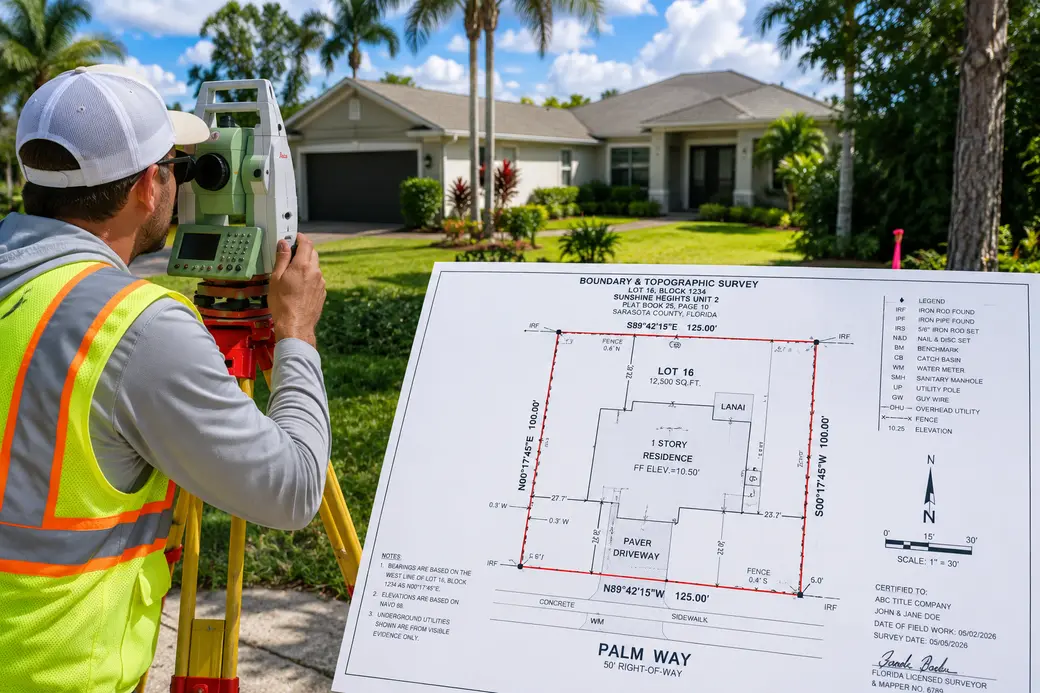
A property survey is a professional measurement and drawing of real estate that can show the property's boundaries, improvements, and other physical features relevant to ownership. For Florida home buyers, a survey can help identify issues such as a fence crossing a boundary, an improvement near a property line, or an easement affecting part of the lot. A survey is not automatically required in every purchase, but it can provide information that a listing, aerial map, appraisal, or home inspection does not. Whether you should obtain one depends on the property, contract, financing, title requirements, and advice of the professionals involved in your transaction.
Quick Answers About Property Surveys in Florida
What Is a Property Survey?
A property survey is prepared by a qualified professional surveyor to document physical facts about real property. Depending on the type and scope of the survey, it can identify property boundaries, improvements, easements, encroachments, and other features relevant to the parcel.
Do Florida Home Buyers Have to Get a Survey?
Not every Florida purchase has the same survey requirement. The applicable contract, lender, title insurer, property characteristics, and other circumstances can affect whether a survey is required or recommended. Buyers should confirm the requirements for their transaction with their lender, closing or title professional, and other appropriate professionals.
What Can a Survey Reveal?
A survey can show where the parcel boundaries are in relation to the home and other improvements. Depending on the survey, it may also identify features such as fences, driveways, pools, accessory structures, easements, and apparent encroachments that deserve additional review.
Is a Property Survey the Same as a Home Inspection?
No. A home inspection generally evaluates the physical condition of the home and its systems, while a survey addresses the land, boundaries, location of improvements, and related matters within its scope. One does not replace the other.
Is a Survey the Same as an Appraisal?
No. An appraisal develops an opinion of property value for its intended purpose, while a property survey measures and documents physical facts about the real estate. A favorable appraisal does not establish where your legal property boundaries are.
Can I Rely on the County Property Map Instead?
A property appraiser or online GIS map can be useful for general research, but it should not be treated as a substitute for a professional boundary survey. Florida law specifically distinguishes property-appraisal mapping from professional surveying activities.
Who Should Perform a Property Survey in Florida?
Professional surveying and mapping is regulated in Florida. Buyers should use an appropriately licensed or registered Florida professional surveyor and mapper for work requiring professional surveying services and confirm that the survey ordered is appropriate for the transaction.
What Does a Property Survey Actually Do?
At its most basic level, a survey helps answer an important homeownership question: where is the property, physically and legally, in relation to the land and improvements around it?
Florida's statutory definition of surveying and mapping includes determining and displaying facts involving the size, shape, topography, location, relation, and orientation of improved or unimproved real property. The professional practice also encompasses property boundaries, subdivisions, existing improvements, proposed improvements, legal descriptions, and other surveying work.
For a typical residential buyer, the finished survey is usually a drawing that allows the buyer and appropriate professionals to understand how the home and other improvements relate to the parcel being purchased.
What Might Be Shown on a Residential Property Survey?
The exact contents depend on the type of survey, property, records reviewed, fieldwork, and scope requested. A residential boundary survey may address items such as:
- Property boundary lines
- Lot dimensions
- The location of the house relative to the boundaries
- Garages and other structures within the survey's scope
- Pools and certain related improvements
- Fences and walls
- Driveways and walkways
- Recorded easements when applicable to the survey
- Apparent encroachments
- Boundary monuments or markers located or set as part of the work
- Other physical features relevant to the particular survey
A buyer should not assume every item above will appear on every survey. The surveyor or closing professional can explain what type of survey is being ordered and what information its scope is intended to provide.
Why Property Boundaries Matter More Than They May Seem
A buyer may tour a property and assume that the fence, landscaping, driveway, or seawall marks the legal edge of the lot. That assumption may be wrong.
Physical occupation and legal boundaries are different concepts. A fence may have been installed inside a property line. A driveway could extend across an area affected by an easement. A neighboring improvement could appear to cross a boundary. A shed, pool enclosure, wall, or other improvement may also sit closer to a property line than a buyer expected.
A survey can identify physical conditions for further evaluation, but the survey itself does not necessarily resolve the legal consequences of what it shows. Questions about ownership rights, easements, encroachments, title, boundary disputes, or contractual remedies should be reviewed with the closing or title professional and, when appropriate, a qualified Florida real estate attorney.
What Is an Encroachment?
An encroachment generally involves an improvement or physical feature extending across or into an area where a boundary or property right may create an issue. A survey may reveal an apparent condition that was not obvious during a showing.
For example, a survey might show that a fence does not follow the property boundary, part of a driveway appears to cross a boundary, or another improvement is positioned differently from what the buyer assumed.
That does not automatically tell the buyer what legal rights the parties have or what should happen next. The survey establishes or displays surveying information. The legal significance of a particular condition should be evaluated by the appropriate title and legal professionals.
What Is an Easement?
An easement generally involves a right to use or access some portion of property for a particular purpose. Residential properties can be affected by utility, drainage, access, conservation, and other types of easements.
This can become particularly important when a buyer plans future improvements. A large side yard may look like an obvious location for a pool, addition, detached garage, fence, or other project, but an easement, setback, association restriction, or permitting requirement may affect what can actually be constructed there.
A survey is one part of that research, not a guarantee that a proposed improvement is permissible. Before relying on the feasibility of future construction, buyers should verify the specific project with the appropriate surveyor, association, contractor, engineer or architect when applicable, and local permitting or zoning authority.
Do You Need a Survey to Buy a House in Florida?
There is no useful one-word answer for every Florida transaction. Whether a survey is required can depend on the purchase contract, lender, title insurer, closing requirements, and the property itself.
The current Florida Realtors/Florida Bar "AS IS" Residential Contract for Sale and Purchase, for example, provides that a buyer may, at the buyer's expense, have the real property surveyed and certified by a registered Florida surveyor at least five days before closing. It also addresses furnishing an existing seller survey when one covers the property.
Your actual rights, obligations, deadlines, and remedies depend on the contract used in your transaction and the specific circumstances. Contract questions should be directed to a qualified Florida real estate attorney or other appropriate legal professional.
Why Might a Buyer Want a Survey Even When It Is Optional?
The practical reason is simple: you are buying the land as well as the house.
A survey can give buyers information that may not be apparent from photographs, a listing, a walkthrough, or an online parcel map. That can be especially useful when:
- The property has fences or walls near apparent boundaries
- The driveway is close to a neighboring parcel
- There is a pool, detached structure, or other significant improvement
- The buyer wants to make future additions or improvements
- The parcel has an unusual shape
- Waterfront boundaries or improvements are important to the purchase
- Recorded easements affect the property
- The buyer has questions about where the property actually ends
- The lender or title insurer requests survey information
These are reasons to investigate, not a determination that every buyer must order a new survey. A licensed surveyor, lender, closing professional, title insurer, and attorney can help determine what is appropriate for the specific transaction.
How Does a Survey Relate to Title Insurance?
Surveys and title insurance address different issues, but they can interact during a real estate closing.
A title search examines records affecting ownership and title. A survey examines physical and boundary-related facts about the property. Some matters affecting a parcel may be visible through accurate surveying even when they are not apparent simply from reviewing the public record.
Title policies can contain what are commonly called survey exceptions. Title-industry standards explain that such exceptions may exclude matters such as encroachments, overlaps, boundary disputes, or other conditions that an accurate current survey would disclose.
Title coverage is policy-specific. Buyers should have their title commitment, survey requirements, exceptions, endorsements, and final policy explained by the title insurer, closing professional, or qualified Florida real estate attorney rather than assuming that ordering a survey automatically creates or removes particular insurance coverage.
Is an Old Survey Good Enough?
Sometimes an existing survey can be useful, but its age alone does not answer whether it is acceptable for a new transaction.
The property may have changed since the earlier survey was prepared. A pool, fence, addition, driveway, shed, seawall improvement, or other feature may have been installed or altered. Documents affecting the property may also have changed.
Whether an existing survey can be relied upon, recertified, updated, or accepted for a particular closing is a transaction-specific question. The surveyor, lender, title insurer, and closing professional should determine what they require rather than a buyer assuming an old copy is sufficient.
A Survey Is Not the Same as an Elevation Certificate
This distinction is particularly important on Florida's Gulf Coast. A boundary survey and an elevation certificate serve different purposes.
A boundary survey is focused on property location, boundaries, and related physical features within its scope. An elevation certificate documents elevation information used in connection with floodplain management and potentially flood-insurance matters. Florida law separately addresses requirements involving surveyors and elevation certificates.
Buyers should not assume that receiving one means they have the other. Flood zones, elevation data, insurance requirements, and premiums should be evaluated with the appropriate surveyor, floodplain authority, lender, and qualified insurance professional for the specific property.
Why Surveys Can Be Especially Important for Gulf Coast Waterfront Property
Waterfront real estate can add another layer of questions because buyers may be evaluating seawalls, docks, lifts, canals, shoreline conditions, access, easements, and other improvements in addition to the house itself.
Hunt Brothers Realty's buyer's guide to waterfront homes on Florida's Gulf Coast explains why waterfront due diligence should go beyond the view. Buyers may need to investigate the physical condition and permitting of waterfront improvements, water depth and boating access, insurance, flood exposure, and property-specific ownership considerations.
A survey can contribute important information, but it does not establish the structural condition of a seawall or dock, guarantee navigability, determine insurance coverage, or replace permitting research. Those matters should be evaluated by the appropriate surveyor, marine contractor, engineer, inspector, insurance professional, title professional, attorney, and government authority as applicable.
Can a Property Survey Tell Me Where I Can Build a Pool or Fence?
A survey can provide essential information for planning improvements, but it should not be treated as approval to build.
Whether a pool, fence, addition, garage, dock, or other improvement can be constructed may depend on zoning setbacks, easements, association restrictions, environmental requirements, building codes, utility locations, coastal regulations, permits, and other property-specific factors.
If the ability to build a particular improvement is important to a purchase, buyers should investigate feasibility before relying on it. The appropriate local permitting authority, association, licensed surveyor, contractor, engineer, architect, attorney, or other qualified professional can address the specific issue.
What a Property Survey Does Not Replace
A survey is an important due-diligence tool, but it has a specific professional purpose. Buyers should not treat it as a substitute for other evaluations.
| Document or Service | Primary Purpose |
|---|---|
| Property Survey | Documents boundaries, location, improvements, and other surveying information within its scope |
| Home Inspection | Evaluates physical condition and systems within the inspection's scope |
| Appraisal | Develops an opinion of value for its intended use |
| Title Search | Researches recorded ownership and matters affecting title |
| Elevation Certificate | Documents elevation information for floodplain and related purposes |
| Property Appraiser or GIS Map | Provides general property, appraisal, mapping, or public-record information, not a substitute for a professional boundary survey |
When Should a Buyer Order the Survey?
Timing matters because a survey is more useful when the buyer and appropriate professionals have enough time to review it before closing.
The Florida Realtors/Florida Bar "AS IS" contract contains specific survey language and timing, but other contracts may differ. Buyers should follow the deadlines and procedures in the agreement they actually signed.
Waiting until the last moment can leave less time to understand an unexpected condition. Buyers should coordinate early with their licensed real estate professional, lender, surveyor, closing agent, title professional, and attorney when applicable so that required work can be completed within the relevant contractual deadlines.
What If the Survey Finds a Problem?
First, understand exactly what the survey shows. A line or notation on a survey may have a technical meaning that is easy to misinterpret without professional explanation.
Depending on the finding, the buyer may need input from the surveyor, title company, closing professional, local government, association, contractor, engineer, or attorney. A possible encroachment, easement issue, boundary discrepancy, or title concern should not be diagnosed from an online search or treated as automatically minor or automatically fatal to the transaction.
Contract rights and remedies are especially important. If a survey reveals a condition that may affect the transaction, buyers should promptly obtain appropriate legal guidance because notice and closing deadlines can matter.
Property Survey Checklist for Florida Buyers
Before closing, buyers considering a survey can use these questions to organize the conversation with their transaction professionals:
- Does my contract address a survey and establish a deadline?
- Does the seller have an existing survey?
- Has the property changed since an earlier survey was completed?
- Does my lender require a particular survey or certification?
- What does the title insurer or closing agent require?
- Are there fences, walls, driveways, pools, docks, sheds, or other improvements near boundaries?
- Are easements shown that could affect how I intend to use the property?
- Do I plan to add a pool, fence, addition, dock, garage, or other improvement?
- Does anything on the survey appear inconsistent with what I observed at the property?
- Who should review any issue before I proceed to closing?
So, Do You Really Need a Property Survey?
A survey is not universally required for every Florida home purchase, but buyers should understand what they give up if they proceed without the information a current survey could provide.
For many buyers, the value of a survey is clarity. It helps document the physical relationship between the property being purchased, its boundaries, its improvements, and certain rights or conditions affecting the land. That information can be especially relevant for larger lots, unusual parcels, waterfront homes, properties with fences or accessory structures, and homes where future improvements are part of the buyer's plans.
The appropriate decision should be made for the specific transaction after considering the contract, lender requirements, title coverage, property characteristics, existing survey information, and guidance from qualified professionals.
Buying a Home on Florida's Gulf Coast?
A property survey is one piece of a larger due-diligence process. Buyers may also need to consider inspections, title, insurance, financing, flood information, association documents, permits, property condition, and the characteristics of the specific neighborhood or waterfront setting.
Hunt Brothers Realty helps buyers navigate the real estate side of purchasing homes and condominiums throughout Sarasota and Florida's Gulf Coast. Buyers can also explore Gulf Coast communities, review what different budgets can buy in Sarasota, or learn more about the additional due diligence involved in buying a waterfront home on Florida's Gulf Coast.
Informational notice: This article is provided for general informational and educational purposes only and is not legal, surveying, title, lending, insurance, engineering, construction, tax, or other professional advice. Survey requirements and the legal significance of boundaries, easements, encroachments, title exceptions, and other conditions depend on the individual property and transaction. Buyers should verify survey requirements and findings with an appropriately licensed Florida surveyor and mapper and consult the applicable lender, title or closing professional, local authority, association, insurance professional, Florida real estate attorney, or other qualified professional before making decisions that require individualized guidance.
Sources
- Florida Legislature, Florida Statutes Section 472.005, Surveying and Mapping Definitions
- Florida Legislature, Florida Statutes Section 472.027, Standards of Practice
- Florida Legislature, Florida Statutes Section 472.031, Surveying and Mapping Licensing Provisions
- Florida Realtors and The Florida Bar, "AS IS" Residential Contract for Sale and Purchase
- Fidelity National Title Group, Real Property Law and Title Standards, Survey Matters
- Hunt Brothers Realty, A Buyer's Guide to Waterfront Homes on Florida's Gulf Coast
- Hunt Brothers Realty, Explore Gulf Coast Communities
Contact Hunt Brothers Realty
46 N. Washington Blvd, Ste 3, Sarasota, FL 34236
Phone: (941) 388-7017
Email: info@huntbrothersrealty.com
Website: HuntBrothersRealty.com
Categories
- All Blogs 2030
- Anna Maria Island 84
- Bird Key 4
- Bradenton 236
- Buying a Home 1092
- Casey Key 2
- Clearwater 10
- Condos & HOA Living 1009
- Ellenton 5
- Englewood 9
- First Time Homebuyers 1200
- Foreclosures 3
- Home Selling 3
- Homeownership 1223
- Lakewood Ranch 24
- Lido Key 28
- Longboat Key 79
- Luxury/Waterfront Properties 1164
- Market Updates & Trends 691
- Mortgages & Financing 42
- Move-Up Buyers 21
- Neighborhood Guides 807
- New Construction 33
- Palmetto 3
- Parrish 6
- Port Charlotte 10
- Punta Gorda 17
- Real Estate Investing 1081
- Relocation to Florida 1123
- Safety Harbor 2
- Sarasota 76
- Sarasota - Downtown 160
- Selling a Home 144
- Siesta Key 90
- St. Petersburg 7
- Tierra Verde 5
- Vacation & Second Homes 1273
- Venice 142
- Wellen Park 13
Recent Posts