2026 Is Not 2008: Why This Housing Market Is Different
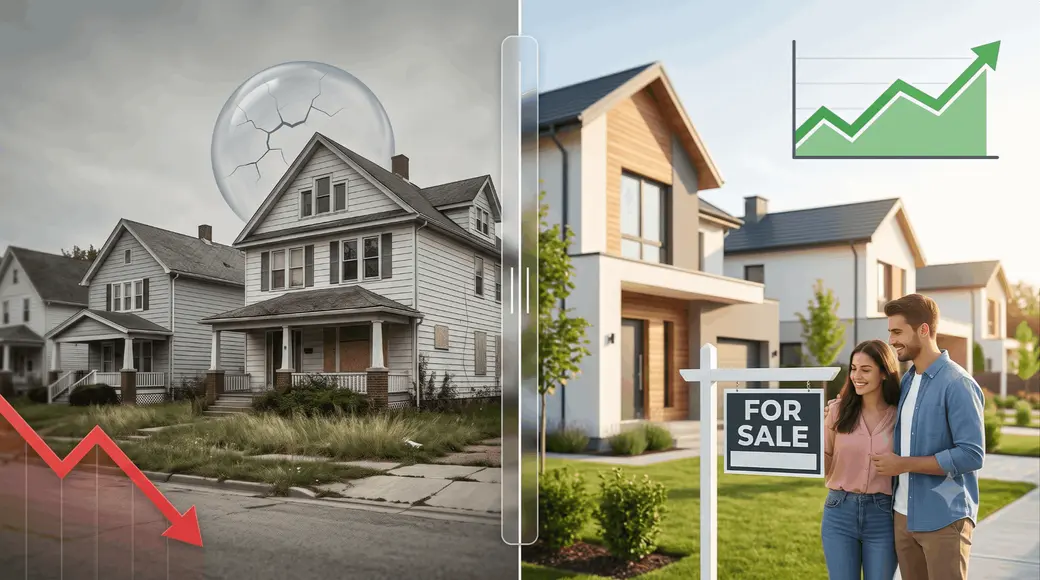
Higher mortgage rates. Price reductions. Homes taking longer to sell in some markets. More headlines about foreclosures.
For anyone who remembers the housing crash that surrounded the 2008 financial crisis, today's market can feel uncomfortably familiar.
But similar headlines do not necessarily mean similar underlying conditions.
The 2026 housing market has genuine challenges. Affordability remains difficult. Mortgage rates have reduced purchasing power. Some markets have experienced price adjustments. Foreclosure activity has risen from unusually low levels.
Yet the financial position of homeowners, quality of mortgage underwriting, amount of homeowner equity and scale of distressed inventory are fundamentally different from the conditions that preceded the last housing crash.
For buyers and sellers following the Sarasota and Florida Gulf Coast real estate market, understanding those differences is more useful than asking whether history is simply repeating itself.
Is the 2026 Housing Market Another 2008?
No. Current housing data does not show a repeat of the conditions that produced the 2008 housing and financial crisis.
That does not mean home prices cannot decline. It does not mean every homeowner is financially secure. And it certainly does not mean every Florida market will perform the same way.
What it means is that a slowing or correcting housing market is not automatically a housing crash.
To understand why, it helps to look beneath prices and examine the financial structure supporting today's homeowners.
What Made 2008 So Different?
The 2008 housing crisis was not simply a period when home prices went down.
The crisis developed after years of risky lending, rapid expansion of subprime mortgages, highly leveraged homeowners and mortgage products that could become much more expensive when interest rates reset.
When home values fell, millions of homeowners had little or no equity to protect them. Borrowers who could no longer afford their payments often could not simply sell the property and repay the mortgage.
Foreclosures and short sales then added additional inventory to an already weakening market. Falling prices created more negative equity, which contributed to further distress.
The result was not merely a normal real estate correction. Housing distress became deeply connected to instability throughout the financial system.
2026 vs. 2008: The Differences at a Glance
| Factor | 2008 Era | 2026 |
|---|---|---|
| Mortgage underwriting | Widespread risky and subprime lending | Generally stronger underwriting and borrower documentation |
| Homeowner equity | Negative equity became widespread | Homeowners collectively hold substantial equity |
| Mortgage structure | Payment-reset risk affected many vulnerable borrowers | Many owners hold long-term fixed mortgages at comparatively low rates |
| Foreclosures | Massive nationwide distress | Rising, but still far below housing-crisis levels |
| Inventory | Distressed properties contributed to excess supply | National inventory has recovered but remains below 2017–2019 norms |
| Main buyer challenge | Credit and financial-system crisis | Affordability, mortgage rates and property-specific ownership costs |
1. Today's Homeowners Have Considerably More Equity
Homeowner equity may be the most important difference between today's market and the housing crisis.
Federal Reserve data cited by Realtor.com placed total U.S. household real estate wealth at a record $48.7 trillion during the first quarter of 2026. After mortgage debt, homeowners held an estimated $34.9 trillion in equity.
That equity creates an important financial cushion.
Consider a homeowner who owes $300,000 on a property worth $500,000. A 10% decline in value would reduce the property to $450,000, but the owner would still have substantial equity.
That is very different from an owner who purchased with minimal equity and owes approximately as much as — or more than — the home is worth.
2. Mortgage Lending Is Different From the Pre-2008 Era
The mortgage itself matters just as much as the home's value.
In the years preceding the housing crash, subprime lending expanded rapidly and many borrowers received loans that left little room for financial stress.
Today's mortgage market operates under substantially different underwriting standards. Borrowers generally face more rigorous income, credit and ability-to-repay requirements than many borrowers did during the pre-crisis lending boom.
That does not eliminate mortgage defaults. Job losses, illness, divorce and other financial pressures can still create hardship.
But a market dominated by more carefully underwritten mortgages is structurally different from one built around widespread high-risk lending.
3. Millions of Homeowners Have Low Fixed Mortgage Rates
Higher mortgage rates are one of the biggest problems facing buyers in 2026. But there is an important distinction between today's higher rates and the mortgage stress associated with the previous crash.
Today's rates primarily affect people trying to buy or finance a home now.
They do not automatically increase the payment on an existing homeowner's fixed-rate mortgage.
In the first quarter of 2026, nearly half of outstanding mortgages still carried rates of 4% or lower. Another 19.5% of outstanding mortgages were at 3% or below.
Those low rates create the well-known "lock-in effect," because homeowners can be reluctant to give up an inexpensive existing mortgage to purchase another property at today's higher borrowing costs.
That can suppress listings, but it may also help stabilize existing homeowners' monthly housing costs.
4. Foreclosures Are Rising — But Context Matters
This is one area where buyers and homeowners should resist both extremes.
It would be inaccurate to say foreclosures are not increasing.
ATTOM reported foreclosure filings on 227,548 U.S. properties during the first half of 2026, a 21% increase from the same period in 2025.
Florida has also been among the states with elevated foreclosure activity.
Those trends deserve attention.
But the national first-half figure represented foreclosure filings on approximately 0.16% of U.S. housing units. Current foreclosure activity remains dramatically below the levels reached following the 2008 housing crash.
Rising foreclosures and a foreclosure crisis are not the same thing.
5. More Inventory Does Not Automatically Mean Oversupply
Another source of confusion is housing inventory.
Buyers in many markets have substantially more choice than they did during the pandemic-era housing frenzy. Listings have increased, bidding wars are less universal and sellers often face more competition.
Nationally, Realtor.com counted 1,126,252 active listings in July 2026, an increase of 2.1% from the previous year.
Yet national inventory remained 11.6% below the typical level seen during 2017 through 2019.
That is an important distinction. Inventory recovering from exceptionally low levels is not the same thing as a market being flooded with distressed homes.
6. Home Prices Can Fall Without Creating a Housing Crash
One of the most persistent misconceptions about housing is that declining prices automatically equal a crash.
They do not.
Realtor.com's July 2026 data showed the national median listing price at $428,950, down 2.4% from a year earlier. Price per square foot was down 2.0% nationally.
Those figures show a softer pricing environment. They do not, by themselves, describe a systemic housing crisis.
After the extraordinary appreciation of the pandemic years, some markets can experience flat prices or corrections while homeowners retain considerable equity.
The effect also varies dramatically by location and property type.
7. Real Estate Is Becoming More Local Again
Perhaps the biggest mistake buyers and sellers can make in 2026 is treating "the housing market" as if it were one market.
National data is useful for understanding broad economic conditions, but it cannot tell you exactly what is happening with a downtown Sarasota condo, a Longboat Key Gulf-front residence, a Lakewood Ranch home or new construction in Wellen Park.
Even within the same county, inventory, days on market, insurance considerations, association costs and buyer demand can differ significantly.
That is why local Sarasota and Manatee County housing trends are more useful for a Gulf Coast buyer than a national headline alone.
What Is Happening in Florida in 2026?
Florida deserves special attention because portions of the state experienced enormous price growth during and immediately after the pandemic housing boom.
Higher insurance costs, condominium expenses, mortgage rates and affordability pressures have since changed the equation for some buyers.
But Florida's statewide data still looks very different from a 2008-style distressed market.
Florida Realtors reported 59,174 single-family closed sales during the first quarter of 2026, up 5.3% year over year. The statewide median single-family sale price was $415,000, essentially unchanged from the first quarter of 2025.
Active single-family inventory at the end of the quarter was actually 10.6% lower than a year earlier, while months of supply declined from 5.5 months to 4.8 months.
The takeaway is not that every Florida market is strong. It is that statewide conditions are more nuanced than the phrase "housing crash" suggests.
What About Sarasota and Manatee County?
The Sarasota-Manatee market illustrates exactly why local analysis matters.
The Sarasota housing market in 2026 has become more pricing-sensitive than during the pandemic-era frenzy. Buyers can often take more time, compare competing properties and negotiate rather than assuming every desirable home will immediately attract multiple offers.
But conditions vary by property type.
Single-family homes, condominiums, waterfront properties and new construction do not necessarily move together. Condo buyers, for example, may place greater emphasis on association financials, reserves, insurance and assessments, while waterfront buyers may focus heavily on flood exposure, seawalls, docks and storm resilience.
That creates a market in which property-level due diligence matters more than broad predictions.
Why Florida Condos Need Their Own Analysis
Condominiums deserve to be separated from the broader housing-market conversation.
A condo can experience pricing pressure for reasons that have little to do with a national housing downturn.
Association insurance costs, reserve requirements, structural projects, special assessments and changing monthly fees can all influence what buyers are willing to pay for a particular unit.
Two condominiums across the street from one another can therefore behave very differently if one association is financially well positioned and the other faces significant upcoming capital work.
A declining condo price should be investigated, not automatically interpreted as evidence that the entire Florida housing market is collapsing.
Could Home Prices Still Decline in 2026?
Yes. Saying 2026 is different from 2008 is not the same as predicting that every home will appreciate.
Prices can decline because inventory increases, affordability weakens, buyer preferences change or sellers must compete more aggressively.
Some markets can experience larger corrections than others. Certain condos, neighborhoods or price segments can also decline even while another part of the same metropolitan area remains relatively stable.
A correction becomes something more serious when falling prices interact with widespread negative equity, forced selling, mortgage defaults and financial-system instability.
Those are the distinctions that matter when comparing today's market with 2008.
What Could Change the Outlook?
No housing market is risk-free, and today's stronger fundamentals do not guarantee tomorrow's outcome.
Several developments would deserve close attention:
- A significant rise in unemployment
- A sustained acceleration in mortgage delinquencies
- A much larger increase in foreclosure inventory
- Broad and persistent negative equity
- A major deterioration in household finances
- A sharp oversupply of homes relative to buyer demand
- Financial-system stress connected to housing credit
Watching those fundamentals provides a much better indication of housing risk than reacting to a single month of price reductions or an alarming headline.
What Does the 2026 Market Mean for Buyers?
For buyers, a slower and more balanced market can create opportunities that were difficult to find during the pandemic-era frenzy.
Depending on the property, buyers may have more time to investigate condition, compare recent sales, obtain insurance quotes and negotiate repairs, concessions or price.
That does not mean every seller will negotiate heavily. Well-located, well-maintained and correctly priced properties can still attract strong interest.
Hunt Brothers Realty's guide to buyer negotiating leverage in Sarasota and Manatee explains why days on market, property condition and competing inventory often matter more than simply labeling the entire market a "buyer's market."
2026 Buyers Should Focus On:
- Recent comparable sales rather than peak-era prices
- How long the property has been on the market
- Price-reduction history
- Property condition and deferred maintenance
- Insurance costs
- Flood considerations for coastal property
- HOA or condominium financial health
- Potential special assessments
- Total monthly ownership cost
- Expected ownership timeline
What Does the 2026 Market Mean for Sellers?
Sellers face a different challenge: buyers have become more selective.
The strategy that worked when inventory was exceptionally limited may not work in 2026.
Pricing significantly above recent comparable sales to "leave room to negotiate" can result in a property sitting while buyers choose better-positioned alternatives.
Condition matters as well. When buyers have several choices, a turnkey property can command attention while a similarly priced home needing substantial work may struggle.
As discussed in Hunt Brothers Realty's 2026 Sarasota housing market update, pricing accuracy and property preparation have become increasingly important as the market normalizes.
Should Buyers Wait for a 2008-Style Crash?
Trying to time a future housing crash requires correctly predicting home prices, mortgage rates, inventory, employment conditions and buyer demand simultaneously.
Even if prices decline, the monthly payment on a future purchase could be higher if mortgage rates move upward. Conversely, lower rates could bring more buyers into the market and increase competition.
For many buyers, the more practical question is whether a particular property works at today's price and today's financing cost while meeting a sufficiently long ownership horizon.
That does not mean rushing to buy. It means evaluating the decision according to personal finances and local property fundamentals rather than assuming a repeat of 2008 is inevitable.
A Better Question Than "Is 2008 Happening Again?"
For buyers and sellers, there is a more useful question:
What is happening with this property, in this neighborhood, at this price?
A waterfront home on Bird Key does not necessarily behave like a downtown Sarasota condominium. A home in Lakewood Ranch may face different competition from resale and new construction than a property on Siesta Key. A Longboat Key condo with significant upcoming assessments may behave differently from another building a few blocks away.
The further the market moves away from the extraordinary conditions of 2020 through 2022, the more those individual differences matter.
The Bottom Line: 2026 Is a Normalization Story, Not a Replay of 2008
The 2026 housing market is not perfect.
Affordability remains difficult. Higher mortgage rates have changed purchasing power. Some markets and property types are experiencing price declines. Foreclosures have increased from recent lows, and Florida buyers face additional questions involving insurance and coastal ownership costs.
Those are legitimate concerns.
But today's homeowners collectively hold enormous equity. Mortgage underwriting is stronger. Millions of owners have fixed-rate loans at comparatively low interest rates. Foreclosures remain far below housing-crisis levels, and national housing inventory remains below pre-pandemic norms.
A market can become slower, more balanced and more price-sensitive without becoming 2008.
For Sarasota and Gulf Coast buyers and sellers, the most productive strategy is to stop trying to fit today's market into yesterday's crisis and instead evaluate the numbers, risks and opportunities that exist now.
Navigate the 2026 Sarasota Real Estate Market
Hunt Brothers Realty helps buyers and sellers interpret Sarasota and Florida Gulf Coast real estate at the neighborhood and property level — where market conditions actually affect buying and selling decisions.
For buyers, that can mean evaluating recent comparable sales, negotiating leverage, insurance, association costs and long-term ownership expenses. For sellers, it means understanding active competition, recent sales, buyer expectations and the pricing strategy most appropriate for today's market.
Continue your research with Early 2026 Sarasota & Manatee County Housing Trends Gulf Coast Buyers Should Know, Sarasota Housing Market Update: What Buyers and Sellers Should Expect This Summer and August Negotiation Season: When Buyers Have Leverage in Sarasota and Manatee.
Sources
- Hunt Brothers Realty, Sarasota and Gulf Coast Real Estate
- Realtor.com Economic Research, July 2026 Monthly Housing Trends
- Realtor.com Economic Research, Q1 2026 Outstanding Mortgage Data
- ATTOM, U.S. Foreclosure Market Data, First Half 2026
- Federal Reserve, Household Real Estate and Mortgage Debt Data
- Florida Realtors, Q1 and Q2 2026 Florida Housing Market Data
- Hunt Brothers Realty, Early 2026 Sarasota & Manatee County Housing Trends
- Hunt Brothers Realty, Sarasota Housing Market Update
Contact Hunt Brothers Realty
46 N Washington Blvd, Ste #3, Sarasota, Florida 34236
Phone: (941) 388-7017
Email: info@huntbrothersrealty.com
Website: HuntBrothersRealty.com
Categories
- All Blogs 1446
- Anna Maria Island 68
- Bird Key 3
- Bradenton 63
- Buying a Home 598
- Casey Key 2
- Clearwater 5
- Condos & HOA Living 506
- Ellenton 4
- Englewood 5
- First Time Homebuyers 672
- Foreclosures 3
- Homeownership 649
- Lakewood Ranch 15
- Lido Key 24
- Longboat Key 65
- Luxury/Waterfront Properties 588
- Market Updates & Trends 291
- Mortgages & Financing 29
- Move-Up Buyers 20
- Neighborhood Guides 438
- New Construction 23
- Palmetto 2
- Parrish 4
- Port Charlotte 7
- Punta Gorda 11
- Real Estate Investing 521
- Relocation to Florida 571
- Safety Harbor 2
- Sarasota - Downtown 120
- Selling a Home 135
- Siesta Key 87
- St. Petersburg 3
- Tierra Verde 4
- Vacation & Second Homes 704
- Venice 21
- Wellen Park 7
Recent Posts