Can a Home Have Both HOA and CDD Fees?
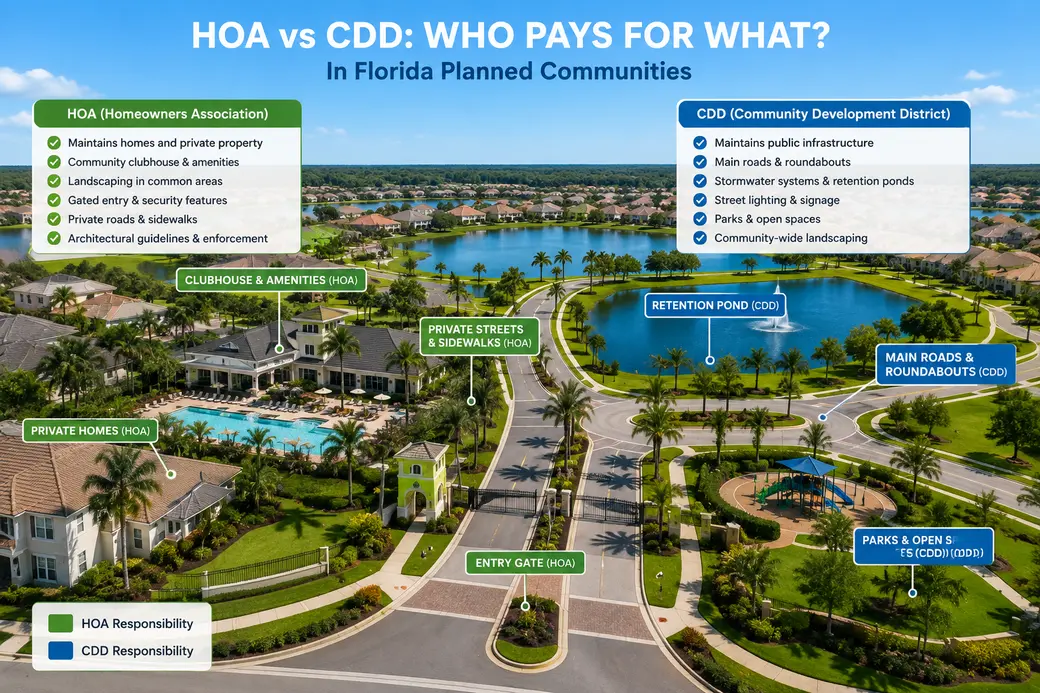
Yes. A Florida home can have both homeowners association fees and Community Development District assessments because an HOA and a CDD are separate entities with different purposes. An HOA is a private association that operates under the community's governing documents, while a CDD is a governmental entity created under Florida law that can finance, operate and maintain qualifying community infrastructure and services. In some planned communities, homeowners therefore pay regular HOA assessments while also paying CDD assessments, often through the annual property tax bill. Buyers should verify both for the exact property because the amount, what each pays for, and how the charges are collected can vary substantially from one community to another.
Quick Answers About HOA and CDD Fees in Florida
Can I really have to pay both an HOA and a CDD?
Yes. A property can be located within a Community Development District while also being subject to a homeowners association. Because they are separate entities, paying one does not automatically eliminate the other.
What is the main difference between an HOA and a CDD?
An HOA is a private association governed by recorded community documents. A CDD is a governmental entity operating under Florida's Community Development District law. Their responsibilities can overlap in ways that appear similar to homeowners, but their legal structures and funding mechanisms are different.
What do HOA fees pay for?
It depends on the association. HOA assessments may support common-area maintenance, landscaping, gates, pools, clubhouses, private roads, management, insurance or other community expenses. Buyers should review the actual budget and governing documents rather than assume what is included.
What do CDD assessments pay for?
CDD assessments can help finance, operate and maintain authorized district infrastructure and facilities. Depending on the district, that can involve roads, stormwater systems, utilities, landscaping, recreational facilities and other qualifying community improvements or services.
Where will I see the CDD charge?
CDD assessments are commonly collected on the annual property tax bill, often as non-ad valorem assessments. The exact collection method and assessment structure should be verified for the specific district and property.
Does a CDD eventually disappear?
Not necessarily. A district may have debt-related assessments associated with infrastructure financing, but the CDD can continue operating and assessing property for ongoing operations, maintenance and authorized services. Verify the specific district rather than assuming the entire assessment ends on a particular date.
How do I find out whether a home has both?
Review the listing information, HOA documents, current association budget, applicable CDD records, property tax information and transaction documents. Verify the current amounts rather than relying solely on a listing's estimated monthly expenses.
What Is an HOA?
HOA stands for homeowners association. In many Florida planned communities, membership in the association is a condition of owning a property within the community.
Florida Statutes Chapter 720 provides the statutory framework for qualifying Florida homeowners associations. The law defines a homeowners association as a Florida corporation responsible for operating a community in which membership is mandatory as a condition of parcel ownership and which is authorized to impose assessments under the applicable governing documents.
The important word for buyers is association. An HOA is not the same entity as the local government or a Community Development District.
What Can HOA Fees Cover?
There is no single list of services included in every HOA fee. The association's governing documents, budget and responsibilities determine what the money supports.
Depending on the community, HOA expenses may involve:
- Common-area landscaping
- Community pools
- Clubhouses and fitness facilities
- Gated entrances
- Private roads or shared property when applicable
- Association insurance
- Management and administrative expenses
- Maintenance of association-owned property
- Other expenses authorized by the governing documents
Two communities with similar pools, landscaping and clubhouses can have very different HOA budgets and homeowner responsibilities. Always verify what the specific fee includes.
What Is a CDD in Florida?
CDD stands for Community Development District.
Under Florida Statutes Chapter 190, Community Development Districts provide a governmental mechanism for managing and financing basic services and infrastructure for community development.
That governmental status is a major distinction from an HOA. Florida's HOA statute specifically states that the term homeowners association does not include a CDD or another similar special taxing district created under statute.
In other words, an HOA and a CDD are not two names for the same community organization.
Why Would a Community Have a CDD?
Large planned developments can require substantial infrastructure before or while homes are being built. Florida's CDD framework provides a method for qualifying infrastructure and community facilities to be financed, constructed, operated and maintained through a district.
Depending on the particular district and its authorized facilities, CDD responsibilities can involve infrastructure such as:
- Road and transportation improvements
- Stormwater management systems
- Water-related infrastructure
- Landscaping and common areas
- Recreational facilities
- Other authorized district improvements and services
The exact responsibilities of an individual CDD should be confirmed from that district's records and budget.
Why Can the Same Home Have Both HOA and CDD Fees?
Because the HOA and CDD can perform different functions within the same broader development.
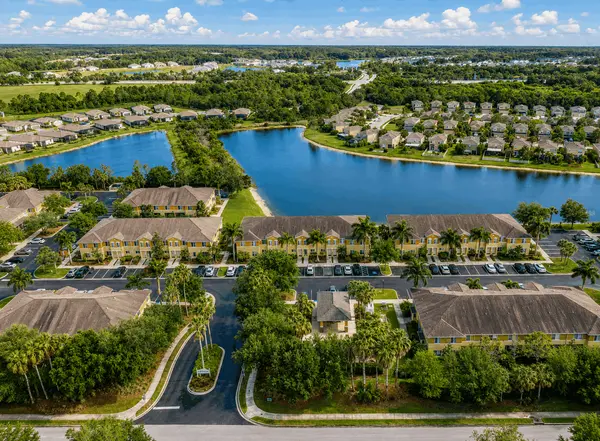
Imagine a large Florida master-planned community. Its CDD might finance and maintain certain district infrastructure, stormwater systems or recreational facilities. A separate HOA might administer deed restrictions, maintain association property, manage neighborhood landscaping or operate other amenities assigned to the association.
The homeowner may therefore have obligations to both entities.
This structure is particularly relevant when evaluating newer Florida planned communities. Hunt Brothers Realty's guide to CDD vs. HOA fees in Wellen Park explains how buyers can encounter both costs within newer communities and why they should evaluate them separately.
CDD vs. HOA: A Simple Comparison
| Question | HOA | CDD |
|---|---|---|
| What is it? | Private community association | Governmental district created under Florida law |
| What governs it? | Governing documents and applicable Florida law | Florida law and district governance |
| What can it fund? | Association expenses, property, amenities and services as authorized | Authorized district infrastructure, facilities, operations and services |
| How is it commonly paid? | Directly to the association on its payment schedule | Often through assessments appearing on the property tax bill |
| Can a property have both? | Yes | Yes |
This comparison is intentionally general. The actual responsibilities and charges for a specific HOA or CDD are determined by the applicable documents, budgets, district records and law.
How Are CDD Assessments Collected?
Florida law gives Community Development Districts authority to impose qualifying taxes and assessments. Florida Statutes Section 190.021 addresses district taxes and non-ad valorem assessments, while Section 190.022 authorizes special assessments for qualifying district facilities.
For many homeowners, the practical result is that CDD assessments appear on the annual property tax bill as non-ad valorem assessments. This can make the cost easy to overlook when a buyer focuses only on the advertised HOA payment.
A CDD Assessment Can Have More Than One Component
When investigating a CDD, ask what makes up the current assessment rather than looking only at the total amount.
Depending on the district, assessments may include costs associated with financing infrastructure as well as ongoing district operations and maintenance. These components can behave differently over time.
Florida law allows CDD special assessments for authorized district facilities and provides that district assessments may, under the applicable statutory framework, be payable over a period of years. Buyers should obtain information for the specific district rather than assume that every CDD uses the same financing structure.
Does the CDD Fee Eventually Go Away?
This is one of the most common misunderstandings about CDDs.
A debt-related portion of a district assessment may be associated with a defined financing period. That does not mean the CDD itself automatically disappears when that particular debt is paid.
The district can continue to have ongoing responsibilities for operating and maintaining authorized infrastructure, facilities and services. Those responsibilities can require continuing assessments.
If someone tells you that a property's "CDD ends in 10 years," ask exactly what ends. The statement may refer to a particular debt assessment rather than every future district charge.
Can You Pay Off a CDD Early?
Some district debt assessments may have a payoff mechanism, but buyers should not assume that every CDD obligation can simply be eliminated with one payment.
Even if a property owner can satisfy an outstanding debt-related assessment, ongoing operations and maintenance assessments may continue as long as the district has expenses and levies them.
Before paying off or valuing a property based on a CDD balance, request the current payoff information and assessment details directly from the applicable district or its authorized administrator. Questions about tax treatment or the financial consequences of a payoff should be reviewed with an appropriate tax or financial professional.
Are CDD Fees Included in Property Taxes?
CDD assessments frequently appear on the same annual bill as property taxes, but that does not mean every CDD charge is an ad valorem property tax based on the home's taxable value.
Florida law specifically provides mechanisms for CDD non-ad valorem and special assessments. Buyers should look at the actual tax bill and district records to identify what is being charged and how it is classified.
Questions about whether a particular assessment is deductible or how it should be treated for federal or state tax purposes require individualized tax guidance. Consult a qualified tax professional regarding your circumstances.
How HOA and CDD Costs Affect Your Home-Buying Budget
When comparing two Florida homes, purchase price alone does not tell you which one has the lower ownership cost.
A realistic housing budget may need to consider:
- Mortgage principal and interest
- Property taxes
- CDD assessments
- HOA assessments
- Homeowners insurance
- Flood insurance when applicable
- Other association or amenity charges
- Maintenance and repairs
- Utilities and other ownership expenses
A home with a lower purchase price can have higher recurring expenses than a more expensive property with a different fee structure. Compare the total ownership picture rather than treating HOA or CDD costs as minor add-ons.
Why This Matters When Comparing New Construction and Resale Homes
CDD assessments are particularly important to investigate when shopping in newer master-planned developments, although buyers should verify every individual property rather than make assumptions based on age alone.
As Hunt Brothers Realty explains in Older Florida Home vs. New Construction, newer Sarasota-area communities can offer extensive amenities while also introducing HOA fees, CDD assessments, membership requirements or other recurring charges that buyers should include in their comparison.
An established resale neighborhood might have no CDD and a modest HOA, while a newer community could have both. Another resale home located inside an existing CDD could still carry district assessments. The property itself, not simply whether it is new or resale, determines what must be investigated.
Wellen Park Is a Good Example of Why Buyers Need Property-Specific Numbers
Large master-planned areas can contain multiple neighborhoods with different associations, amenities and assessment structures.
Hunt Brothers Realty's Wellen Park HOA and CDD guide explains that buyers may encounter both costs and that fee structures can differ among neighborhoods within the broader community.
That means asking, "What are the fees in Wellen Park?" is less useful than asking, "What are every HOA, CDD and other recurring community charge associated with this specific property?"
The Same Issue Applies in Growing Parrish Communities
Parrish is another Florida Gulf Coast market where buyers can encounter newer planned developments alongside established neighborhoods.
The Hunt Brothers Realty guide to living in Parrish, Florida notes that buyers can encounter homeowners associations, Community Development Districts or both. Some Parrish properties may have CDD obligations while others do not.
This is why community-wide estimates should never replace verification for the individual parcel.
Do HOA and CDD Fees Stay the Same?
Buyers should not assume current HOA or CDD assessments will remain unchanged indefinitely.
HOA budgets can change as association expenses, insurance, maintenance, reserves, contracts and other costs change. CDD governing boards also adopt budgets and assessments for district obligations.
Florida Statutes Section 190.048, which governs the required disclosure for initial sales within a CDD, expressly states that district taxes and assessments are set annually by the district's governing board.
Use today's charges to evaluate today's ownership cost, but do not treat them as a guarantee of future expenses.
Can an HOA Charge a Special Assessment Even If I Already Pay a CDD?
The existence of a CDD does not by itself eliminate an HOA's separate financial obligations or authority under its governing documents and applicable law.
Florida Statutes Section 720.308 addresses HOA assessments and charges, including assessments levied pursuant to annual budgets or special assessments.
Whether a particular HOA assessment is authorized, how it must be approved and what an individual owner owes are document-specific and potentially legal questions. Review the governing documents and association records, and consult a qualified Florida real estate attorney when legal interpretation is material to your decision.
What Should Buyers Review Before Purchasing a Home With HOA and CDD Costs?
Before deciding whether a community fits your budget, build a complete list of recurring and potential community obligations.
- Current HOA assessment
- HOA payment frequency
- Services and amenities included in the HOA assessment
- Association budget and applicable financial information
- Current or approved HOA special assessments
- CDD or other district assessments applying to the parcel
- Debt-related and operations or maintenance components of the CDD assessment when applicable
- Current property tax bill
- Available CDD budget and assessment information
- HOA rules and restrictions
- Separate amenity, club or membership charges when applicable
- Transfer, application or other transaction-related fees when applicable
Ask for current documents. An old listing, previous owner's payment or builder marketing sheet may not reflect the amount that applies when you purchase.
Do Not Compare Communities Using HOA Fees Alone
A community advertising a relatively low HOA fee can still have meaningful CDD assessments or separate amenity charges. Another neighborhood might have a higher HOA assessment but no CDD.
Neither structure is automatically better. What matters is the total cost, what those expenses support, the community's financial structure and whether the amenities and services align with what you value.
A useful comparison is therefore not simply:
Community A HOA vs. Community B HOA
Instead, compare:
HOA + CDD + other mandatory community costs + property taxes + insurance + expected homeownership expenses.
The Most Important Question Is Not HOA or CDD, It Is Total Ownership Cost
Yes, a Florida home can have both HOA and CDD obligations. Once you understand that, the more useful question becomes whether the complete cost structure makes sense for the home and lifestyle you are considering.
Identify every recurring community charge, determine what each one supports, understand whether a CDD includes debt and ongoing operating assessments, and review any known or approved HOA special assessments. Then compare those costs alongside the mortgage, property taxes, insurance and expected maintenance.
That gives you a much clearer picture than looking at the purchase price or HOA fee alone.
Comparing Florida Communities? Hunt Brothers Realty Can Help
Hunt Brothers Realty helps Florida Gulf Coast buyers compare homes based on more than the asking price. HOA assessments, CDD obligations, community amenities, property taxes, insurance considerations and other ownership expenses can all affect how two seemingly similar homes fit a buyer's plans.
For additional guidance, read CDD vs. HOA Fees in Wellen Park, compare older Florida homes with new construction, or explore living in Parrish, Florida.
Informational notice: This article provides general real estate information for educational purposes and is not individualized legal, tax, financial or association advice. HOA obligations, CDD assessments, district debt, special assessments, governing documents and tax treatment vary by property and community. Buyers should verify current information with the applicable homeowners association, Community Development District, property tax records and transaction documents. Questions involving contractual rights, governing documents or other legal obligations should be reviewed with a qualified Florida real estate attorney, while individualized tax questions should be reviewed with a qualified tax professional.
Sources
- Florida Legislature, Chapter 720, Homeowners' Associations
- Florida Legislature, Chapter 190, Community Development Districts
- Florida Statutes Section 190.021, Taxes and Non-Ad Valorem Assessments
- Florida Statutes Section 190.022, Special Assessments
- Florida Statutes Section 190.048, CDD Disclosure to Purchasers
- Florida Statutes Section 720.308, HOA Assessments and Charges
- Hunt Brothers Realty, CDD vs. HOA Fees in Wellen Park
- Hunt Brothers Realty, Older Florida Home vs. New Construction
- Hunt Brothers Realty, Living in Parrish, Florida
Contact Hunt Brothers Realty
46 N. Washington Blvd, Ste 3, Sarasota, FL 34236
Phone: (941) 388-7017
Email: info@huntbrothersrealty.com
Website: HuntBrothersRealty.com
Categories
- All Blogs 2152
- Anna Maria Island 86
- Bird Key 4
- Bradenton 236
- Buying a Home 1211
- Casey Key 2
- Clearwater 11
- Condos & HOA Living 1127
- Ellenton 6
- Englewood 11
- First Time Homebuyers 1320
- Foreclosures 5
- Home Selling 6
- Homeownership 1344
- Lakewood Ranch 25
- Lido Key 28
- Longboat Key 80
- Luxury/Waterfront Properties 1283
- Market Updates & Trends 804
- Mortgages & Financing 51
- Move-Up Buyers 23
- Neighborhood Guides 919
- New Construction 36
- Palmetto 3
- Parrish 6
- Port Charlotte 10
- Punta Gorda 17
- Real Estate Investing 1200
- Relocation to Florida 1239
- Safety Harbor 3
- Sarasota 86
- Sarasota - Downtown 163
- Selling a Home 146
- Siesta Key 92
- St. Petersburg 8
- Tierra Verde 5
- Vacation & Second Homes 1393
- Venice 209
- Wellen Park 20
Recent Posts