Save Our Homes Portability in Florida: Can You Take Your Property Tax Savings With You?
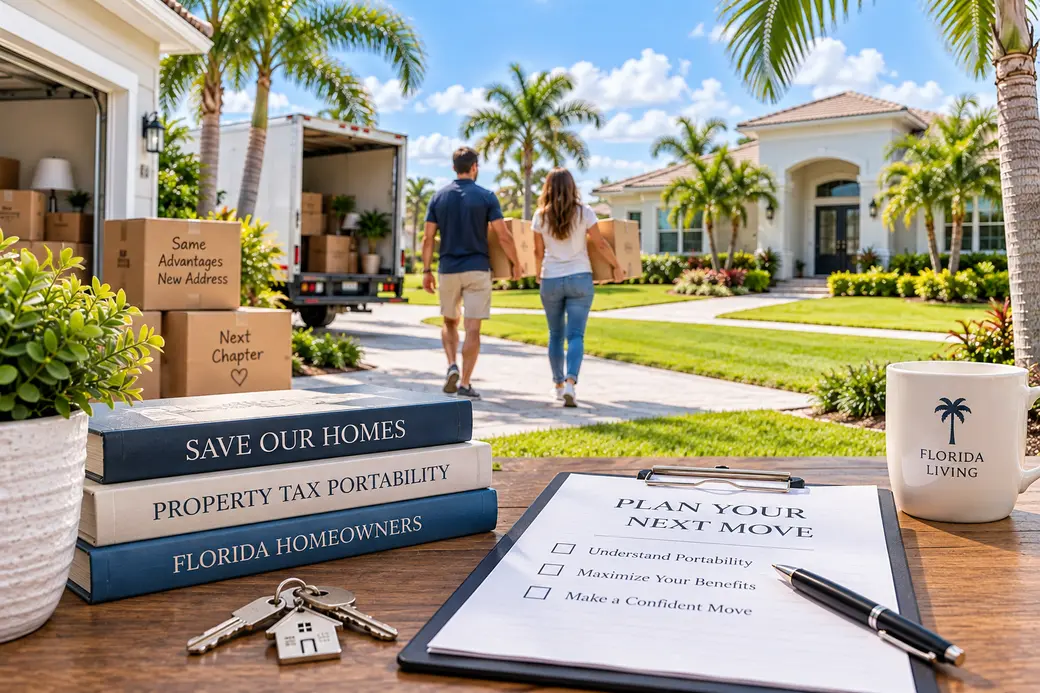
If you sell one Florida homestead and establish another, you may be able to take some of your accumulated Save Our Homes assessment benefit with you. Florida calls this portability. The Homestead Exemption itself does not transfer from one house to another, but an eligible homeowner can potentially transfer up to $500,000 of the assessment difference created under Save Our Homes, subject to Florida’s calculation rules. Timing matters. You must establish a new Florida homestead within the applicable three-year period and file the required portability paperwork with the county property appraiser. The actual benefit depends on your previous and new homesteads, so portability should be calculated for your specific situation.
Quick Answers About Save Our Homes Portability in Florida
What is Save Our Homes portability?
Save Our Homes portability allows an eligible Florida homeowner to transfer some or all of the accumulated assessment difference from a previous Florida homestead to a new Florida homestead. This can reduce the new home’s assessed value compared with what it otherwise would have been.
How much can you port in Florida?
Florida portability can transfer an eligible Save Our Homes assessment difference of up to $500,000. The amount actually transferred depends on the assessment difference from the previous homestead and whether the new home has a higher or lower just value.
Does your Homestead Exemption transfer automatically?
No. Florida’s Homestead Exemption is not transferable. You must establish eligibility and apply for Homestead Exemption on your new permanent Florida residence. Portability is a separate transfer of an eligible Save Our Homes assessment difference.
How long do you have to use portability?
You generally must establish Homestead Exemption on the new Florida home within three years of January 1 of the year you abandoned the previous homestead. The timing is based on tax years and the abandonment of the old homestead, not simply three calendar years after your closing date.
What form do you use for Florida portability?
Florida uses Form DR-501T, Transfer of Homestead Assessment Difference. It is filed with the Homestead Exemption application, Form DR-501, through the property appraiser for the county where the new homestead is located.
Can you port your benefit to another Florida county?
Yes, portability is not limited to moving within the same county. An eligible homeowner can move between Florida counties. The property appraisers coordinate the information necessary to verify the prior homestead and assessment difference.
Can you take the seller’s Save Our Homes savings?
No. Portability concerns your eligible assessment difference from your own previous Florida homestead. You do not inherit the seller’s accumulated Save Our Homes benefit simply because you purchase the seller’s house. Hunt Brothers Realty’s guide to property taxes after buying a Florida home explains why the seller’s current tax bill can be misleading.
Does portability guarantee a specific tax bill?
No. Portability can reduce assessed value, but the final property-tax bill also depends on exemptions, taxable value, millage rates and other property-specific factors. The county property appraiser should calculate the applicable portability benefit and provide the most appropriate resources for estimating future taxes.
What Does Save Our Homes Actually Do?
To understand portability, first understand Save Our Homes. After a qualifying Florida residence receives Homestead Exemption and the Save Our Homes limitation applies, annual increases in assessed value are generally limited to the lower of 3% of the previous year’s assessed value or the applicable percentage change in the Consumer Price Index.
The limitation applies to assessed value. It does not limit how much the property’s market, or just, value can increase, and it is not a guarantee that the final property-tax bill can increase by no more than 3%.
Over years of ownership, market value can increase faster than assessed value. When that happens, a difference develops between the property’s just value and its assessed value. That accumulated difference is the Save Our Homes benefit that may become relevant for portability.
For more background on the underlying exemption and assessment limitation, read Hunt Brothers Realty’s Florida Homestead Exemption 2026 Guide.
What Exactly Are You Taking With You?
The phrase “taking your property tax savings with you” is convenient, but it can also create confusion. Portability does not transfer a dollar amount from one tax bill to another.
Instead, the potential benefit involves the assessment difference between the just value and assessed value of the previous homestead. Subject to Florida’s portability rules and limits, that benefit can reduce the assessed value of the new homestead.
That distinction matters because the same portability amount does not necessarily produce the same property-tax savings in every location. Taxing authorities and millage rates vary, and exemptions can apply differently to different portions of the tax bill.
How Does Florida Portability Work When You Buy a More Expensive Home?
When the new homestead has a higher just value than the previous homestead, an eligible owner can generally transfer the previous assessment difference up to Florida’s $500,000 portability limit.
Consider a simplified example:
- Previous home just value: $500,000
- Previous home assessed value: $350,000
- Illustrative Save Our Homes assessment difference: $150,000
- New home just value: $650,000
- Potential portability amount for this simplified example: up to $150,000
If the homeowner satisfies all applicable requirements, that transferred assessment difference could reduce the new home’s assessed value compared with an assessment without portability.
This example is for education only. It does not calculate an actual property assessment or tax bill. The county property appraiser determines the qualifying values and portability amount for the individual homeowner.
What Happens If You Downsize to a Less Expensive Florida Home?
Moving to a less expensive home does not necessarily eliminate portability, but the calculation changes. When the new homestead’s just value is lower than the old homestead’s just value, Florida generally uses a proportional calculation.
This means someone downsizing should not assume that the entire dollar amount of the previous assessment difference will simply be subtracted from the new home’s value.
The Manatee County Property Appraiser, for example, illustrates this principle using a previous homestead with a $225,000 just value, a $195,000 assessed value and a $30,000 Save Our Homes benefit. In its example, moving to a $200,000 new homestead results in a transferred benefit of $26,000 rather than the full $30,000.
Homeowners downsizing should therefore have the county property appraiser calculate the applicable benefit rather than trying to transfer the old assessment difference dollar for dollar.
What Is the $500,000 Portability Limit?
Florida limits the amount of Save Our Homes assessment difference that can be transferred under portability. The maximum transferable assessment difference is generally $500,000, subject to the applicable eligibility and calculation rules.
That does not mean every homeowner moving between Florida homesteads receives a $500,000 reduction. A homeowner can only port the eligible benefit actually accumulated on the previous homestead, subject to the statutory maximum and the calculation applicable to the new property.
Is $500,000 the amount you save in property taxes?
No. The $500,000 limit concerns the transferable assessment difference, not a $500,000 tax exemption and not a $500,000 reduction in your property-tax bill. Actual tax savings depend on the resulting taxable values and applicable tax rates.
What Is Florida’s Three-Year Portability Rule?
Florida Department of Revenue guidance states that an owner seeking to transfer the Save Our Homes benefit must establish Homestead Exemption on the new Florida home within three years of January 1 of the year the previous homestead was abandoned.
The wording is important. The portability period should not simply be described as “three years from the day you sell your house.” Florida’s property-tax system works around January 1 assessment dates and tax years.
Can you rent for a while before buying your next Florida homestead?
Potentially, provided the new homestead is established within the applicable portability period and all other requirements are met. Anyone planning a delayed move should confirm the exact final qualifying tax year with the county property appraiser before relying on portability in a future homebuying budget.
How Do You Apply for Save Our Homes Portability?
Portability is connected to establishing Homestead Exemption on the new residence. The Florida Department of Revenue instructs homeowners to file the Transfer of Homestead Assessment Difference, Form DR-501T, with the Homestead Exemption application, Form DR-501.
The forms are filed with the property appraiser in the county where the new homestead is located. The standard filing deadline is March 1.
- Establish the new property as your qualifying permanent Florida residence.
- Apply for Homestead Exemption on the new residence.
- Complete Form DR-501T for the portability transfer.
- Provide information identifying the previous Florida homestead.
- File with the property appraiser for the county containing the new residence.
- Submit the required forms by the applicable deadline.
- Respond to requests for additional information from the property appraiser.
Homeowners should use the current forms and instructions provided by the Florida Department of Revenue and their county property appraiser rather than relying on an older saved application.
Does Portability Transfer Automatically When You Buy?
No. Purchasing another Florida home does not automatically move the Save Our Homes assessment difference to the new property.
The new residence must qualify for Homestead Exemption, and the owner must complete the required portability filing. This is why portability belongs on the post-closing checklist for homeowners who previously had a Florida homestead.
If you are unsure whether a previous residence generated a portability benefit, ask the county property appraiser rather than assuming there is no benefit available.
Can You Move From Sarasota County to Manatee County and Still Use Portability?
Yes, an eligible portability transfer can cross county lines within Florida. For example, someone selling a qualifying homestead in Sarasota County and establishing a new qualifying homestead in Manatee County may be able to port the eligible Save Our Homes assessment difference.
The homeowner applies through the property appraiser for the county containing the new homestead. The property appraiser obtains or verifies the necessary information concerning the previous homestead as part of the portability process.
This can be particularly relevant for buyers comparing communities throughout the Sarasota and Bradenton area. Hunt Brothers Realty’s community guide can help buyers research housing options across Florida’s Gulf Coast while property-tax eligibility and calculations remain the responsibility of the appropriate county property appraiser.
Why Should You Investigate Portability Before Setting a Homebuying Budget?
Property taxes are an important part of the ongoing cost of owning a Florida home. A buyer with a substantial eligible portability benefit may have a different future assessed value than another buyer purchasing the same property without portability.
That makes generic tax estimates less useful for homeowners moving from an existing Florida homestead. When a portability benefit may apply, the buyer should include it in discussions with the county property appraiser and use a property-specific estimate.
Buyers financing the new residence should also discuss realistic property-tax assumptions with their mortgage lender or loan professional because taxes can affect qualification, escrow calculations and the overall monthly housing payment.
Why Is the Seller’s Current Property-Tax Bill Still Misleading?
Portability does not change the basic rule that a buyer should not use the seller’s existing tax bill as a prediction of future property taxes.
The seller’s assessment can reflect the seller’s years of ownership, exemptions and accumulated Save Our Homes benefit. Following a qualifying change of ownership, that seller-specific assessment limitation generally does not simply remain attached to the house for the buyer.
An eligible buyer may instead bring some of the buyer’s own Save Our Homes benefit from a previous Florida homestead. That can produce a very different tax situation from both the seller’s historical bill and the tax situation of another buyer.
Hunt Brothers Realty’s property-tax guide for Florida homebuyers explains the reassessment issue in greater detail.
Can First-Time Florida Homebuyers Use Portability?
A buyer who has never had a qualifying Florida homestead generally would not have a previous Florida Save Our Homes assessment difference to transfer. Portability is based on the eligible benefit accumulated on a prior Florida homestead.
A new Florida resident may still qualify for Homestead Exemption after satisfying the applicable ownership and permanent-residency requirements. Save Our Homes can then become relevant for that new homestead under Florida’s assessment rules.
Can You Port Save Our Homes From Another State?
No. Florida Save Our Homes portability concerns an eligible assessment difference from a previous Florida homestead. A property-tax benefit accumulated on a residence in another state does not become a Florida Save Our Homes portability benefit.
Someone relocating from another state should instead investigate whether the new Florida residence qualifies for Homestead Exemption and any other Florida property-tax benefits applicable to the homeowner’s circumstances.
What If Two Owners Had the Previous Homestead?
Ownership changes involving multiple owners can make portability more complicated. Florida has specific rules and forms addressing ownership interests in an abandoned homestead, and the outcome can depend on how the previous and new properties are owned.
Divorce, separation, inheritance, trusts, changes in co-ownership and situations in which former co-owners establish different new homesteads should not be analyzed using a simple online portability example.
The county property appraiser should determine the applicable portability calculation. Questions involving ownership rights, divorce, estates, trusts or interpretation of legal documents should be reviewed with a qualified Florida attorney when individualized legal guidance is needed.
Does Portability Mean Your Property Taxes Cannot Increase?
No. Portability can reduce the assessed value of the new homestead compared with an assessment without the transferred benefit, but it does not freeze the property-tax bill.
Property taxes depend on taxable value and the millage rates imposed by the applicable taxing authorities. Save Our Homes limits qualifying increases in assessed value after it applies, but changes in tax rates and other circumstances can still affect the final bill.
Think of portability as an assessment benefit, not as a guarantee of a specific annual property-tax payment.
What Should Florida Homeowners Verify Before Moving?
- Confirm that the previous property was a qualifying Florida homestead.
- Determine whether an assessment difference exists on the previous homestead.
- Ask the property appraiser for an estimate of the potential portability benefit.
- Identify the year in which the previous homestead is considered abandoned for portability purposes.
- Confirm the final year in which a new homestead can be established under the three-year rule.
- Determine whether moving to a higher-value or lower-value home changes the portability calculation.
- Apply for Homestead Exemption on the new residence.
- Complete Form DR-501T.
- File by the applicable March 1 deadline.
- Do not assume the seller’s tax bill represents your future taxes.
- Use a property-specific post-purchase tax estimate when planning your housing budget.
What Should You Ask the Property Appraiser About Portability?
The county property appraiser is the appropriate source for determining eligibility and calculating the assessment benefit. Useful questions include:
- Do I have an eligible Save Our Homes assessment difference?
- What is my estimated portability amount?
- How would buying a less expensive home affect the calculation?
- What is my deadline for establishing the new homestead?
- Which forms must I file?
- What documentation do you need from me?
- How does my ownership structure affect the benefit?
- What might the new property’s assessed value be after portability?
- Does your office provide a tax estimator I can use for planning?
What Is the Bottom Line on Florida Save Our Homes Portability?
Yes, eligible Florida homeowners may be able to take an important property-tax assessment benefit with them when moving from one Florida homestead to another. What moves is not the old Homestead Exemption or the old tax bill. It is some or all of the eligible Save Our Homes assessment difference, subject to Florida’s portability rules.
The potential transfer can be significant, with a statewide limit of up to $500,000 of assessment difference. But the actual benefit depends on the previous homestead, new homestead, relative property values, ownership circumstances and filing eligibility.
For anyone moving within Florida, portability is worth investigating before setting a homebuying budget. Confirm the available benefit and filing timeline with the county property appraiser, then use a realistic post-purchase property-tax estimate when comparing homes.
Planning Your Next Florida Move With Hunt Brothers Realty
If you are selling one Florida home and purchasing another, Hunt Brothers Realty can help with the real estate side of the move while you verify portability and property-tax matters with the appropriate professionals. Read Hunt Brothers Realty’s Florida Homestead Exemption 2026 Guide, learn how property taxes can change after buying a Florida home, browse Florida Gulf Coast communities, search properties with the Hunt Brothers Realty map search, or contact Hunt Brothers Realty to discuss your next home.
This article is provided for general informational and educational purposes only and is not individualized legal, financial, tax, lending, title or other professional advice. Save Our Homes portability eligibility, assessment differences, ownership allocations, deadlines and resulting property taxes depend on the homeowner, previous homestead, new property and applicable law. Homeowners should verify eligibility, calculations, forms and deadlines with the appropriate Florida county property appraiser. Individual tax consequences should be reviewed with a qualified tax professional or CPA. Questions involving ownership rights, trusts, estates, divorce, title or other legal matters should be reviewed with a qualified Florida attorney or other appropriate legal professional.
Sources
- Florida Department of Revenue, Homestead Exemption, Save Our Homes and Portability
- Florida Department of Revenue, Save Our Homes Assessment Limitation and Portability Transfer
- Florida Department of Revenue, Property Tax Forms including DR-501T
- Manatee County Property Appraiser, Portability of Save Our Homes
- Hunt Brothers Realty, Florida Homestead Exemption 2026 Guide
- Hunt Brothers Realty, How Much Can Property Taxes Change After I Buy a House?
Hunt Brothers Realty
46 N. Washington Blvd, Ste 3, Sarasota, FL 34236
Phone: (941) 388-7017
Email: info@huntbrothersrealty.com
Website: HuntBrothersRealty.com
Categories
- All Blogs 1426
- Anna Maria Island 66
- Bird Key 3
- Bradenton 53
- Buying a Home 580
- Casey Key 2
- Clearwater 5
- Condos & HOA Living 489
- Ellenton 4
- Englewood 5
- First Time Homebuyers 653
- Foreclosures 3
- Homeownership 629
- Lakewood Ranch 15
- Lido Key 24
- Longboat Key 65
- Luxury/Waterfront Properties 568
- Market Updates & Trends 283
- Mortgages & Financing 29
- Move-Up Buyers 20
- Neighborhood Guides 425
- New Construction 22
- Palmetto 2
- Parrish 4
- Port Charlotte 7
- Punta Gorda 11
- Real Estate Investing 501
- Relocation to Florida 551
- Safety Harbor 2
- Sarasota - Downtown 112
- Selling a Home 134
- Siesta Key 87
- St. Petersburg 3
- Tierra Verde 4
- Vacation & Second Homes 684
- Venice 20
- Wellen Park 7
Recent Posts