How Much Can Property Taxes Change After I Buy a House?
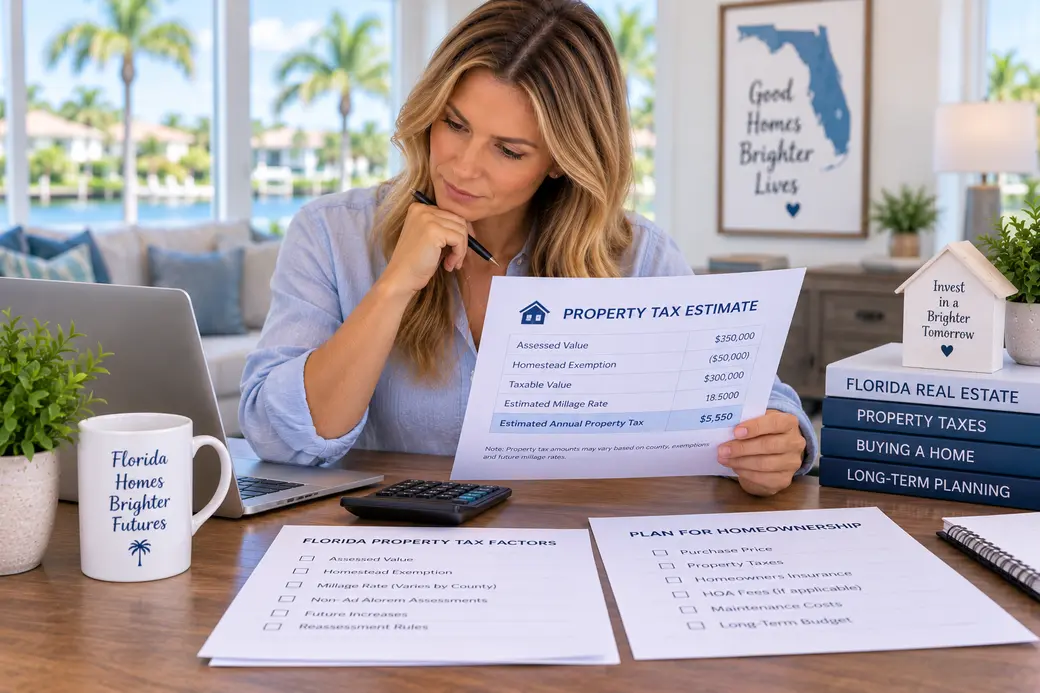
Property taxes can change substantially after you buy a Florida house, especially when the seller has owned and homesteaded the property for many years. A change of ownership generally causes the property's assessed value to be reset to just value as of January 1 following the change of ownership. That means the seller's existing tax bill may be a poor estimate of what you will eventually pay. Your actual taxes will depend on the new assessed value, exemptions you qualify for, applicable tax rates and other property-specific factors.
For Florida buyers, the practical rule is simple: do not build your homeownership budget around the seller's current property tax bill. Obtain a property-specific estimate from the county property appraiser and investigate whether you qualify for Homestead Exemption and Save Our Homes portability. Hunt Brothers Realty's Florida Homestead Exemption guide explains these benefits in greater detail.
Quick Answers About Property Taxes After Buying a House
Can my property taxes go up after I buy a Florida home?
Yes. A change of ownership can cause the property's assessed value to be reset to just value. If the previous owner had a large Save Our Homes benefit, your future tax bill could be considerably higher than the amount shown on the seller's most recent tax bill.
Is there a maximum percentage my taxes can increase after purchase?
There is no single percentage cap that tells a buyer how much the tax bill can change because of the purchase itself. Florida assessment limitations such as Save Our Homes generally apply after the property's assessment has been reset following a qualifying ownership change, not as a limit protecting the buyer from that initial reassessment.
Why might the seller's property taxes be much lower than mine?
A longtime Florida homeowner may have accumulated a substantial difference between the home's market value and assessed value through Save Our Homes. That seller-specific assessment benefit generally does not simply remain attached to the house for the new buyer.
Does Homestead Exemption stop property taxes from increasing?
No. Homestead benefits can reduce taxable value, and Save Our Homes can limit future increases in assessed value, but neither guarantees that your actual property tax bill will remain unchanged. Tax rates and other factors can still affect the amount owed.
What is the Save Our Homes cap?
After qualifying homestead property becomes subject to Save Our Homes, annual increases in assessed value are generally limited to the lesser of 3 percent or the applicable change in the Consumer Price Index. The limitation applies to assessed value, not directly to the final tax bill.
Can I transfer my Save Our Homes benefit to another Florida house?
Potentially. Florida's portability provisions may allow an eligible homeowner moving from one Florida homestead to another to transfer some or all of the assessment difference, subject to applicable requirements. Ask the county property appraiser to determine how portability applies to your circumstances.
How should I estimate property taxes before buying?
Use the appropriate county property appraiser's tax-estimation resources when available and base your estimate on the property's expected post-purchase assessment rather than simply copying the seller's current bill. For individualized tax consequences, consult a qualified tax professional or CPA.
Why Can Property Taxes Jump After You Buy a Florida Home?
Florida's property tax system can create a major difference between what a longtime owner pays and what a new buyer eventually pays.
The reason involves the distinction between a property's market or just value and its assessed value. A qualifying homestead owner can benefit over time from Save Our Homes, which limits how quickly assessed value can increase even when the property's market value rises faster.
Suppose someone purchased a home many years ago and has continuously qualified for Homestead Exemption. The home's market value may have increased significantly, while its assessed value increased more slowly because of Save Our Homes.
When that owner sells the property, the accumulated assessment difference generally does not simply stay with the house for the new buyer. Following a qualifying ownership change, the property is generally reassessed at just value as of the following January 1.
The Seller's Tax Bill Is Not Your Future Tax Bill
This is one of the most important Florida home-buying concepts to understand.
A listing might show that the seller paid $4,000 in property taxes last year. That does not mean you should put $4,000 into your annual ownership budget.
The seller may have purchased the property decades ago, qualified for exemptions you do not qualify for, accumulated a substantial Save Our Homes assessment difference or otherwise have a tax situation that is different from yours.
The Florida Department of Revenue specifically warns new homeowners that their taxes can be higher than those paid by the previous owner because ownership changes can remove exemptions and cause reassessment.
What Happens to the Assessed Value When a Florida Home Is Sold?
Florida law generally provides that homestead property subject to Save Our Homes is assessed at just value as of January 1 following a qualifying change of ownership.
This process is often informally called a reset or reassessment.
It does not necessarily mean the county simply uses the purchase price as the new assessed value. The county property appraiser is responsible for determining just value under Florida law. The recent sale is relevant information, but buyers should rely on the property appraiser for the property's official assessment.
A Simple Example of Why Taxes Can Change
Consider a simplified hypothetical example.
| Example | Seller | New Buyer |
|---|---|---|
| Illustrative Market Value | $600,000 | $600,000 |
| Illustrative Assessed Value | $325,000 | Potentially much closer to current just value after reassessment |
| Why Different? | Long-term Save Our Homes benefit | Prior owner's assessment limitation generally does not remain with the property after a qualifying sale |
This example is intentionally simplified and is not a tax calculation. Actual assessed value, exemptions, taxable value, millage rates and taxes must be determined for the specific property and owner.
Could My Property Tax Bill Increase by Thousands of Dollars?
Yes, that is possible when there is a large difference between the previous owner's assessed value and the property's post-purchase assessed value.
The larger the accumulated Save Our Homes difference, the more misleading the previous owner's tax bill can be for a new buyer. This can be particularly noticeable with properties that have been owned and homesteaded for a long time while market values have risen substantially.
There is no responsible way to state that every Florida buyer's taxes will rise by a certain percentage or dollar amount. The answer is property-specific.
What Is Florida Homestead Exemption?
Florida Homestead Exemption provides property tax benefits for qualifying owners who make the property their permanent Florida residence.
The exemption can reduce taxable value, subject to the rules governing the applicable exemption portions and taxing authorities. Qualifying homestead property can also become eligible for the Save Our Homes assessment limitation.
For current exemption amounts, qualification requirements and filing information, see Hunt Brothers Realty's Florida Homestead Exemption 2026 Guide.
What Does Save Our Homes Actually Limit?
Save Our Homes limits increases in the assessed value of qualifying Florida homestead property after the benefit applies.
Under Florida law, the annual increase is generally limited to the lesser of:
- 3 percent of the prior year's assessed value, or
- The applicable percentage change in the Consumer Price Index.
This distinction matters because people sometimes describe Save Our Homes as a "3 percent property tax cap." That description can be misleading. The limitation applies to assessed value, not directly to the amount of the final property tax bill.
Can My Tax Bill Rise by More Than 3 Percent Even With Save Our Homes?
Potentially, yes. Save Our Homes does not guarantee that the total tax bill can increase by no more than 3 percent.
The final amount of property tax depends on more than assessed value. Taxing authorities establish millage rates, exemptions affect taxable value differently, and changes or improvements to the property can also affect assessment.
For budgeting purposes, distinguish between an assessment limitation and a guarantee about the final tax bill. They are not the same thing.
What Is Save Our Homes Portability?
Portability can help eligible Florida homeowners who move from one homesteaded Florida property to another.
Instead of receiving the previous seller's Save Our Homes benefit, an eligible buyer may be able to transfer, or port, some or all of the assessment difference accumulated on the buyer's own previous Florida homestead to the new homestead.
Eligibility and the amount that can be transferred depend on Florida law and the owner's circumstances. Portability should therefore be verified with the appropriate county property appraiser rather than estimated from the seller's tax record.
Does the Purchase Price Automatically Become the Assessed Value?
Do not assume that the county will simply copy the purchase price onto the assessment roll.
Florida property appraisers determine just value under state law. A recent arm's-length sale can be relevant evidence of market value, but the official assessment is determined through the property appraiser's valuation process.
That is another reason a buyer should use a county tax estimator when available rather than multiplying the purchase price by a tax rate and assuming the result will exactly match the future bill.
What About a Second Home or Investment Property?
A second home or investment property generally does not qualify for Homestead Exemption merely because you own it. Florida's assessment rules for nonhomestead residential property are different from Save Our Homes.
For qualifying nonhomestead residential property, Florida law generally limits annual assessment increases to 10 percent after the applicable reassessment, except for school district levies. A qualifying change of ownership can reset the property to just value for the next assessment date.
The 10 percent limitation should not be interpreted as a universal 10 percent cap on the entire property tax bill. Buyers of second homes and investment properties should obtain a property-specific estimate and discuss tax treatment with a qualified tax professional.
Why Can Taxes Still Increase When Property Values Fall?
This can happen when the property's assessed value remains below its just value.
The Florida Department of Revenue explains that an assessed value can continue increasing within the applicable assessment limitation even if market value decreases or remains unchanged, as long as the assessed value does not exceed just value.
This is another example of why market value, assessed value, taxable value and the final tax bill should not be treated as interchangeable terms.
Market Value, Assessed Value and Taxable Value Are Different
| Term | General Meaning |
|---|---|
| Just or Market Value | The property appraiser's determination of value under Florida law |
| Assessed Value | The value after applicable assessment limitations are considered |
| Taxable Value | Generally, assessed value after applicable exemptions are deducted for a particular taxing authority |
| Property Tax Bill | The resulting taxes based on taxable values, applicable rates and other relevant charges |
Understanding these distinctions makes it easier to see why a limitation on assessed value does not automatically translate into the same percentage limitation on the final bill.
New Construction Can Create Another Tax Surprise
Buyers of newly constructed homes should pay particularly close attention to the tax history they see before closing.
A prior tax record may reflect vacant land, a partially completed property or another assessment that does not represent the completed home. Once the improvements are placed on the tax roll, the assessed value and resulting taxes can look very different.
Hunt Brothers Realty's older Florida home versus new construction guide emphasizes comparing the complete expected ownership budget rather than relying on historical taxes alone.
Can Home Improvements Affect Future Property Taxes?
Yes. Certain additions and improvements can affect a property's assessment under Florida law.
That means a homeowner should not assume an assessment limitation makes every future improvement irrelevant for tax purposes. A major addition, new structure or other qualifying improvement may be treated differently from the existing protected assessment.
Before undertaking a major project where the potential tax impact matters to your budget, verify the assessment treatment with the county property appraiser and discuss individualized tax consequences with a qualified tax professional.
How Can Higher Taxes Affect Your Mortgage Payment?
If property taxes are paid through a mortgage escrow account, a higher tax obligation can eventually affect the amount collected as part of your monthly housing payment.
This is important because buyers sometimes focus on the mortgage principal and interest while assuming the initial escrow estimate represents a permanently fixed monthly payment. Taxes and insurance can change even when the principal and interest portion of a fixed-rate mortgage remains fixed.
Ask your mortgage lender how property taxes are being estimated for qualification and escrow purposes, especially when the seller's current assessment is substantially below the property's current value.
Property Taxes Are Only One Part of the Ownership Budget
A realistic Florida home-buying budget should account for more than principal and interest.
- Estimated post-purchase property taxes
- Homeowners insurance
- Flood insurance when applicable
- HOA or condominium assessments
- CDD or other assessments when applicable
- Maintenance and repairs
- Utilities
- Expected capital improvements
Association costs can change too. Hunt Brothers Realty's guide explaining whether HOA fees can increase after buying a Florida home explains why buyers should evaluate total ownership costs rather than focusing on a single monthly number.
How Should You Estimate Future Property Taxes Before Making an Offer?
Start by looking up the property through the appropriate county property appraiser. Review the current market value, assessed value, taxable value, exemptions and tax history.
If the assessed value is far below current market value, that is a strong signal that the seller's tax bill may not be a useful estimate for the buyer.
Then use the county property appraiser's tax estimator when available. Enter realistic information for the expected ownership situation and investigate whether Homestead Exemption or portability may apply.
The resulting number should still be treated as an estimate rather than a guarantee. Final assessments and taxes are determined through the official property tax process.
Questions to Ask About Property Taxes Before Buying
- What is the property's current just or market value?
- What is the current assessed value?
- How large is the difference between those values?
- Which exemptions does the current owner receive?
- Will I qualify for Homestead Exemption?
- Might I qualify for Save Our Homes portability?
- Does the county provide a buyer tax estimator?
- Does the current assessment include the completed home and improvements?
- Are there other assessments that need to be included in my ownership budget?
For property-specific tax consequences, buyers should verify information with the county property appraiser and a qualified tax professional or CPA rather than relying solely on a listing, seller tax bill or generalized online estimate.
Frequently Asked Questions About Florida Property Taxes After Buying
If I buy a $500,000 Florida home, what will my property taxes be?
The purchase price alone is not enough to determine the future tax bill. The property's official assessment, applicable exemptions, taxing authorities, millage rates and other property-specific factors must be considered. Use the relevant county property appraiser's estimator for a more useful planning figure.
Will my taxes immediately change on the day I close?
Not necessarily in the way buyers sometimes expect. Florida property is assessed as of January 1, and a qualifying change of ownership generally causes reassessment at just value as of the following January 1. Closing prorations and the timing of tax bills are separate issues that should be reviewed with the closing or title professional handling the transaction.
If the seller has Homestead Exemption, do I inherit it?
Do not assume the seller's exemption or accumulated Save Our Homes benefit becomes yours. A buyer who qualifies must establish eligibility for the buyer's own homestead benefits and file as required with the county property appraiser.
Can I use the property tax amount shown on Zillow or an MLS listing?
Historical tax information can be useful for research, but it should not be treated as the buyer's future tax estimate. Verify the official record with the county property appraiser and estimate the post-purchase tax situation separately.
Does Save Our Homes transfer automatically when I move?
No. Eligible Florida homeowners may be able to transfer an assessment difference through portability, but eligibility and filing requirements apply. Confirm the process and deadlines with the county property appraiser.
Can property taxes decrease after I buy?
They can under some circumstances, but a decrease should not be assumed. Changes in value, exemptions, tax rates and other factors can affect the bill. The property appraiser determines assessment values, while local taxing authorities establish applicable tax rates.
The Bottom Line on Property Taxes After Buying a House
Property taxes can change significantly after buying a Florida home. The biggest potential change often occurs because the previous owner's protected assessed value is reset following a qualifying change of ownership.
After a qualifying owner establishes Homestead Exemption, Save Our Homes can limit future increases in assessed value. Eligible homeowners moving from another Florida homestead may also benefit from portability. Neither benefit means the seller's existing tax bill becomes the buyer's tax bill or that the buyer's final taxes can never increase substantially.
Before buying, use a realistic post-purchase property tax estimate as part of your housing budget. That provides a much better picture of affordability than simply looking at what the current owner pays.
Plan Your Florida Home Purchase With Hunt Brothers Realty
Hunt Brothers Realty helps buyers evaluate Florida homes with attention to the property-specific considerations that can affect ownership after closing, including taxes, association costs, insurance questions, inspections and location.
If you are planning a purchase, read the Florida Homestead Exemption 2026 Guide, review why you should compare the complete ownership costs of older homes and new construction, and learn how HOA fees can change after buying a Florida home. To discuss your home search, contact Hunt Brothers Realty.
Informational notice: This article provides general real estate and educational information only and is not individualized tax, financial, legal or lending advice. Property tax treatment depends on the specific owner, property, exemptions, assessment history and applicable taxing authorities. Buyers should obtain a property-specific estimate from the appropriate county property appraiser and consult a qualified tax professional or CPA regarding their individual circumstances. Questions concerning closing prorations should be reviewed with the title or closing professional, and mortgage escrow estimates should be confirmed with the buyer's lender.
Sources
- Florida Department of Revenue, First-Time Homebuyers and Property Tax
- Florida Department of Revenue, Save Our Homes Assessment Limitation and Portability Transfer
- Florida Legislature, Section 193.155, Homestead Assessments
- Florida Legislature, Section 193.1554, Nonhomestead Residential Property
- Hunt Brothers Realty, Florida Homestead Exemption 2026 Guide
- Hunt Brothers Realty, Older Florida Home vs. New Construction
- Hunt Brothers Realty, Can HOA Fees Increase After You Buy a Home in Florida?
Contact Hunt Brothers Realty
46 N. Washington Blvd, Ste 3
Sarasota, FL 34236
Phone: (941) 388-7017
Email: info@huntbrothersrealty.com
Website: https://www.huntbrothersrealty.com/
Categories
- All Blogs 2212
- Anna Maria Island 86
- Bird Key 4
- Bradenton 237
- Buying a Home 1266
- Casey Key 2
- Clearwater 11
- Condos & HOA Living 1183
- Ellenton 6
- Englewood 12
- First Time Homebuyers 1375
- Foreclosures 5
- Home Selling 7
- Homeownership 1402
- Lakewood Ranch 25
- Lido Key 28
- Longboat Key 80
- Luxury/Waterfront Properties 1343
- Market Updates & Trends 862
- Mortgages & Financing 60
- Move-Up Buyers 25
- Neighborhood Guides 978
- New Construction 37
- Palmetto 3
- Parrish 6
- Port Charlotte 10
- Punta Gorda 41
- Real Estate Investing 1258
- Relocation to Florida 1296
- Safety Harbor 3
- Sarasota 91
- Sarasota - Downtown 164
- Selling a Home 146
- Siesta Key 92
- St. Petersburg 8
- Tierra Verde 5
- Vacation & Second Homes 1452
- Venice 209
- Wellen Park 20
Recent Posts