What Should You Check Before Buying in an HOA?
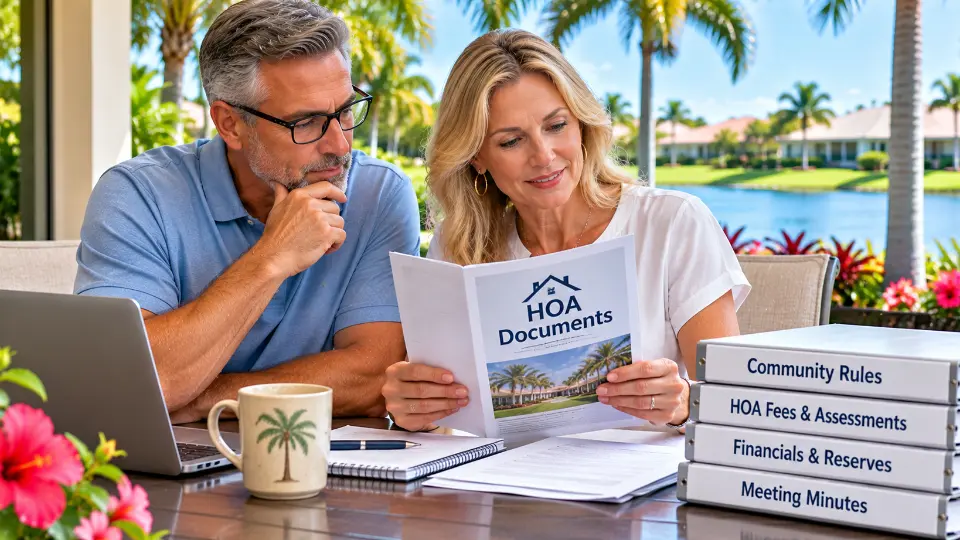
Before buying a home in a Florida HOA, check the association as carefully as you check the house. Review the declaration and current rules, regular assessments, budget, available financial information, reserves, special assessments, recent meeting records, rental restrictions, pet and parking rules, architectural requirements and exactly what the association maintains. Also determine whether another association, Community Development District (CDD), club or amenity fee applies. A low HOA fee alone does not establish that a community is inexpensive to own or financially strong. The goal is to understand both the property you are buying and the obligations that come with association membership.
Quick Answers About Buying in a Florida HOA
What is the most important thing to check before buying in an HOA?
Read the current governing documents and evaluate the association's financial obligations. A community can look ideal during a showing but be a poor fit if its rental, pet, parking, architectural or maintenance rules conflict with how you intend to use the property.
Should I only look at the monthly HOA fee?
No. Compare what the assessment covers, the association's responsibilities, available reserve information, known special assessments and expenses you will still pay individually. Hunt Brothers Realty's Florida HOA fee guide explains why the assessment amount is only part of the ownership cost.
Can HOA fees increase after I buy?
Yes. Buyers should not treat the seller's current assessment as a permanent price. Association expenses and budgets can change, and additional assessments may arise when authorized. Review Hunt Brothers Realty's guide to whether Florida HOA fees can increase after purchase.
Should I check for special assessments?
Yes. Ask about approved assessments, assessments currently being discussed and significant projects that could require additional funding. Also review recent meeting records and available financial information for indications of major upcoming expenses.
Can an HOA restrict renting my home?
Florida HOA governing documents can contain rental restrictions, subject to applicable law and the specific documents. If leasing matters to your purchase, verify minimum lease periods, rental frequency, application requirements and other current restrictions before buying. Do not rely solely on a listing description or another owner's understanding of the rules.
Can an HOA control exterior changes to my home?
An HOA may have architectural authority established through its declaration and authorized standards. If you plan to install a fence, pool, generator, landscaping, addition or other exterior improvement, investigate the applicable approval requirements before purchasing rather than assuming the project will be permitted.
Are HOA fees and CDD fees the same?
No. A homeowners association is a private association, while a Community Development District is a governmental entity created for specified infrastructure and service purposes. Some Florida properties have both. Hunt Brothers Realty's Florida HOA versus CDD guide explains the distinction.
Is buying in an HOA the same as buying a condo?
No. Florida homeowners associations and condominium associations operate under different statutory frameworks and ownership structures. This guide focuses primarily on Chapter 720 homeowners associations. Condo buyers should separately review Hunt Brothers Realty's Florida condominium buyer guide.
1. Read the HOA Declaration, Bylaws and Current Rules
The governing documents tell you what ownership in the community actually requires. Do not assume that attractive common areas, a reasonable assessment or a conversation with a current resident tells you everything you need to know about the HOA.
Depending on the association, important documents can include:
- Declaration of covenants and restrictions
- Articles of incorporation
- Bylaws
- Recorded amendments
- Current community rules
- Architectural guidelines
- Association policies applicable to owners
Under Section 720.401, Florida Statutes, a prospective purchaser in a covered HOA community must receive a disclosure summary before executing the contract. The statutory disclosure identifies matters including mandatory association membership, restrictive covenants and assessment obligations, and specifically directs prospective purchasers to the covenants and governing documents.
Treat that disclosure as a starting point, not a substitute for reading the documents themselves. Questions about the legal effect, interpretation or enforceability of particular provisions should be reviewed with a qualified Florida real estate or community-association attorney.
2. Find Out Exactly How Much the HOA Costs
The advertised HOA fee is only useful when you know what it includes and what other community-related charges apply. Two associations charging similar amounts can have completely different responsibilities.
Ask:
- What is the current regular assessment?
- Is it paid monthly, quarterly or annually?
- What services does it cover?
- Are there separate master-association dues?
- Are club or amenity fees separate?
- Is there a capital contribution or transfer-related charge?
- Does a CDD or another special-district assessment apply?
- Are there other recurring community expenses?
Hunt Brothers Realty's guide to HOA fees in Florida explains why there is no universal “normal” HOA fee. The amount depends on what the association operates, maintains and funds.
3. Review the HOA Budget
The annual budget helps explain where owners' assessments are expected to go and what financial responsibilities the association carries. Looking only at the assessment amount tells you very little about the obligations behind that number.
Section 720.303, Florida Statutes requires an HOA to prepare an annual budget setting out estimated revenues and operating expenses. Buyers reviewing available financial information can look for major expense categories such as landscaping, management, insurance, recreational amenities, common facilities and other association responsibilities.
Useful questions include whether expenses have been increasing, whether major projects are anticipated and whether current assessments appear to fund the responsibilities shown in the budget. Buyers who need an individualized evaluation of association finances should consult an appropriately qualified financial, accounting or association professional.
4. Ask About Reserves and Long-Term Expenses
Do not simply ask whether an HOA “has reserves.” Determine what major assets the association is responsible for and what available reserve information shows about future funding needs.
Depending on the community, an HOA may have responsibilities involving:
- Private roads
- Gates and entry systems
- Clubhouses
- Swimming pools
- Recreational facilities
- Common landscaping
- Irrigation systems
- Stormwater or drainage facilities
- Other common property
The exact responsibilities depend on the specific community. Reserve adequacy is not established simply by seeing money in an account. Consider the association's actual assets, anticipated projects and available financial information together.
5. Investigate Special Assessments and Major Projects
A current HOA fee may not reveal an additional assessment already approved or a significant project being discussed. Buyers should investigate both existing financial obligations and foreseeable projects before making a purchasing decision.
Ask whether the association has:
- Approved special assessments
- Proposed assessments under discussion
- Major repair or replacement projects
- Association loans or other significant obligations
- Large insurance-cost changes
- Projects that could require additional owner funding
Recent board and membership meeting records can provide useful context because they may show projects or expenses that are not obvious from the current assessment alone. A special assessment should be evaluated using current association records and the purchase contract, particularly when determining whether a buyer or seller is responsible for a particular obligation.
6. Review Recent HOA Meeting Records
Recent meeting records can reveal issues that a budget alone may not show. They can provide context about projects, rule changes, maintenance concerns, assessments and other association business.
Florida's HOA official-records statute includes board and membership meeting minutes among association records. When appropriate records are available for review, look for recurring discussions involving:
- Large maintenance projects
- Insurance changes
- Budget pressure
- Special assessments
- Proposed amendments
- Changes to community facilities
- Significant contracts or projects
The purpose is not to interpret every disagreement as a warning sign. It is to understand what the association is actively managing and whether those issues could affect ownership.
7. Check Rental Restrictions Before You Buy
If renting the property is important to your plan, verify the current HOA rules before purchasing. Do not assume you can rent because another property in the neighborhood is being leased or because the listing describes the home as an investment opportunity.
Depending on the community, governing documents may address:
- Minimum lease terms
- Rental frequency
- Application procedures
- Tenant registration
- Association approval procedures
- Other authorized leasing conditions
Section 720.306, Florida Statutes contains specific provisions concerning amendments that regulate rental agreements, including when certain amendments apply to existing owners and exceptions involving shorter-term and frequent rentals. Because the effect of a restriction can depend on the date, documents and ownership circumstances, buyers whose purchase depends on rental rights should have the current provisions reviewed carefully and obtain legal guidance when needed.
8. Check Pet, Parking, Boat and RV Rules
HOA rules can affect everyday property use in ways buyers may not notice during a showing. If a particular use matters to you, verify that issue specifically before closing.
Review current provisions concerning:
- Pets
- Street and driveway parking
- Commercial vehicles
- Recreational vehicles
- Boats and trailers
- Garage use
- Outdoor storage
- Exterior displays and decorations
Florida law limits certain HOA restrictions, and individual documents vary. A buyer with a boat, RV, work vehicle or other specialized requirement should obtain current written information rather than assuming that what is physically possible on the lot is permitted by the association.
9. Check the Architectural Rules Before Planning Improvements
If part of your reason for buying the home is a future improvement, investigate HOA approval before making the purchase. A large yard does not automatically mean you can install every desired structure or exterior feature.
Potentially regulated improvements can include:
- Swimming pools and screen enclosures
- Fences
- Exterior paint
- Roofing materials
- Landscaping changes
- Driveway modifications
- Generators and related equipment
- Additions and accessory structures
Section 720.3035, Florida Statutes addresses HOA architectural-control authority and owner improvements. Hunt Brothers Realty's guide to what a Florida HOA can regulate on your property provides additional buyer context.
HOA approval and government permitting are separate issues. Buyers planning substantial improvements should verify both association requirements and applicable local permitting, zoning and construction requirements with the appropriate association and governmental authorities.
10. Determine What the HOA Maintains and What You Maintain
Do not assume that living in an HOA means the association maintains the exterior of your home. Maintenance responsibilities vary substantially among Florida communities.
| Property or Community Component | What the Buyer Should Verify |
|---|---|
| Roof | Who is responsible for repair and replacement? |
| Exterior painting | Does the HOA provide painting, regulate colors, or both? |
| Lawn and landscaping | Are individual lawns included in the assessment? |
| Irrigation | Who maintains the system and pays applicable water expenses? |
| Driveway | Who maintains it, and are modifications restricted? |
| Private roads | Are they maintained by the HOA, a CDD or another entity? |
| Drainage facilities | Which entity maintains ponds, drainage systems or related common facilities? |
This distinction affects both convenience and cost. A higher HOA assessment that includes meaningful maintenance should not automatically be compared with a lower fee where owners pay those expenses individually.
11. Find Out Whether Multiple Associations Apply
Some Florida homes are subject to more than one association or layer of community governance. A property may belong to a neighborhood association plus a master association, or have separate recreational or club obligations.
Florida's HOA estoppel statute specifically requires the certificate to list other associations of which the parcel is a member. Buyers should identify each applicable organization and calculate the combined cost rather than relying on one fee shown in a property listing.
This is particularly relevant when comparing master-planned communities around Sarasota, Lakewood Ranch, Venice, Wellen Park, North Port and other Florida Gulf Coast markets, where community structures can differ substantially from one neighborhood to another.
12. Check Whether the Property Also Has a CDD
An HOA assessment and a Community Development District assessment are separate obligations, and a Florida property can have both. Buyers should identify each cost when calculating total ownership expenses.
A CDD is a governmental entity used for specified community infrastructure and services. Applicable assessments may appear as non-ad valorem charges on the property-tax bill. The current HOA fee shown in a listing therefore may not represent every community-related cost affecting the property.
Before buying, verify whether the property is within a CDD, the current assessment, whether debt and operating components apply and what community facilities or services are associated with the district. Hunt Brothers Realty's HOA versus CDD guide provides a detailed comparison.
13. Review the HOA Estoppel Information
An HOA estoppel certificate provides important property-specific information near the transaction and should not be confused with a general community brochure or listing description.
Under Section 720.30851, Florida Statutes, the HOA estoppel certificate includes information such as:
- The regular periodic assessment
- How far assessments have been paid
- The next assessment installment
- Assessments and other amounts owed on the parcel
- Additional assessments scheduled during the certificate's effective period
- Certain capital contribution, resale, transfer or other fees
- Whether an open noticed rule violation exists
- Whether association approval is required for transfer
- Whether a right of first refusal applies
- Other associations affecting the parcel
- Contact information for insurance maintained by the association
The estoppel is valuable transaction information, but it is not a prediction of every future HOA expense or rule change. Buyers should use it alongside the governing documents, budget and other due-diligence information.
14. Check for Existing Violations Affecting the Property
A buyer should determine whether the property has an open HOA violation rather than assuming that an existing fence, shed, landscaping feature or exterior modification was properly approved.
The current statutory HOA estoppel form asks whether there is an open violation of a rule or regulation noticed to the parcel owner in the association's official records. Buyers should also investigate approvals for property features that are important to the purchase.
Questions involving responsibility for correcting an existing violation or the legal effect of prior approvals should be evaluated through the contract, association records and appropriate legal guidance.
15. Understand the HOA's Insurance Responsibilities
Association insurance does not eliminate the need for property-specific homeowners insurance. Buyers should understand what the HOA insures and what remains the individual owner's responsibility.
Insurance arrangements can differ depending on the property and community structure. The HOA estoppel form requires contact information for insurance maintained by the association, but buyers should not infer from that information that their individual home, belongings, liability or flood exposure is fully covered.
Insurance availability, coverage and premiums can vary substantially by property. Obtain property-specific quotes and review both association and individual coverage responsibilities with a qualified insurance professional before making a purchasing decision.
16. Evaluate Flood and Drainage Issues Separately From the HOA
An HOA does not eliminate property-specific flood, drainage or insurance considerations. This can be particularly important in Florida Gulf Coast communities with ponds, stormwater systems, coastal exposure or low-lying areas.
Depending on the property, investigate:
- Current flood information
- Property-specific insurance options
- Known drainage easements
- Who maintains neighborhood stormwater facilities
- Whether drainage projects are planned
- The condition of drainage features affecting the property
Flood, drainage and engineering concerns should be evaluated using current property information and, when appropriate, qualified insurance professionals, inspectors, surveyors, engineers and local governmental authorities.
17. Be Especially Careful in New-Construction HOA Communities
A new community's current HOA fee, amenities and governance structure may not represent what ownership will look like after the development is completed. Buyers should investigate the association and development plan separately from the individual new home.
Ask:
- Is the association still controlled by the developer?
- What is known about eventual homeowner control?
- Are current assessments based on completed operations or a developing community?
- Are all advertised amenities complete and operating?
- Who will ultimately own and maintain community facilities?
- Does a CDD apply?
- Are there master and neighborhood associations?
- Could future development phases change community operations?
Hunt Brothers Realty's Florida new-construction buyer guide explains additional issues involving builder contracts, HOA and CDD costs, inspections and ownership expenses.
18. Do Not Skip the Home Inspection Because the Community Has an HOA
HOA due diligence and property inspections answer different questions. Reviewing the association does not tell you the condition of the individual house.
Depending on the property, an inspection may evaluate the roof, HVAC equipment, plumbing, electrical systems, windows, doors, pool equipment and other accessible components. Specialized evaluations may be appropriate for particular properties or findings.
Inspection findings should be evaluated with the appropriate licensed inspector, contractor, engineer or other qualified professional before the buyer makes a decision based on the condition or expected cost of a property component.
Florida HOA Buyer Checklist
Before buying a Florida HOA property, work through the association and the individual home separately. A practical checklist includes:
- Confirm that association membership is mandatory.
- Read the declaration and current amendments.
- Review the bylaws and current rules.
- Verify the current regular assessment.
- Determine exactly what the HOA fee covers.
- Identify any additional master-association, club or amenity charges.
- Review the current association budget.
- Review available financial reports and reserve information.
- Investigate approved and proposed special assessments.
- Ask about major planned projects.
- Review available recent board and membership meeting records.
- Verify rental restrictions if leasing matters to you.
- Check pet rules.
- Check parking, boat, trailer and RV restrictions.
- Review architectural approval requirements.
- Determine what the HOA maintains and what the homeowner maintains.
- Identify every association affecting the parcel.
- Determine whether a CDD or other special assessment applies.
- Review current estoppel information during the transaction.
- Investigate open HOA violations affecting the property.
- Understand association and homeowner insurance responsibilities.
- Evaluate property-specific flood and drainage considerations.
- Arrange an appropriate independent home inspection.
- Verify planned improvements with the HOA and permitting authority before relying on their feasibility.
- Seek qualified legal, financial, insurance or other professional review when an issue materially affects the purchase.
Is a Low HOA Fee Better?
No. A low HOA fee is not automatically better, just as a high HOA fee is not automatically evidence of poor management. The number needs context.
An association maintaining only an entrance and limited landscaping may reasonably cost less than one responsible for gates, private roads, extensive landscaping, pools, recreational facilities and other common assets. Conversely, owners in the lower-fee community may personally pay for expenses included in another association's assessment.
The more useful comparison is total ownership cost, association responsibilities, available financial information and whether the rules fit the way you intend to use the property.
What Are Potential HOA Warning Signs?
No single document or number automatically proves that an HOA is financially strong or problematic, but certain findings deserve additional investigation.
Issues worth understanding can include:
- Repeated or substantial recent assessment increases
- Large approved or proposed special assessments
- Major projects without an obvious funding source
- Association loans or significant obligations
- Unclear responsibility for major community assets
- Rules that conflict with your intended use of the property
- An open violation affecting the home
- Multiple fees or associations not reflected in the initial listing information
- Material pending litigation or disputes requiring further review
These issues are reasons to ask more questions, not automatic reasons to reject a community. Their significance depends on the association, property, governing documents and buyer's intended use.
What Is the Biggest Mistake Buyers Make With HOAs?
One of the biggest mistakes is treating the HOA as a minor monthly bill instead of part of the property being purchased. Association membership can affect costs, maintenance responsibilities and how the property may be used.
A home can meet every physical requirement and still be the wrong purchase if the buyer intends to rent it, store an RV, install a particular improvement or avoid a certain type of maintenance expense and the association documents conflict with that plan.
Hunt Brothers Realty's comprehensive Florida HOA buyer guide provides additional questions for comparing association-governed communities.
The Bottom Line Before Buying in a Florida HOA
Before buying in an HOA, investigate the association's rules, finances and responsibilities with the same seriousness you apply to inspecting the house. Start with the governing documents and current assessment, then examine the budget, available financial information, reserves, special assessments, recent meeting records and maintenance responsibilities.
Next, compare the rules with your actual plans. If you want to rent the home, install a pool, keep a boat, park an RV, change the landscaping or make another significant improvement, investigate that specific issue before purchasing.
The objective is not to decide whether HOAs are universally good or bad. It is to determine whether the particular association's costs, responsibilities and restrictions fit the way you intend to own and use the home.
Compare Florida HOA Communities With Hunt Brothers Realty
Hunt Brothers Realty helps buyers compare homes and communities throughout Sarasota and Florida's Gulf Coast, including HOA-governed neighborhoods, master-planned communities, new construction and condominium properties.
Before narrowing your search, review Hunt Brothers Realty's guides to what a Florida HOA actually does, how Florida HOA fees work, and the difference between an HOA and CDD. To compare specific communities and current homes, contact Hunt Brothers Realty.
Informational notice: This article provides general real estate and educational information only and is not individualized legal, financial, tax, insurance, lending, inspection, engineering, construction, title, association or other professional advice. HOA rights, restrictions, assessments and responsibilities depend on current Florida law and the specific community's governing documents and records. Buyers should obtain and review current association information, seek property-specific insurance and inspection guidance, and consult a qualified Florida real estate or community-association attorney when contract rights, restrictions, document interpretation, assessments or other legal matters materially affect a purchasing decision.
Sources
- Florida Senate, 2026 Florida Statutes Chapter 720, Homeowners' Associations
- Florida Senate, Section 720.401, HOA Disclosure Prior to Sale
- Florida Senate, Section 720.303, HOA Records, Budgets and Financial Reporting
- Florida Senate, Section 720.30851, HOA Estoppel Certificates
- Florida Senate, Section 720.3035, Architectural Control and Owner Improvements
- Florida Senate, Section 720.306, HOA Governing-Document Amendments and Rental Provisions
- Hunt Brothers Realty, Buying a Home in a Florida HOA
- Hunt Brothers Realty, How Much Are HOA Fees in Florida?
- Hunt Brothers Realty, HOA vs. CDD in Florida
Hunt Brothers Realty
46 N. Washington Blvd, Ste 3, Sarasota, FL 34236
Phone: (941) 388-7017
Email: info@huntbrothersrealty.com
Website: HuntBrothersRealty.com
Categories
- All Blogs 2714
- Anna Maria Island 93
- Bird Key 6
- Bradenton 242
- Buying a Home 1727
- Casey Key 3
- Clearwater 16
- Condos & HOA Living 1663
- Ellenton 9
- Englewood 16
- First Time Homebuyers 1851
- Foreclosures 4
- Home Selling 12
- Homeownership 1898
- Lakewood Ranch 37
- Lido Key 29
- Longboat Key 81
- Luxury/Waterfront Properties 1841
- Market Updates & Trends 1340
- Mortgages & Financing 89
- Move-Up Buyers 25
- Neighborhood Guides 1469
- New Construction 48
- Palmetto 4
- Parrish 39
- Port Charlotte 36
- Punta Gorda 165
- Real Estate Investing 1754
- Relocation to Florida 1782
- Safety Harbor 4
- Sarasota 167
- Sarasota - Downtown 176
- Selling a Home 149
- Siesta Key 95
- St. Petersburg 11
- Taxes and Homestead 7
- Tierra Verde 7
- Vacation & Second Homes 1947
- Venice 225
- Wellen Park 24
Recent Posts