How Much Are Closing Costs for Homebuyers in Florida in 2026?
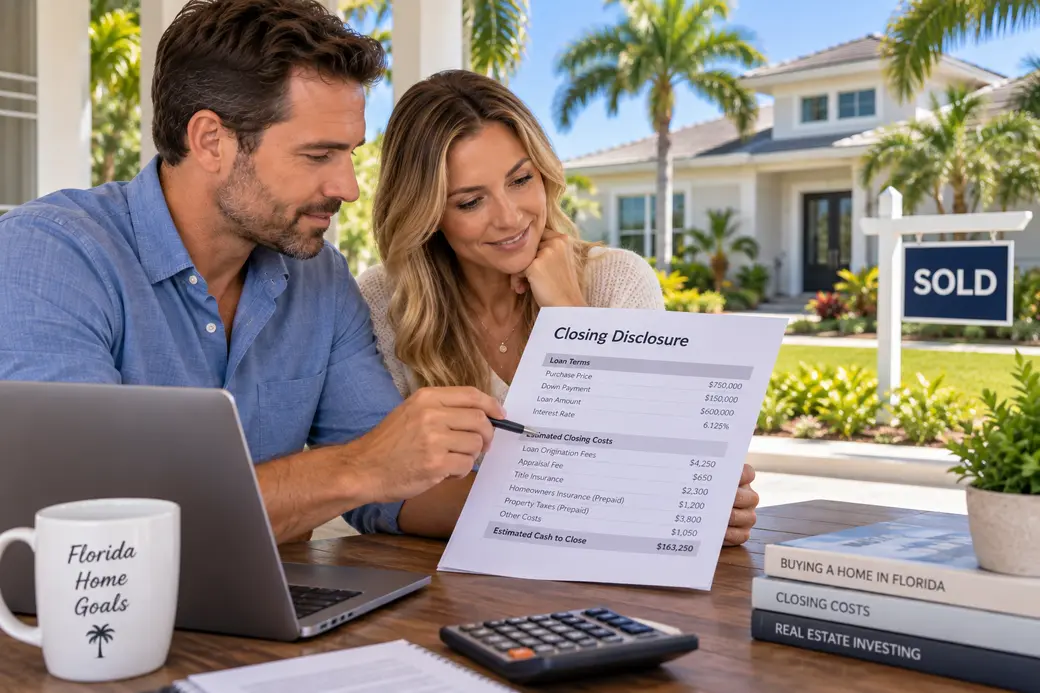
Florida homebuyers can use approximately 2% to 5% of the purchase price as a general planning estimate for closing costs in 2026, excluding the down payment, according to current Consumer Financial Protection Bureau guidance. On a $500,000 home, that broad range equals roughly $10,000 to $25,000. Actual buyer closing costs can be lower or higher depending on the mortgage, lender charges, title arrangements, insurance, prepaid expenses, escrow requirements, property type and purchase contract. For financed Florida purchases, state taxes associated with the mortgage can also affect the total. The most reliable numbers come from the buyer's Loan Estimate, Closing Disclosure and closing professional.
Closing costs are also different from the down payment. A buyer putting 10% down on a $500,000 home is not necessarily bringing only $50,000 to the transaction. Closing costs, prepaid expenses and other adjustments can increase the required funds, while earnest-money deposits, lender credits, negotiated seller concessions and other applicable credits can reduce the amount still due at closing.
Quick Answers About Florida Homebuyer Closing Costs in 2026
How much are typical buyer closing costs in Florida?
For early budgeting, the Consumer Financial Protection Bureau currently says closing costs typically range from about 2% to 5% of the purchase price, not including the down payment. Florida buyers should treat that as a planning range rather than a quote.
How much are closing costs on a $500,000 Florida home?
Using the CFPB's broad 2% to 5% planning range, approximately $10,000 to $25,000. That is an illustration, not a transaction-specific estimate. The actual total depends on financing, lender fees, prepaid expenses, title arrangements, insurance, contract terms and other factors.
Are closing costs separate from the down payment?
Yes. The down payment is the portion of the purchase price the buyer pays rather than finances. Closing costs are transaction and loan-related expenses. Buyers should budget for both.
Does earnest money get added to closing costs?
Earnest money is not normally an additional closing fee. When the transaction closes, deposits already made are generally credited in the calculation of the buyer's remaining funds due, subject to the contract and closing statement.
Can a Florida seller pay some of the buyer's closing costs?
Potentially. Seller concessions can sometimes cover eligible buyer costs when negotiated in the contract, but mortgage programs can limit the amount or types of concessions permitted. Buyers should confirm the structure with their lender and real estate professional before relying on a seller credit.
Who pays for title insurance in Florida?
Do not assume there is one statewide answer for every transaction. The allocation of an owner's title policy, lender's title coverage, searches and closing services can depend on the contract provision selected and other transaction circumstances. Review the signed purchase agreement and closing estimate for the specific property.
When will I know my actual closing costs?
Financed buyers receive a Loan Estimate early in the mortgage process and a Closing Disclosure before closing under applicable federal requirements. Those documents provide far more useful transaction-specific information than a generic percentage estimate.
Is cash to close the same as closing costs?
No. Cash to close is the final amount the buyer needs to provide after accounting for the down payment, closing costs, prepaid expenses, deposits already paid, applicable credits and other transaction adjustments.
What Does the 2% to 5% Closing-Cost Estimate Look Like in Dollars?
Percentages are easier to understand when converted into actual dollars. The examples below use the Consumer Financial Protection Bureau's general 2% to 5% planning range.
| Purchase Price | 2% Estimate | 5% Estimate |
|---|---|---|
| $300,000 | $6,000 | $15,000 |
| $400,000 | $8,000 | $20,000 |
| $500,000 | $10,000 | $25,000 |
| $750,000 | $15,000 | $37,500 |
| $1,000,000 | $20,000 | $50,000 |
These figures are budgeting illustrations, not quotes. A buyer's actual closing costs are driven by the individual transaction. A financed $500,000 purchase with substantial prepaid insurance and escrow funding can look very different from a $500,000 cash purchase.
What Are Florida Buyer Closing Costs?
"Closing costs" is an umbrella term for expenses associated with completing the home purchase and, when applicable, obtaining the mortgage. It is not a single charge paid to one company.
Depending on the transaction, a Florida buyer may encounter:
- Loan origination and lender charges
- Discount points, if selected
- Appraisal charges
- Credit and other loan-related charges
- Title insurance and title-related expenses, depending on the contract
- Closing or settlement services
- Recording charges
- Florida taxes associated with a mortgage when applicable
- Prepaid interest
- Homeowners insurance premiums or prepayments
- Initial property-tax and insurance escrow funding when required
- Association application or transfer charges when applicable
- Survey or elevation-related expenses when applicable
- Other property, loan or transaction-specific expenses
The Florida Realtors/Florida Bar residential contract illustrates why buyers should look at their actual agreement rather than an internet checklist. Its cost provisions identify a variety of buyer expenses and provide alternative arrangements for title-related costs.
What Florida Taxes Can Apply to a Buyer's Mortgage?
Financed Florida purchases can include state taxes associated with the mortgage. These are important because they are based on the amount borrowed rather than simply the purchase price.
Documentary stamp tax on the mortgage
The Florida Department of Revenue states that mortgages and other evidences of indebtedness recorded in Florida are subject to documentary stamp tax at $0.35 per $100, or portion thereof, of the amount secured.
Nonrecurring intangible tax
Florida also imposes a nonrecurring intangible tax on obligations secured by a mortgage or lien on Florida real property. The current rate is 2 mills, calculated by multiplying the applicable secured obligation by 0.002. The Department states that the lender is legally liable for this tax but may pass the amount to the borrower.
For illustration, consider a $500,000 purchase with 20% down and a $400,000 mortgage. Applying the current general rates to a straightforward $400,000 secured obligation would produce approximately $1,400 of mortgage documentary stamp tax and $800 of nonrecurring intangible tax, before considering any transaction-specific issue. That is approximately $2,200 associated with these two Florida mortgage taxes alone.
Tax treatment can depend on the actual documents and transaction. Buyers should verify the amount with their lender, title or closing professional and, where individualized tax advice is necessary, a qualified tax professional.
What About Florida Documentary Stamp Tax on the Deed?
Florida also imposes documentary stamp tax on deeds and other documents transferring an interest in Florida real property. In all Florida counties except Miami-Dade, the current rate is $0.70 per $100 or portion thereof of consideration. Miami-Dade has different rates and a surtax structure for certain transfers.
That does not mean every Florida buyer should automatically add deed documentary stamp tax to the buyer side of an online closing-cost estimate. Who bears particular transaction expenses can depend on the purchase agreement, transaction structure and applicable law. The Department of Revenue notes that parties to a taxable document can be liable for the tax regardless of which party contractually agrees to pay it.
For budgeting, use the allocation shown in the actual purchase contract and closing estimate rather than assuming every Florida tax will appear on the buyer's side.
Did Florida Change These Residential Mortgage Tax Rates in 2026?
The Florida Department of Revenue issued a documentary stamp tax legislative update on July 7, 2026. The published change extends a narrow exemption through June 30, 2028 for certain qualifying non-interest-bearing obligations of $3,500 or less connected with the sale of an alarm system.
That 2026 update does not change the general residential mortgage documentary stamp tax rate discussed above. Buyers should nevertheless rely on the rates and calculations provided by their closing professional for the actual transaction because laws and tax treatment can change.
How Much Do Lender Fees Add to Closing Costs?
Mortgage-related expenses can be a substantial portion of buyer closing costs, but there is no single Florida lender-fee schedule. Charges depend on the lender, loan program, borrower, interest-rate structure and other financing terms.
A Loan Estimate can include origination charges and other loan costs, along with services the borrower may or may not be permitted to shop for. Buyers comparing mortgages should therefore look beyond the advertised interest rate and compare the actual loan costs.
Hunt Brothers Realty's 2026 down-payment guide recommends asking lenders to compare multiple financing scenarios, including estimated closing costs and the amount of cash required at closing.
Mortgage rates, qualification, lender fees and closing costs depend on the individual borrower and loan. Buyers should obtain current Loan Estimates and review financing questions with a qualified mortgage lender or loan professional.
Are Discount Points Part of Closing Costs?
They can be. A buyer may encounter discount points when choosing a mortgage rate structure. Paying points generally means paying additional money upfront in connection with obtaining a particular interest rate.
Whether paying points is financially beneficial depends on the actual cost, rate difference, expected ownership or loan period and the buyer's circumstances. Buyers should ask the lender to show alternatives with and without points rather than assuming the lowest quoted rate has the lowest overall cost.
How Does the Appraisal Affect Florida Closing Costs?
When financing requires an appraisal, the appraisal charge is generally part of the buyer's transaction expenses. The exact fee varies with the property, appraisal assignment and other circumstances.
An appraisal and a home inspection serve different purposes. The appraisal is primarily related to valuation and the lender's collateral requirements. A buyer's inspection is intended to help the buyer understand property condition within the scope of the inspection.
Do not assume paying for one eliminates the need for the other.
Are Home Inspections Included in Closing Costs?
Inspection expenses are part of the broader cash buyers should budget for during a home purchase, although they are commonly paid before the closing date rather than collected as part of the final settlement.
Depending on the property, buyers may consider a general home inspection and specialized evaluations involving a roof, pool, septic system, well, seawall, dock, pests or structural conditions. The appropriate scope depends on the property.
Hunt Brothers Realty's guide to Florida inspection findings explains why material conditions can also affect insurance, financing and the buyer's repair budget.
Inspection findings should be evaluated with the appropriate licensed inspector, contractor, engineer or other qualified professional before a buyer makes a property-specific decision.
How Much Does Title Insurance Add to Florida Buyer Closing Costs?
Title-related costs are one area where generic Florida closing-cost articles can become misleading. The purchase contract can determine which party selects the closing agent and who pays specified owner and lender title-policy expenses.
The Florida Realtors/Florida Bar residential contract includes multiple title arrangements. Depending on the provision selected, the seller may pay certain owner's policy costs, the buyer may pay them, or a regional provision may apply. A financed buyer can also have lender's title-policy and endorsement expenses.
Buyer takeaway: do not estimate title costs based only on what a friend paid in another Florida county. Check the title provision in the actual contract and obtain a transaction-specific estimate from the title or closing professional.
Why Can Homeowners Insurance Increase Cash Needed at Closing?
Insurance is an especially important budgeting issue for Florida buyers because the amount needed before closing may be more than one month's premium. Depending on the financing and policy, buyers may need to pay homeowners insurance in advance and may also need funds to establish an insurance escrow account.
This is one reason two buyers purchasing similarly priced homes can have substantially different cash-to-close figures.
Hunt Brothers Realty's Florida homeowners insurance guide recommends obtaining property-specific quotes early after going under contract rather than waiting until the final days before closing.
Insurance availability, coverage, deductibles, underwriting requirements and premiums can vary substantially by property and applicant. Buyers should obtain property-specific quotes and discuss coverage with a qualified insurance professional before relying on an insurance estimate in a purchasing decision.
What Are Prepaid Expenses and Escrows?
Some of the money due at closing is not a fee for completing the transaction. It may instead represent expenses paid in advance or money placed into an escrow account for future bills.
Depending on the mortgage and closing date, these amounts can include:
- Prepaid mortgage interest
- Homeowners insurance paid in advance
- Initial homeowners insurance escrow deposits
- Initial property-tax escrow deposits
- Other applicable prepaid or escrow items
Because these amounts depend partly on timing, insurance premiums, taxes and loan requirements, they can change the final cash-to-close figure even when lender fees remain similar.
What Closing Costs Can Condo and HOA Buyers Encounter?
Buying within a condominium or homeowners association can introduce additional transaction expenses. Depending on the community and contract, these can include application charges, transfer charges or other association-related amounts.
Those transaction costs are separate from the more important long-term question of the association's recurring assessments and possible special assessments. A buyer should distinguish between what is due once at closing and what will continue after ownership begins.
Association charges, approval requirements, assessments and financial obligations vary. Buyers should review current association information and verify property-specific requirements with the association, closing professional and appropriate legal or financial professionals when necessary.
Does a Cash Buyer Still Have Closing Costs in Florida?
Yes, although the cost structure is different. A cash buyer avoids mortgage origination charges, lender appraisal requirements, lender's title coverage and Florida taxes associated with creating a new mortgage.
A cash transaction can still involve title expenses, closing services, inspections, recording charges, survey expenses, association charges, insurance and other property or contract-specific costs.
Therefore, "no mortgage" should not be interpreted as "no closing costs."
Can Seller Concessions Reduce a Florida Buyer's Closing Costs?
Potentially. Instead of negotiating only the purchase price, a buyer may sometimes negotiate for the seller to contribute toward eligible closing expenses.
For a buyer who is more constrained by upfront cash than monthly payment, an acceptable seller concession can sometimes be more useful than an equivalent nominal price reduction. But that depends on the loan and transaction.
Mortgage programs can limit seller contributions and determine which costs can be paid with them. Appraisal and underwriting considerations can also matter. Buyers should have their lender confirm that a proposed concession works with the intended financing before making the offer dependent on it.
Are Earnest Money and Closing Costs the Same Thing?
No. Earnest money is a deposit made in connection with the purchase agreement. Closing costs are expenses associated with completing the purchase and, when applicable, obtaining financing.
When the transaction closes, the buyer's deposit is generally accounted for as a credit toward the funds required for the transaction. This distinction is explained in more detail in Hunt Brothers Realty's earnest money vs. down payment guide.
For example, a buyer who has already placed $10,000 in escrow generally does not simply add another $10,000 to the closing-day total as though that money had never been paid. The closing statement accounts for applicable deposits and credits.
Closing Costs vs. Cash to Close: What Is the Difference?
This distinction is essential when planning a Florida home purchase.
Closing costs are the expenses associated with completing the transaction and obtaining financing.
Cash to close is the net amount the buyer must provide to complete the purchase after all applicable components and credits are calculated.
The calculation can include:
- Down payment
- Closing costs
- Prepaid expenses
- Escrow funding
- Property-tax and other transaction adjustments
- Earnest-money deposits already paid
- Seller concessions when applicable
- Lender credits when applicable
- Other credits or adjustments
This is why buyers should ask, "How much cash will I actually need to close?" rather than focusing only on the closing-cost percentage.
How Much Cash Might a Buyer Need on a $500,000 Florida Home?
Consider a purely hypothetical buyer purchasing a $500,000 Florida home with 10% down.
- Purchase price: $500,000
- 10% down payment: $50,000
- Broad 2% to 5% closing-cost planning range: $10,000 to $25,000
That suggests an early planning figure of approximately $60,000 to $75,000 for the down payment plus closing costs before considering how deposits, seller or lender credits, prorations and other adjustments affect the final amount.
It also does not mean the buyer should plan to use every remaining dollar at closing. Moving expenses, repairs, furnishings and financial reserves still matter. Hunt Brothers Realty's down-payment guide explains why preserving adequate cash after closing can be an important part of the financing decision.
How Can Florida Buyers Estimate Closing Costs More Accurately?
The 2% to 5% range is most useful before the buyer has chosen a specific property and lender. Once the search becomes serious, replace percentages with actual numbers.
- Ask the lender for a detailed Loan Estimate. Review origination charges, points, third-party services, prepaid items and estimated cash to close.
- Check the purchase contract. Identify which party is responsible for title-related expenses and other negotiated costs.
- Get homeowners insurance quotes early. Do not budget using the seller's premium or a generic estimate.
- Budget separately for inspections. Some are paid before closing and may not appear in the final amount due.
- Identify association charges. Condo and HOA purchases can have application, transfer or other transaction-specific expenses.
- Track your earnest-money deposit. Make sure deposits already paid are properly reflected in the transaction calculations.
- Review the Closing Disclosure carefully. Compare the final figures with earlier estimates and ask about changes you do not understand.
What Closing-Cost Questions Should You Ask Your Florida Lender?
- What are my estimated total loan costs?
- Am I paying discount points?
- Are there lender credits?
- What appraisal and other third-party charges should I expect?
- What Florida mortgage taxes are included?
- How much prepaid interest is estimated?
- How much will be collected for insurance and tax escrows?
- How would another down-payment amount change my costs?
- What seller concessions are permitted with this loan?
- What is my current estimated cash to close?
Mortgage terms and qualification are borrower-specific. A qualified mortgage professional should explain how each cost applies to the buyer's actual loan.
What Should You Ask Your Florida Closing or Title Professional?
- Which title provision applies under my purchase contract?
- Which title and closing charges am I responsible for?
- What recording charges apply?
- What Florida taxes appear on my side of the closing statement?
- Are there association or other property-specific charges?
- How are property taxes and other expenses being prorated or adjusted?
- Has my earnest-money deposit been credited correctly?
- What is the final amount I must provide, and what are the verified instructions for delivering those funds?
Do Not Budget Every Dollar for the Down Payment
One of the most useful closing-cost lessons comes before a buyer ever signs a contract. If you have $100,000 available for a home purchase, that does not necessarily mean you have $100,000 available for the down payment.
The CFPB recommends first considering the cash that should remain available for moving, renovations, furnishings, other savings goals and an emergency cushion, then estimating closing costs before deciding the maximum down payment.
That approach is particularly relevant in Florida, where buyers may also need to investigate property-specific insurance, storm-related considerations, association expenses and immediate maintenance.
The Best Closing-Cost Estimate Is Property and Loan Specific
For a Florida homebuyer in 2026, 2% to 5% of purchase price remains a useful early planning range for closing costs, excluding the down payment. But it should be the beginning of the calculation, not the end.
Once you identify a home and financing option, replace the percentage estimate with the lender's Loan Estimate, insurance quotes, title or closing estimate, association information and your actual purchase contract. Then distinguish closing costs from the broader cash-to-close figure.
That gives you a much clearer answer to the question that matters most: how much money will you actually need to complete this particular Florida home purchase while still maintaining an appropriate financial cushion afterward?
Plan Your Florida Home Purchase With Hunt Brothers Realty
Hunt Brothers Realty helps buyers navigate Florida Gulf Coast home purchases from property search and offer strategy through inspections and closing. Buyers preparing a budget can also read how much to put down on a house, understand the difference between earnest money and a down payment, learn when to shop for Florida homeowners insurance, or explore Florida Gulf Coast communities.
Informational notice: This article provides general real estate and educational information and is not individualized financial, lending, tax, insurance, title or legal advice. Closing costs, taxes, loan charges, title expenses, insurance, credits and cash-to-close requirements vary by buyer, property, mortgage, contract and transaction. Buyers should review their actual Loan Estimate, Closing Disclosure and purchase agreement and verify transaction-specific figures with the appropriate mortgage lender, title or closing professional, insurance agent, tax professional or Florida real estate attorney when individualized guidance is required.
Sources
- Consumer Financial Protection Bureau, Figure Out How Much You Want to Spend
- Consumer Financial Protection Bureau, Determine Your Down Payment and Estimate Closing Costs
- Florida Department of Revenue, Documentary Stamp Tax
- Florida Department of Revenue, Nonrecurring Intangible Tax
- Florida Department of Revenue, Documentary Stamp Tax 2026 Legislative Change
- Florida Realtors/Florida Bar, Residential Contract for Sale and Purchase Cost Provisions
- Hunt Brothers Realty, How Much Should You Put Down on a House?
- Hunt Brothers Realty, Earnest Money vs. Down Payment
- Hunt Brothers Realty, When Should Florida Home Buyers Shop for Homeowners Insurance?
Contact Hunt Brothers Realty
Hunt Brothers Realty
46 N. Washington Blvd, Ste 3
Sarasota, FL 34236
Phone: (941) 388-7017
Email: info@huntbrothersrealty.com
Website: HuntBrothersRealty.com
Categories
- All Blogs 1406
- Anna Maria Island 66
- Bird Key 3
- Bradenton 44
- Buying a Home 562
- Casey Key 2
- Clearwater 5
- Condos & HOA Living 472
- Ellenton 4
- Englewood 5
- First Time Homebuyers 634
- Foreclosures 3
- Homeownership 610
- Lakewood Ranch 15
- Lido Key 24
- Longboat Key 65
- Luxury/Waterfront Properties 548
- Market Updates & Trends 276
- Mortgages & Financing 27
- Move-Up Buyers 20
- Neighborhood Guides 416
- New Construction 21
- Palmetto 2
- Parrish 4
- Port Charlotte 7
- Punta Gorda 11
- Real Estate Investing 481
- Relocation to Florida 532
- Safety Harbor 2
- Sarasota - Downtown 110
- Selling a Home 134
- Siesta Key 87
- St. Petersburg 3
- Tierra Verde 3
- Vacation & Second Homes 665
- Venice 20
- Wellen Park 7
Recent Posts