
Florida Property Taxes After Buying a Home: Why the Seller’s Tax Bill Can Be Misleading
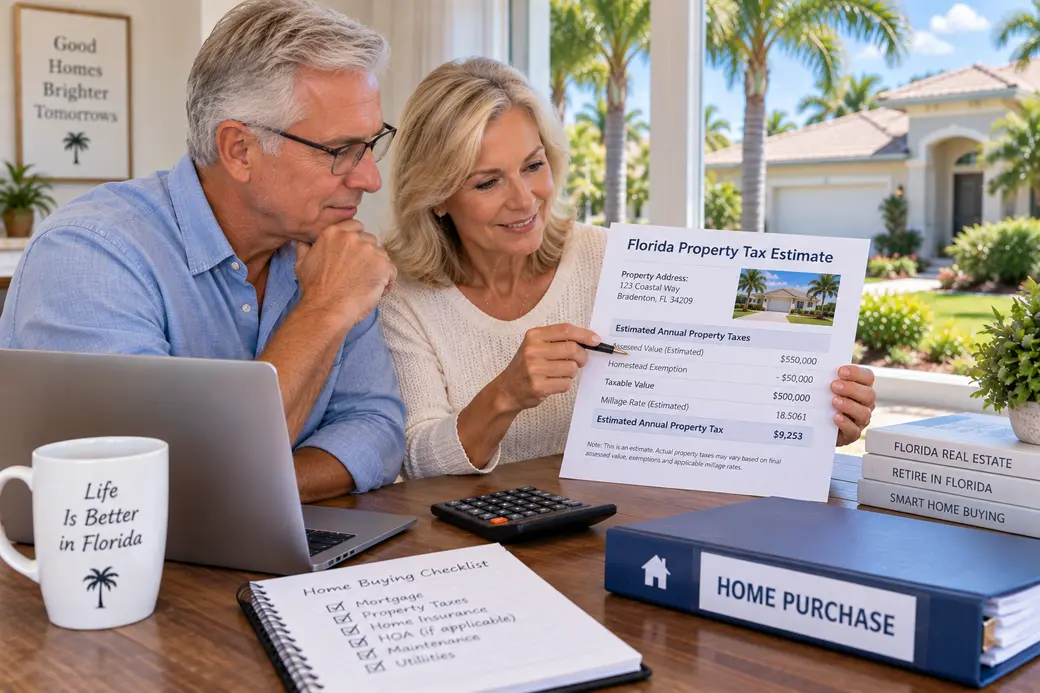
The property taxes a Florida seller pays today may be very different from what a buyer pays after purchasing the home. A longtime owner may have a substantially reduced assessed value because of the Homestead Exemption and years of Save Our Homes assessment limitations. After a qualifying change of ownership, Florida generally reassesses the property at just value as of January 1 of the following year. The buyer can apply for any exemptions and portability benefits for which the buyer qualifies, but the seller’s accumulated tax benefits do not simply transfer with the house. For that reason, buyers should estimate future taxes rather than building their budget around the seller’s current tax bill.
This can be one of the more important budgeting issues when buying a home on Florida’s Gulf Coast. The difference can be especially noticeable when purchasing from someone who has owned and homesteaded a property for many years.
Quick Answers About Florida Property Taxes After Buying a Home
Will I pay the same property taxes as the seller?
Not necessarily. The seller may have exemptions and an accumulated Save Our Homes assessment benefit that reduce the property’s taxable value. A qualifying change of ownership can cause the property to be reassessed, making the buyer’s future tax bill different.
When is a Florida home reassessed after a sale?
Florida law generally provides that homestead property is assessed at just value as of January 1 of the year following a qualifying change of ownership. Specific transfers can be treated differently under Florida law, so unusual ownership situations should be verified with the county property appraiser and appropriate legal or tax professionals.
Does the seller’s Homestead Exemption transfer to the buyer?
No. The buyer must qualify for and apply for the buyer’s own Homestead Exemption. Florida’s Homestead Exemption can reduce taxable value for qualifying permanent residences, but eligibility is based on the new owner’s circumstances.
What is Save Our Homes?
Save Our Homes is Florida’s assessment limitation for qualifying homestead property. After the benefit applies, annual increases in assessed value are generally limited to the lower of 3 percent or the applicable Consumer Price Index change, subject to Florida law.
Can I transfer my Save Our Homes benefit to a new Florida home?
Potentially. Eligible Florida homeowners may be able to transfer, or “port,” some or all of their own accumulated Save Our Homes assessment difference from a previous Florida homestead to a new Florida homestead. Portability is separate from the seller’s tax history and requires the buyer to meet applicable requirements.
Does the purchase price automatically become the new assessed value?
Do not assume that the county simply copies the purchase price onto the tax roll. Florida property appraisers determine just value under applicable law. A recent arm’s-length sale can be relevant evidence of market value, but buyers should use the county property appraiser’s property-specific estimate rather than assuming purchase price and assessed value will always be identical.
How should I estimate property taxes before buying?
Start with the appropriate county property appraiser rather than the seller’s existing bill. Use available tax-estimator tools where offered and account for the buyer’s expected ownership status, possible exemptions and potential portability. Consult a qualified tax professional when individualized tax consequences affect the purchasing decision.
Why Can the Seller’s Florida Property Tax Bill Be So Misleading?
Florida’s property tax system distinguishes among a property’s just value, assessed value and taxable value. Those numbers can be substantially different.
The Florida Department of Revenue explains the basic relationship this way:
- Just value generally reflects the property’s market value as determined for property-tax purposes.
- Assessed value reflects just value after applicable assessment limitations.
- Taxable value reflects assessed value after applicable exemptions.
- Property tax liability then depends on taxable value and the applicable taxing authorities and rates.
A seller who has owned a homesteaded Florida property for many years may have an assessed value significantly below its current just value because Save Our Homes has limited annual increases in assessed value.
That history belongs to the seller’s ownership situation. A buyer should not assume the same assessed value will continue after the transaction.
What Happens to the Assessed Value When a Florida Home Is Sold?
Under Florida Statute 193.155, homestead property is generally assessed at just value as of January 1 of the year following a qualifying change of ownership. Florida law contains exceptions for certain transfers, so the rule should not be applied mechanically to unusual ownership changes.
For a conventional home purchase, however, the practical buyer lesson is straightforward: the previous owner’s capped assessed value generally should not be used as the buyer’s future assessed value.
The Florida Department of Revenue specifically warns first-time Florida homebuyers that they can be surprised when their property taxes become higher than those of the previous owner after reassessment.
Why Does Save Our Homes Create Such a Big Difference?
Save Our Homes can create a growing difference between a homesteaded property’s just value and assessed value over a long period of ownership.
Once the limitation applies, Florida law generally limits annual increases in the assessed value of qualifying homestead property to the lower of:
- 3 percent of the previous year’s assessed value, or
- The applicable percentage change in the Consumer Price Index.
Suppose a homeowner purchased many years ago and the property’s market value increased considerably during that ownership. Save Our Homes may have prevented the assessed value from increasing as rapidly as the property’s just value.
The result can be a tax bill based on an assessed value far below what a new buyer might encounter after a qualifying ownership change.
An Example of Why the Seller’s Tax Bill Can Understate a Buyer’s Future Taxes
Consider a simplified hypothetical example. The figures below illustrate the concept only and are not a property-tax calculation for a particular Florida home.
| Property Tax Factor | Longtime Seller | New Buyer |
|---|---|---|
| Current market environment | Home has appreciated during years of ownership | Buyer acquires property at current market conditions |
| Assessed value | May reflect years of Save Our Homes limitations | Generally reset to just value following a qualifying ownership change |
| Homestead Exemption | Seller may currently qualify | Buyer must separately qualify and apply |
| Save Our Homes benefit | May have accumulated over many years | Seller’s accumulated benefit does not simply remain with the property |
| Portability | Depends on seller’s next homestead and eligibility | Buyer may have a separate portability benefit from the buyer’s prior Florida homestead |
This is why two people can own the same property in consecutive years yet face substantially different property-tax circumstances.
Does the Seller’s Tax Situation Continue During the Year You Buy?
There is an important timing issue that can make the first year particularly confusing.
The Florida Department of Revenue’s Property Tax Information for First-Time Florida Homebuyers explains that the previous owner’s exemption and Save Our Homes benefit remain with the property for the remainder of the tax calendar year in which the home is purchased.
That means the tax information surrounding the year of purchase can still reflect the previous owner’s tax position. The reassessment associated with the ownership change generally takes effect the following January 1.
Buyer takeaway: seeing the seller’s existing tax bill, or even a first closing-year tax amount connected to that assessment, does not mean that amount is a reliable forecast of future annual taxes.
What Is Florida’s Homestead Exemption?
Florida provides property-tax benefits for qualifying owners who make a property their permanent residence.
The Florida Department of Revenue’s property-tax exemption guidance explains that eligible homeowners may receive a Homestead Exemption that reduces taxable value. The exemption can reduce taxable value by as much as $50,000 under the applicable structure, although not every portion applies to every taxing authority.
The exemption is tied to the qualifying homeowner and permanent residence. Buying a home that the seller homesteaded does not automatically give the buyer the seller’s exemption.
For a more detailed explanation of qualification, timing and filing, see Hunt Brothers Realty’s Florida Homestead Exemption 2026 Guide.
When Does a New Florida Homeowner Apply for Homestead Exemption?
Homestead qualification is tied to ownership and permanent residency as of January 1 for the applicable tax year, with applications handled by the county property appraiser.
For example, a buyer who closes during 2026 and owns and occupies the home as a qualifying permanent residence on January 1, 2027 may be eligible to apply for the 2027 Homestead Exemption, assuming all requirements are satisfied.
Application deadlines and individual eligibility matter. Buyers should confirm the current filing requirements directly with the property appraiser in the county where the home is located.
What Is Save Our Homes Portability?
Portability can be particularly important for someone who is selling one Florida homestead and purchasing another.
The seller’s accumulated Save Our Homes benefit does not transfer to the buyer. However, the buyer may bring the buyer’s own eligible Save Our Homes assessment difference from a previous Florida homestead.
The Florida Department of Revenue explains that eligible homeowners may transfer, or “port,” all or part of their homestead assessment difference to a new Florida homestead. Portability can reduce the assessed value of the new homestead compared with what it otherwise would be.
The amount available and resulting tax effect depend on the buyer’s prior homestead, new property, timing and eligibility. Buyers should have their potential portability calculated or estimated by the appropriate county property appraiser rather than assuming a particular dollar savings.
Is Portability the Same as Transferring the Homestead Exemption?
No. These concepts are related but different.
Florida Department of Revenue guidance states that a homeowner cannot simply transfer the Homestead Exemption itself from one property to another. The owner applies for Homestead Exemption on the new qualifying residence.
What an eligible homeowner may be able to transfer is all or part of the Save Our Homes assessment difference. That transfer is what Florida refers to as portability.
Does the Purchase Price Determine the New Property Tax Bill?
Not by itself.
Florida property appraisers determine just value under state law. A recent arm’s-length sale can provide important evidence of market value, but buyers should not assume that a $700,000 purchase automatically creates exactly $700,000 of assessed value and then multiply that number by a tax rate.
The actual tax calculation can involve:
- The property appraiser’s just value
- Applicable assessment limitations
- Homestead or other exemptions
- Portability when applicable
- Taxing district and millage rates
- Other applicable property-specific assessments
For budgeting purposes, a county tax estimator is more useful than assuming either the seller’s bill or a simple percentage of purchase price will be exact.
Why Can Two Similar Florida Homes Have Very Different Tax Bills?
Two neighboring homes with similar market values can have very different property-tax bills because their ownership and assessment histories may be different.
For example:
- Owner A may have homesteaded the property for 20 years.
- Owner B may have purchased a similar home recently.
- One owner may qualify for additional exemptions.
- One owner may have brought a portability benefit from another Florida homestead.
- The properties may fall within different taxing or special-assessment circumstances.
This makes a neighbor’s tax bill an unreliable shortcut for estimating what a buyer will owe.
What If the Home Will Be a Second Home or Investment Property?
The tax analysis changes when the property will not qualify as the buyer’s permanent Florida residence.
A vacation home, seasonal residence or investment property generally does not receive the Homestead Exemption merely because the owner owns property in Florida.
Florida also has separate assessment rules for nonhomestead residential property. Under current Florida Statute 193.1554, qualifying nonhomestead residential property is subject to a different assessment limitation for non-school levies, and a qualifying change of ownership generally triggers assessment at just value.
Buyers considering a seasonal or vacation property can review Hunt Brothers Realty’s Florida second-home buyer guidance, which also emphasizes estimating future taxes from the buyer’s expected ownership rather than the seller’s current bill.
How Should Sarasota Buyers Estimate Future Property Taxes?
For a Sarasota County property, start with the Sarasota County Property Appraiser. Review the specific parcel and available tax information, but remember that historical assessments belong to the property’s prior ownership circumstances.
A buyer’s estimate should consider:
- Expected post-purchase reassessment
- Whether the property will become the buyer’s permanent residence
- Potential Homestead Exemption eligibility
- Potential Save Our Homes portability
- The applicable taxing district
- Current and future millage rates, which can change
- Applicable non-ad valorem assessments
The final future tax bill cannot be guaranteed at the time of purchase because assessed values, exemptions, taxing-authority budgets and rates can change.
How Should Manatee County Buyers Estimate Property Taxes?
The Manatee County Property Appraiser provides tax-estimating guidance specifically addressing the variables that can affect a new owner’s property taxes.
The office notes that modern tax estimates can depend on the property, market conditions, exemptions, Save Our Homes portability and the assessment limitations applicable to the owner. For someone who has recently purchased or is considering a specific Manatee County property, the Property Appraiser provides a tax-estimator option through parcel details.
This is much more useful than looking at the seller’s bill and assuming the buyer’s future taxes will be approximately the same.
Can a Property Tax Increase Change Your Monthly Mortgage Payment?
Potentially, particularly when property taxes are paid through a mortgage escrow account.
A buyer may focus on principal and interest when comparing homes, but the total housing payment can also include escrowed property taxes and insurance. If the actual tax bill after reassessment is higher than the amount initially collected through escrow, the lender’s later escrow analysis can affect the required monthly payment or create an escrow shortage.
Buyers using financing should discuss estimated taxes and escrow assumptions with their mortgage professional before relying on a projected monthly payment.
Why Property Taxes Should Be Part of Your Total Ownership Budget
A home’s affordability should not be evaluated from the mortgage principal and interest alone.
Depending on the property, a Florida buyer may need to budget for:
- Mortgage principal and interest
- Property taxes based on the buyer’s expected ownership circumstances
- Homeowners insurance
- Flood insurance when applicable
- HOA or condominium assessments when applicable
- CDD assessments when applicable
- Maintenance and repairs
- Pool and landscaping costs when applicable
- Utilities
- Long-term capital expenses
This total-cost approach is especially useful when comparing two homes with different tax histories. The property showing the lower current tax bill may not remain the lower-tax option after both properties are evaluated under the buyer’s circumstances.
Should You Compare Homes Using Their Current Property Tax Bills?
Current tax bills provide useful historical information, but they should not be the primary comparison.
Imagine two similar homes:
- Home A has been owned and homesteaded by the same owner for 25 years.
- Home B changed ownership much more recently.
Home A could display a dramatically lower current tax bill even though both homes have similar current market values. That does not necessarily mean Home A will cost the buyer less in property taxes after the next reassessment.
Compare estimated buyer taxes with estimated buyer taxes, not seller taxes with seller taxes.
What Should Buyers Ask Before Making an Offer?
- What is the property’s current just, assessed and taxable value?
- Does the current owner have a Homestead Exemption?
- Is there a significant difference between current just value and assessed value?
- What might the property tax look like after a qualifying change of ownership?
- Will I use the home as my permanent residence, second home or investment property?
- Might I qualify for Homestead Exemption?
- Do I have an eligible Save Our Homes portability benefit from another Florida homestead?
- Are there non-ad valorem or other property-specific assessments I need to include?
- What tax amount is my lender using when estimating my monthly escrow payment?
Common Florida Property Tax Mistakes Buyers Should Avoid
Mistake 1: Copying the seller’s tax bill into your future budget
The seller’s exemptions and assessment history may make that number inappropriate for the buyer.
Mistake 2: Assuming Homestead automatically transfers
The buyer needs to independently qualify and apply for Homestead Exemption.
Mistake 3: Confusing Homestead Exemption with portability
Homestead Exemption and Save Our Homes portability are related but separate benefits.
Mistake 4: Assuming purchase price equals the final assessed value
The property appraiser determines just value under Florida law. Use a property-specific county estimate rather than treating the purchase price as an exact tax assessment.
Mistake 5: Ignoring taxes because the lender gave you a payment estimate
Ask what property-tax assumption was used. A payment estimate based on historical taxes can change when the property is reassessed and the escrow account is updated.
Mistake 6: Treating a tax estimate as a guarantee
Property values, exemptions, millage rates and other assessments can change. A pre-purchase calculation is a budgeting tool, not a guaranteed future tax bill.
The Bottom Line for Florida Homebuyers
The seller’s property tax bill tells you what the property costs under the seller’s current assessment and exemption circumstances. It does not necessarily tell you what the same property will cost under yours.
A qualifying ownership change generally causes the property to be reassessed at just value as of the following January 1. The seller’s Homestead Exemption and accumulated Save Our Homes benefit do not simply transfer to the buyer. A qualifying buyer can apply for a new Homestead Exemption and may separately qualify to port some or all of the buyer’s own Save Our Homes assessment difference from a previous Florida homestead.
Before deciding what a Florida home fits into your budget, estimate taxes using the specific property, expected ownership use, possible exemptions and portability rather than relying on the seller’s current bill.
Buying a Home in Sarasota or Florida’s Gulf Coast?
Hunt Brothers Realty helps buyers evaluate more than the asking price when comparing Florida Gulf Coast homes. Property taxes, insurance, association expenses, condition, location and long-term ownership considerations can all affect the real cost of a property. Buyers can review the Florida Homestead Exemption 2026 Guide, read the 2026 First-Time Homebuyer Guide, or explore Sarasota-area and Florida Gulf Coast communities.
Informational notice: This article provides general real estate and educational information and is not individualized tax, legal, financial, lending or accounting advice. Property-tax assessments, exemptions, portability, millage rates, non-ad valorem assessments and resulting tax liabilities depend on the specific property, owner, taxing jurisdiction and applicable law. Buyers should obtain property-specific information from the appropriate county property appraiser, review mortgage and escrow estimates with their lender, and consult a qualified tax professional or CPA regarding their individual tax circumstances. Questions involving ownership, title or legal rights should be reviewed with a qualified Florida real estate attorney or other appropriate legal professional.
Sources
- Florida Department of Revenue, Property Tax Information for First-Time Florida Homebuyers
- Florida Department of Revenue, Property Tax Exemptions and Additional Benefits
- Florida Department of Revenue, Property Tax Information for Taxpayers
- Florida Department of Revenue, Homestead Assessment Difference and Portability
- Florida Legislature, Florida Statute 193.155, Homestead Assessments
- Florida Legislature, Florida Statute 193.1554, Nonhomestead Residential Property
- Manatee County Property Appraiser, Estimating Your Taxes
- Sarasota County Property Appraiser
- Hunt Brothers Realty, Florida Homestead Exemption 2026 Guide
- Hunt Brothers Realty, Older Florida Home vs. New Construction
Contact Hunt Brothers Realty
Hunt Brothers Realty
46 N. Washington Blvd, Ste 3
Sarasota, FL 34236
Phone: (941) 388-7017
Email: info@huntbrothersrealty.com
Website: HuntBrothersRealty.com
Categories
- All Blogs 1406
- Anna Maria Island 66
- Bird Key 3
- Bradenton 44
- Buying a Home 562
- Casey Key 2
- Clearwater 5
- Condos & HOA Living 472
- Ellenton 4
- Englewood 5
- First Time Homebuyers 634
- Foreclosures 3
- Homeownership 610
- Lakewood Ranch 15
- Lido Key 24
- Longboat Key 65
- Luxury/Waterfront Properties 548
- Market Updates & Trends 276
- Mortgages & Financing 27
- Move-Up Buyers 20
- Neighborhood Guides 416
- New Construction 21
- Palmetto 2
- Parrish 4
- Port Charlotte 7
- Punta Gorda 11
- Real Estate Investing 481
- Relocation to Florida 532
- Safety Harbor 2
- Sarasota - Downtown 110
- Selling a Home 134
- Siesta Key 87
- St. Petersburg 3
- Tierra Verde 3
- Vacation & Second Homes 665
- Venice 20
- Wellen Park 7
Recent Posts