
How Do I Choose the Right Mortgage Lender?
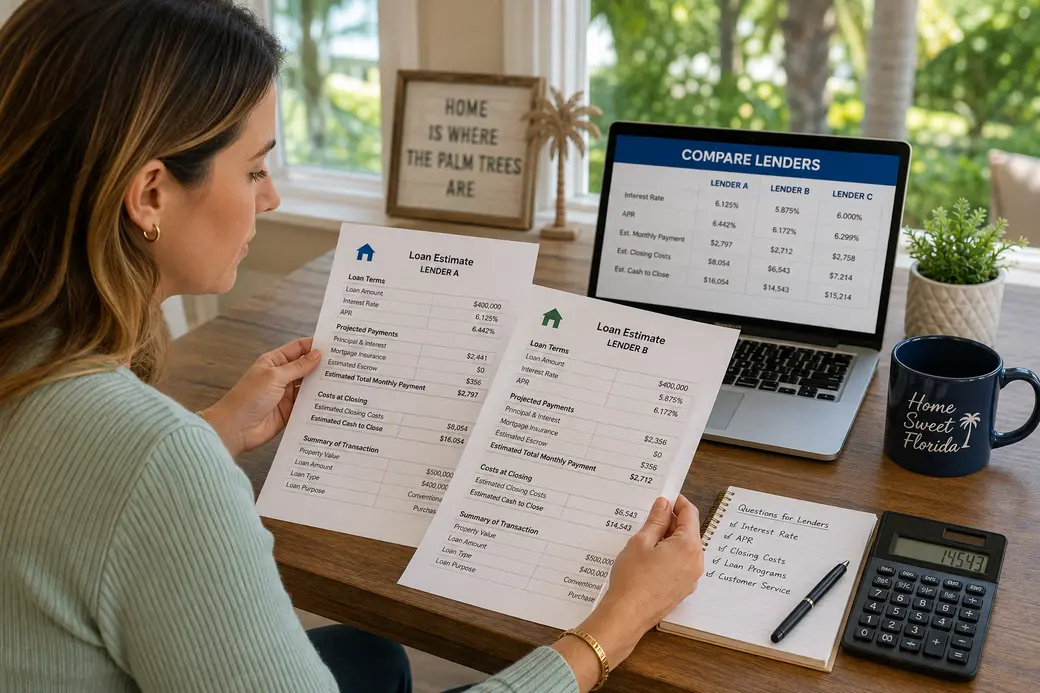
Choose a mortgage lender by comparing more than the advertised interest rate. Ask multiple lenders to price the same type of loan, then compare their Loan Estimates, APRs, lender-controlled fees, points or credits, projected payments and cash needed at closing. Also evaluate whether the loan officer explains your options clearly, responds promptly and can realistically meet your purchase contract's deadlines. The Consumer Financial Protection Bureau recommends comparing at least three loan offers. The right lender is the one offering a competitive loan for your circumstances together with the communication and execution your transaction requires.
Quick Answers About Choosing the Right Mortgage Lender
How many mortgage lenders should I compare?
The Consumer Financial Protection Bureau recommends comparing at least three loan offers from different lenders. Freddie Mac recommends getting quotes from three to five lenders. Comparing multiple offers can reveal meaningful differences in rates, fees and loan structures.
Should I choose the lender with the lowest mortgage rate?
Not automatically. A lower rate may involve points or other costs, and two lenders can structure the same mortgage differently. Compare the rate together with APR, lender fees, points or credits, monthly payment, cash to close and the length of time you expect to keep the loan.
What is the best document for comparing mortgage lenders?
The standardized Loan Estimate is one of the most useful comparison tools. It shows important information about the proposed mortgage, including the estimated interest rate, monthly payment and closing costs, and its standardized format makes competing offers easier to compare.
Is a mortgage broker the same as a lender?
No. A lender provides the mortgage funds, while a mortgage broker generally works with borrowers and lenders to identify available loan options. Buyers can compare banks, credit unions, mortgage companies, nonbank lenders and mortgage brokers rather than limiting the search to one type of provider.
Does the mortgage lender matter if the rate is the same?
Yes. The CFPB identifies factors such as your comfort with the loan officer's ability to answer questions and your confidence that the lender can meet the closing timeframe as relevant considerations. Communication and execution can matter significantly once a purchase is under contract.
Should I get preapproved before looking at homes?
A mortgage preapproval can help a financed buyer better understand the lender's preliminary assessment of borrowing capacity and prepare for a home search. Preapproval is not final loan approval, and the actual property, underwriting, appraisal and other requirements can still affect financing.
Start by Comparing More Than One Mortgage Lender
One of the most important decisions you can make is not choosing the first lender you contact.
Mortgage lenders can offer different interest rates, lender fees, credits and loan options to the same borrower. Shopping therefore gives you information that you cannot obtain from a single quote.
The CFPB's mortgage-shopping guidance recommends making it a goal to compare at least three loan offers. Freddie Mac's mortgage comparison guidance recommends quotes from three to five lenders.
Your comparison might include a bank, credit union, mortgage company, nonbank lender or mortgage broker. The objective is not to collect as many quotes as possible. It is to obtain enough comparable information to understand your choices.
Compare the Same Mortgage at Approximately the Same Time
A mortgage comparison becomes misleading when you compare different products or quotes obtained under materially different market conditions.
Mortgage rates can change frequently. Freddie Mac recommends comparing loans on the same day when practical. The CFPB also advises borrowers to ask each lender for the same kind of loan with the same features so the comparison is as close to apples-to-apples as possible.
For example, comparing a 30-year fixed conventional mortgage with no discount points from one lender against a 30-year fixed loan carrying substantial points from another does not tell you which lender is cheaper simply by looking at the interest rates.
Use the Loan Estimate to Compare Offers
The Loan Estimate was designed to make mortgage shopping easier.
According to the Consumer Financial Protection Bureau, the Loan Estimate is a standardized three-page form containing important information about the mortgage you requested. For covered mortgages, a lender generally must provide it within three business days after receiving the information constituting your application for purposes of the Loan Estimate requirement.
Because lenders use the same standardized form, you can place competing Loan Estimates side by side and examine the differences more systematically.
What should you compare on a Loan Estimate?
Pay attention to:
- Loan amount
- Interest rate
- Whether the rate is fixed or adjustable
- Monthly principal and interest
- Mortgage insurance when applicable
- Estimated total monthly payment
- Origination charges
- Discount points when applicable
- Lender credits when applicable
- Estimated closing costs
- Estimated cash to close
- APR
- Whether the loan contains features such as a prepayment penalty
The CFPB provides an interactive Loan Estimate explainer that buyers can use to understand the individual sections of the form.
Do Not Choose a Mortgage Based Only on the Interest Rate
The interest rate matters, but it does not tell you the complete cost of a mortgage.
A lender may quote a lower rate that requires you to pay discount points upfront. Another lender might quote a somewhat higher rate with lower upfront lender costs. A third might offer lender credits in exchange for a different rate structure.
That is why a rate should always be considered together with the costs required to obtain it.
| Mortgage Detail | Why It Matters |
|---|---|
| Interest rate | Affects principal and interest payments and borrowing cost |
| APR | Provides another measure for comparing the yearly cost of credit, incorporating the interest rate and certain loan charges |
| Points | Can increase upfront cost in exchange for a particular interest rate |
| Lender credits | Can reduce upfront closing costs but may be associated with a higher interest rate |
| Origination charges | Help show costs directly associated with obtaining the loan |
| Cash to close | Shows the estimated amount needed at closing after applicable calculations and credits |
APR Can Help, but It Does Not Replace the Full Comparison
APR, or annual percentage rate, can be useful when comparing mortgage offers because it incorporates the interest rate along with certain points, broker fees and other charges into a yearly cost measure.
However, borrowers should still review the actual fees, rate, monthly payment and loan features rather than choosing solely on APR. The usefulness of any comparison depends on comparing similar loan structures and understanding how long you expect to keep the mortgage.
A qualified mortgage professional can explain how different loan structures affect your particular borrowing costs and payments.
Separate Lender Costs From Property Costs
One of the easiest mistakes when comparing Loan Estimates is assuming that every difference comes from the lender.
It does not.
The CFPB notes that lenders do not control costs such as property taxes and homeowners insurance. Government charges, prepaid items and initial escrow amounts may also require closer examination before treating one lender's estimate as less expensive than another.
When two estimates show noticeably different taxes or insurance for the same property, ask why rather than assuming the lender showing the lower estimate has offered a better mortgage.
Ask Which Loan Programs the Lender Can Offer You
The right lender is also connected to the right loan program for your circumstances.
Depending on borrower and property eligibility, mortgage options can include conventional, FHA, VA, USDA and other specialized programs. Individual lenders may not offer every program, and qualification requirements differ.
Instead of asking only, "What is your best rate?" consider asking, "Which loan options am I eligible for, and how do their costs, down payments and monthly payments compare for my situation?"
Buyers who assume a large down payment is always required can also review Hunt Brothers Realty's guide to home-buying down payments. Actual down-payment requirements and program eligibility should be confirmed with qualified mortgage professionals.
A Good Loan Officer Should Be Able to Explain the Tradeoffs
Mortgage financing involves choices. A useful loan officer should be able to explain those choices in language you understand.
Consider asking:
- Is this interest rate fixed or adjustable?
- Am I paying points to obtain this rate?
- Are lender credits included?
- What fees does your company control?
- What is the estimated monthly payment?
- Does that payment include estimated taxes and insurance?
- Is mortgage insurance required?
- What alternatives should I compare?
- When can the interest rate be locked?
- How long would that rate lock last?
- What could cause the loan terms or costs to change?
- Can your team meet the closing date in my purchase contract?
A lender should be able to explain the proposed financing without pressuring you to ignore questions or compare only one headline number.
Communication Matters More Once You Are Under Contract
Before you have found a home, slow lender communication can be frustrating. After you have a signed purchase contract, it can become much more consequential.
A real estate transaction may contain financing, appraisal, deposit and closing deadlines. The actual rights and obligations depend on the contract, but the practical point is simple: your financing team needs to understand the transaction's timeline.
The CFPB specifically identifies confidence that a lender can meet your closing timeframe as one factor to consider when choosing among mortgage offers.
Questions to ask about communication
- Who will be my primary contact?
- Who handles the file after application?
- How quickly do you typically respond to borrower questions?
- How will I receive status updates?
- Who communicates with my real estate professional and closing team?
- What documentation should I prepare now?
- What issues could affect the proposed closing timeline?
Pay attention to the experience you receive while shopping. If obtaining straightforward answers is difficult before you choose the lender, consider how comfortable you will be relying on that team during underwriting and closing.
Preapproval and Final Loan Approval Are Not the Same Thing
A preapproval can be useful during a financed home search, but buyers should understand its limits.
Preapproval reflects a lender's preliminary review under its process. It does not mean the eventual mortgage is guaranteed. Final approval can depend on verification of borrower information, underwriting, the specific property, appraisal, title matters and satisfaction of lender requirements.
Ask prospective lenders what they reviewed to issue the preapproval and what still needs to happen after you enter into a purchase contract.
Understand the Difference Between Points and Lender Credits
Points and lender credits can make two mortgage quotes look more different than they initially appear.
Discount points generally involve paying more upfront in connection with obtaining a lower interest rate. Lender credits generally reduce some upfront costs in exchange for accepting a higher interest rate than the borrower would otherwise receive under that lender's pricing.
Neither structure is automatically better for every borrower. How long you expect to keep the loan, the amount of cash you want to use at closing and your other financial circumstances can affect the comparison. A qualified mortgage professional should explain the property-specific and borrower-specific numbers before you decide.
Be Careful With "No Closing Cost" Mortgage Offers
A mortgage advertised as having "no closing costs" does not necessarily mean the costs disappeared.
The CFPB cautions that some loans marketed this way can involve higher monthly payments. Depending on the structure, costs may be addressed through lender credits, a different interest rate or another mechanism.
Ask the lender to show you exactly how the no-closing-cost option differs from an alternative quote without those credits or pricing adjustments.
Compare the Cash You Need at Closing
Your down payment is not the only money that may be required to complete a home purchase.
Depending on the transaction, cash needed at closing can reflect the down payment, closing costs, prepaid expenses, initial escrow funding, deposits already paid, seller or lender credits and other adjustments.
This is another reason to compare the entire Loan Estimate rather than looking only at the monthly mortgage payment.
Buyers should also understand how their earnest money deposit fits into the broader transaction. Deposit rights and credits at closing depend on the actual contract and circumstances.
Can You Negotiate With a Mortgage Lender?
You can ask a lender whether it can improve its offer.
The CFPB specifically encourages borrowers to compare Loan Estimates and negotiate. A lender may be willing to match or improve part of a competing offer, although there is no guarantee it will do so.
A competing written Loan Estimate can be especially useful because it allows the lender to see the actual structure you are comparing.
When a lender improves one part of the quote, check the complete estimate again. A lower rate accompanied by higher points, or a lower fee accompanied by a change elsewhere, may produce a different tradeoff rather than a universally better deal.
Should You Use the Mortgage Lender Your Real Estate Agent Recommends?
A real estate professional may be able to identify mortgage professionals who have experience with local transactions, but the financing decision belongs to the buyer.
A referral can be a useful starting point, not a substitute for comparison shopping. You can speak with the referred lender and compare that lender's loan options, costs and service with other qualified providers.
As explained in Hunt Brothers Realty's guide to what a Florida buyer's agent actually does, the real estate professional and mortgage professional perform different roles. Mortgage qualification, loan recommendations, underwriting and lending decisions belong with the appropriate mortgage professionals.
Red Flags When Comparing Mortgage Lenders
A low advertised rate should not cause you to ignore warning signs in the lending process.
Ask additional questions if:
- The written loan terms differ materially from what you were told
- The lender will not clearly explain its fees
- You cannot determine whether points are included in the quoted rate
- The lender discourages you from comparing offers
- Questions about the loan receive unclear or inconsistent answers
- The lender cannot explain the proposed closing timeline
- Important loan features are being discussed only verbally rather than reflected in the appropriate written disclosures
The CFPB advises borrowers to pay attention when a Loan Estimate differs significantly from what was discussed with the loan officer and to ask why.
A Simple Mortgage Lender Comparison Checklist
When you have narrowed your choices, compare each lender using the same questions:
- Am I comparing the same loan type and term?
- Were the quotes obtained at approximately the same time?
- What is the interest rate?
- What is the APR?
- Are discount points included?
- Are lender credits included?
- What are the lender-controlled charges?
- What is the estimated monthly payment?
- What is the estimated cash to close?
- Is mortgage insurance involved?
- What other loan programs should I consider?
- Can the lender explain every material part of the Loan Estimate?
- How responsive has the loan officer been?
- Does the lender understand my purchase timeline?
- Is the lender confident it can meet the required closing date, subject to underwriting and other loan conditions?
That comparison gives you a much stronger basis for choosing a lender than simply selecting the company advertising the lowest rate.
The Right Mortgage Lender Combines Competitive Financing With Reliable Execution
Choosing a mortgage lender is ultimately a comparison of both numbers and service.
Start with multiple lenders. Compare equivalent loan structures at approximately the same time. Use standardized Loan Estimates rather than relying on advertisements or verbal quotes. Examine the interest rate, APR, points, lender credits, fees, payment and estimated cash to close.
Then evaluate the people handling the loan. Can they explain your choices? Do they respond when you have questions? Do they understand the purchase timeline? Are you confident in their ability to manage the financing process through closing, subject to underwriting and the other requirements of the loan?
The lowest number on one line of a quote does not automatically identify the right lender. The complete loan offer and the lender's ability to execute it are what deserve comparison.
Buying a Florida Home? Hunt Brothers Realty Can Help With the Real Estate Side of the Process
Hunt Brothers Realty helps Florida Gulf Coast buyers navigate the real estate side of a financed home purchase, from identifying properties and evaluating available market information to preparing offers and coordinating transaction milestones within the scope of real estate brokerage services.
Buyers preparing for a purchase can also learn what a Florida buyer's agent actually does, review common misconceptions about home-buying down payments, and understand earnest money when buying a Florida home.
Informational notice: This article provides general real estate and mortgage information for educational purposes and is not individualized lending, financial, legal, tax or insurance advice. Mortgage rates, fees, programs, underwriting requirements and borrower eligibility vary by lender, borrower, property and market conditions. Buyers should compare current written loan offers and review mortgage qualification, loan structure, rate locks, costs and financing decisions with appropriately licensed mortgage professionals. Contract-specific legal questions should be reviewed with a qualified Florida real estate attorney, and tax or insurance questions should be directed to the appropriate qualified professionals.
Sources
- Consumer Financial Protection Bureau, Shopping for a Mortgage
- Consumer Financial Protection Bureau, Finding the Best Mortgage Loan
- Consumer Financial Protection Bureau, What Is a Loan Estimate?
- Consumer Financial Protection Bureau, Loan Estimate Explainer
- Consumer Financial Protection Bureau, Request and Review Multiple Loan Estimates
- Consumer Financial Protection Bureau, Compare and Negotiate Loan Offers
- Freddie Mac, Mortgage Comparison Worksheet
- Freddie Mac, Tips for Shopping for a Mortgage Lender
- Hunt Brothers Realty, What Does a Florida Buyer's Agent Actually Do?
- Hunt Brothers Realty, Think You Need a Huge Down Payment to Buy a Home?
- Hunt Brothers Realty, What Is Earnest Money When Buying a House?
Contact Hunt Brothers Realty
46 N. Washington Blvd, Ste 3, Sarasota, FL 34236
Phone: (941) 388-7017
Email: info@huntbrothersrealty.com
Website: HuntBrothersRealty.com
Categories
- All Blogs 2132
- Anna Maria Island 86
- Bird Key 4
- Bradenton 236
- Buying a Home 1191
- Casey Key 2
- Clearwater 11
- Condos & HOA Living 1108
- Ellenton 6
- Englewood 11
- First Time Homebuyers 1300
- Foreclosures 5
- Home Selling 6
- Homeownership 1324
- Lakewood Ranch 25
- Lido Key 28
- Longboat Key 80
- Luxury/Waterfront Properties 1264
- Market Updates & Trends 785
- Mortgages & Financing 49
- Move-Up Buyers 22
- Neighborhood Guides 899
- New Construction 34
- Palmetto 3
- Parrish 6
- Port Charlotte 10
- Punta Gorda 17
- Real Estate Investing 1180
- Relocation to Florida 1220
- Safety Harbor 3
- Sarasota 81
- Sarasota - Downtown 163
- Selling a Home 146
- Siesta Key 91
- St. Petersburg 8
- Tierra Verde 5
- Vacation & Second Homes 1373
- Venice 205
- Wellen Park 20
Recent Posts