How Home Orientation Affects Sun, Shade, and Outdoor Living
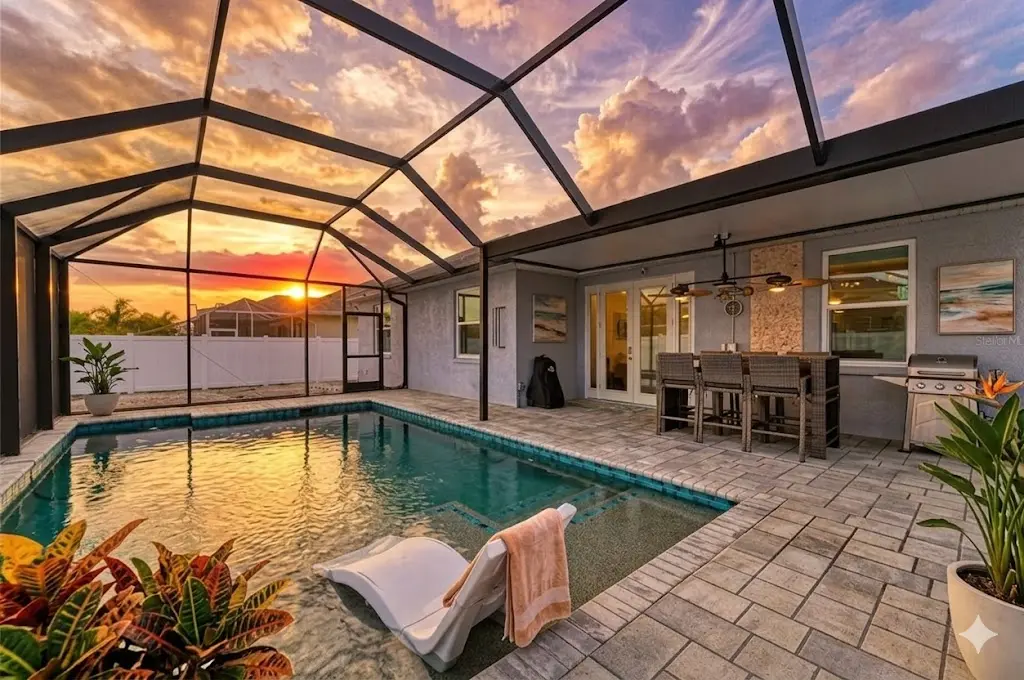
Home orientation determines which parts of a property receive morning sun, afternoon sun and shade throughout the day. In Sarasota and other parts of Florida, this can noticeably affect how a pool, lanai, patio and interior living spaces feel. An east-facing outdoor area generally receives more direct morning sun and becomes more shaded later in the day, while a west-facing outdoor area receives stronger afternoon and evening sun. North and south exposures create different patterns that also change with the season. There is no universally best orientation. The right choice depends on when you want sunshine, how much afternoon heat you enjoy, how you use your outdoor spaces and the specific design and landscaping of the property.
Quick Answers About Home Orientation in Florida
Which direction gets morning sun?
East-facing areas generally receive more direct morning sunlight because the sun rises in the east. For buyers who enjoy breakfast or coffee outside but prefer more shade later in the day, an east-facing lanai or backyard may be appealing.
Which direction gets afternoon sun?
West-facing areas receive more direct sun later in the day. In Florida, that can mean brighter outdoor spaces in the afternoon and evening, but it can also mean more solar heat during one of the hottest parts of the day.
What is the best direction for a pool in Florida?
There is no single best pool orientation for every buyer. Some people want abundant sunshine around the pool, while others prefer afternoon shade. The amount of actual sun also depends on the house, pool location, screen enclosure, trees, neighboring buildings and season.
Is a west-facing backyard bad in Florida?
Not necessarily. A west-facing backyard may be exactly what a buyer wants for afternoon sunshine or sunset views. The tradeoff is stronger late-day solar exposure, which can affect comfort on uncovered patios and through west-facing glass. Shade structures, landscaping and modern glazing can change the experience substantially.
Does home orientation affect energy use?
It can. University of Florida and U.S. Department of Energy guidance identifies east and west solar exposure as particularly important when designing for heat control in warm climates. Actual energy performance depends on many additional factors, including insulation, windows, roof, HVAC equipment, shading and building design.
Should you visit a house at different times before buying?
When practical, yes. A pool or lanai that is shaded during a morning showing may be in direct sun later in the day. A second visit can help you understand how light and shade move across the property.
Why Does Orientation Matter So Much in Florida?
Orientation matters everywhere, but Florida's warm climate makes the relationship between sunshine and shade particularly noticeable. UF/IFAS describes Southwest Florida as having hot, humid summers and mild winters, while Sarasota County also actively addresses extreme summer heat as a local concern.
That means buyers should not evaluate a home only by asking whether it has a pool or covered lanai. Ask when those spaces receive sun and when they receive shade.
A beautiful outdoor area that receives intense sun at the exact time you expect to use it may feel different from what you imagined. Conversely, a heavily shaded pool area may disappoint a buyer who wants maximum sunshine.
What Does an East-Facing Backyard Feel Like?
An east-facing backyard generally receives more direct sunlight during the morning. As the sun moves across the sky, the house itself may begin providing additional shade to portions of the backyard later in the day, depending on the home's design.
This can appeal to buyers who imagine using their lanai for:
- Morning coffee
- Breakfast outside
- Morning swimming
- Early gardening
- More afternoon shade
- Outdoor dinners with less direct late-day sun
The tradeoff is that buyers who want substantial late-afternoon sunshine around the pool may prefer a different exposure.
What Does a West-Facing Backyard Feel Like?
A west-facing backyard generally receives more direct sunlight during the afternoon and toward sunset. This can be highly desirable for buyers who spend afternoons by the pool, want a brighter backyard later in the day or have a property where western orientation creates an attractive sunset view.
The same sunlight can create a comfort tradeoff. The U.S. Department of Energy notes that controlling heat and glare is more difficult on east and west-facing windows, while UF/IFAS recommends prioritizing shade on east and west sides of Florida homes.
For a west-facing pool or lanai, look closely at covered areas, roof overhangs, retractable shades, landscaping and the location of glass doors and windows. These features can make a major difference in how the space feels during the afternoon.
What About a North-Facing Backyard?
A north-facing outdoor area often provides a different balance of light than an east or west exposure. North-facing windows are also recognized by the U.S. Department of Energy as useful for daylighting because they can admit natural light with less summer heat and glare than east and west-facing glass.
For outdoor living, however, the actual shade pattern depends heavily on the height and shape of the house, roofline, neighboring properties and season. Buyers who want abundant direct sun around a pool should pay particular attention to how much sunlight the specific north-facing outdoor area receives rather than judging it from the compass direction alone.
What About a South-Facing Backyard?
A south-facing outdoor area can receive substantial sunlight, although the amount and angle change throughout the year. Roof overhangs and other shading features can be particularly effective on southern exposures because the sun's path is more predictable than on east and west exposures.
For buyers who want a sunny pool or backyard, a southern exposure may deserve consideration. But again, orientation is only the starting point. A neighboring building, mature tree canopy or deep covered lanai can substantially change the actual amount of sunlight.
How Does Orientation Affect a Florida Pool?
For Sarasota buyers, pool orientation deserves more attention than it sometimes receives during a showing. The question is not simply whether the property has a pool. Consider when you expect to use it.
If you usually swim in the morning, eastern exposure may be attractive. If your family spends late afternoons outside, western or southern exposure may provide more of the direct sunlight you want. If you prefer escaping direct afternoon sun, an orientation that creates more late-day shade may be preferable.
Pool temperature cannot be predicted from orientation alone. Pool size and depth, enclosure, landscaping, shade, weather, heating equipment and other factors can all affect water temperature. Buyers who need specific pool heating or equipment information should have the system evaluated by an appropriate qualified pool professional.
How Does Orientation Affect a Lanai or Covered Patio?
A covered lanai can change the effect of orientation considerably. Two homes with identical compass exposure can feel very different if one has a deep roof overhang and the other has an uncovered patio.
When touring a home, stand where you would actually place your outdoor dining table or seating. Look at where the sun is coming from and ask where it will be several hours later.
Consider whether the covered area is deep enough to provide useful shade and whether low-angle morning or afternoon sun can enter beneath the roofline. Horizontal overhangs are generally more effective at controlling high-angle sun than low-angle east or west sun, which is one reason those exposures can require additional shading strategies.
How Does Orientation Affect Natural Light Inside the Home?
Orientation affects the character of interior light as well as outdoor living. East-facing rooms tend to receive stronger direct light earlier in the day, while west-facing rooms receive more direct light later.
North-facing windows can provide natural daylight with less direct summer solar heat and glare. The Department of Energy also notes that strategic window placement and shading can help bring daylight into a home while limiting unwanted heat. :contentReference[oaicite:5]{index=5}
Window size matters too. A wall of west-facing glass creates a very different interior environment from a small west-facing window shaded by mature landscaping.
Does Orientation Affect Cooling Costs?
Orientation can influence solar heat gain, but buyers should be cautious about translating compass direction directly into an expected utility bill. UF/IFAS recommends north-south orientation as an energy-efficient design strategy in the South because it reduces exposure on east and west sides, while Department of Energy guidance also identifies east and west solar exposure as an important consideration in hot, humid climates.
However, actual energy performance also depends on insulation, window efficiency, shading, roof characteristics, HVAC efficiency, air sealing, thermostat settings and occupant behavior. Buyers should review available utility information and consult appropriate energy, HVAC, inspection or building professionals if energy performance is material to their purchasing decision.
Landscaping Can Change the Effect of Orientation
Compass direction does not operate in isolation. Mature landscaping can transform how much sun reaches a house, patio or pool.
UF/IFAS specifically recommends prioritizing shade on east and west sides because those exposures receive substantial sunlight during Florida's warm months. Properly located trees and other landscaping can shade windows and walls and influence temperatures around a home.
There can also be tradeoffs. Heavy shade may reduce direct sun around a pool and affect which landscape plants thrive. Trees should also be evaluated for species, mature size, condition and proximity to structures. Consult appropriate landscape, arborist or other qualified professionals before making major landscaping decisions.
Orientation Matters Even More When There Is a View
Waterfront and view properties introduce another tradeoff. Buyers may willingly accept more afternoon sun because the same western orientation provides a desirable sunset view.
This is common when evaluating Sarasota waterfront real estate. The direction of the water view may be one of the property's defining characteristics, so the question becomes how well the architecture manages the accompanying sun exposure.
Look at window treatments, covered terraces, overhangs, landscaping and the depth of outdoor living areas. A well-designed property may preserve the view while providing comfortable shaded areas at the times you expect to use them.
Condo Orientation Can Be Just as Important
Orientation is not limited to single-family homes. In a condominium, exposure can affect natural light, balcony usability, views and the amount of direct sun entering the residence.
A west-facing high-rise residence may provide dramatic sunset views while also receiving substantial late-day sun through large glass walls. An east-facing residence may offer morning light and become more shaded later.
Floor level, nearby buildings, balcony depth and window specifications can all affect the experience, so two units in the same building may feel very different.
Why You Should Visit the Property More Than Once
A showing provides only a snapshot of the property's light conditions. If outdoor living or natural light is particularly important to you, consider returning at another time of day when practical.
A 10 a.m. showing cannot demonstrate exactly how a west-facing lanai feels at 5 p.m. Likewise, an afternoon showing may not reveal the morning sunlight that reaches an east-facing kitchen or pool.
Sun and shade patterns also shift seasonally. UF/IFAS notes that shade changes daily and seasonally, which is another reason not to treat one showing as a complete picture of year-round conditions.
Questions to Ask During a Home Showing
- Which direction does the backyard face?
- When does the pool receive direct sun?
- When does the lanai become shaded?
- Which rooms receive morning sun?
- Which rooms receive afternoon sun?
- How deep are the covered outdoor areas?
- Do mature trees shade the house or pool?
- Could neighboring buildings affect sunlight?
- How does the orientation affect the property's view?
- Are there exterior shades or other sun-control features?
- Would another showing at a different time of day be useful?
- How important is afternoon sun or shade to the way you plan to use the home?
Which Home Orientation Is Best for You?
Instead of asking for the universally "best" direction, decide which exposure best matches your routine.
- Prefer morning sunshine? Look closely at eastern exposure.
- Prefer more afternoon shade? An east-facing outdoor area may appeal to you.
- Want afternoon and evening sunshine? Consider western exposure and evaluate heat and shade carefully.
- Want a sunny pool? Evaluate the actual pool exposure throughout the day rather than relying on compass direction alone.
- Want comfortable outdoor dining? Pay attention to the relationship between orientation and covered space.
- Buying for a view? Decide whether the view is worth any additional direct solar exposure.
- Concerned about interior heat? Evaluate orientation together with windows, shading, insulation and HVAC performance.
Do Not Overlook Orientation When Comparing Homes
Floor plans, kitchens and finishes are easy to notice during a showing. Orientation is less obvious, but it can influence how you experience the property every day.
For Florida buyers who expect to spend significant time outside, pay particular attention to when the pool, lanai and backyard receive direct sunlight. Walk through the interior and notice which rooms are bright, shaded or exposed to low-angle sun.
Most importantly, evaluate the actual property rather than making a decision from compass direction alone. Architecture, windows, roof overhangs, trees, neighboring structures and seasonal sun angles can substantially change the experience.
Find a Sarasota Home That Fits How You Live
Hunt Brothers Realty helps buyers compare Sarasota and Florida Gulf Coast properties based on the characteristics that shape everyday living, including location, floor plan, outdoor spaces, views, property orientation and ownership considerations. When a pool, lanai or waterfront view is an important part of your search, evaluating how the property actually functions throughout the day can help you make a more informed comparison.
Informational notice: This article provides general real estate and home-orientation information for educational purposes and is not individualized architectural, engineering, energy, construction, landscaping, inspection or other professional advice. Sun exposure, shade, energy performance, pool conditions and outdoor comfort vary by property, design, landscaping and season. Buyers should verify property-specific conditions and consult the appropriate licensed real estate professional, home inspector, architect, engineer, contractor, HVAC professional, pool professional or other qualified specialist when a purchasing decision requires individualized guidance.
Sources
- University of Florida IFAS, Evaluating Green Communities
- University of Florida IFAS, Planting Trees for Energy Savings
- University of Florida IFAS, Design Strategies for a Sustainable Home Landscape
- U.S. Department of Energy, Natural Light and Daylighting
Contact Hunt Brothers Realty
Hunt Brothers Realty
46 N. Washington Blvd, Ste 3
Sarasota, FL 34236
Phone: (941) 388-7017
Email: info@huntbrothersrealty.com
Website: HuntBrothersRealty.com
Categories
- All Blogs 1970
- Anna Maria Island 83
- Bird Key 4
- Bradenton 234
- Buying a Home 1038
- Casey Key 2
- Clearwater 9
- Condos & HOA Living 950
- Ellenton 5
- Englewood 9
- First Time Homebuyers 1144
- Foreclosures 3
- Home Selling 2
- Homeownership 1164
- Lakewood Ranch 20
- Lido Key 27
- Longboat Key 78
- Luxury/Waterfront Properties 1105
- Market Updates & Trends 633
- Mortgages & Financing 42
- Move-Up Buyers 20
- Neighborhood Guides 755
- New Construction 32
- Palmetto 3
- Parrish 6
- Port Charlotte 10
- Punta Gorda 16
- Real Estate Investing 1022
- Relocation to Florida 1066
- Safety Harbor 2
- Sarasota 71
- Sarasota - Downtown 158
- Selling a Home 144
- Siesta Key 89
- St. Petersburg 6
- Tierra Verde 5
- Vacation & Second Homes 1213
- Venice 108
- Wellen Park 11
Recent Posts