Rosemary Park: Downtown Sarasota Residences and Neighborhood Living
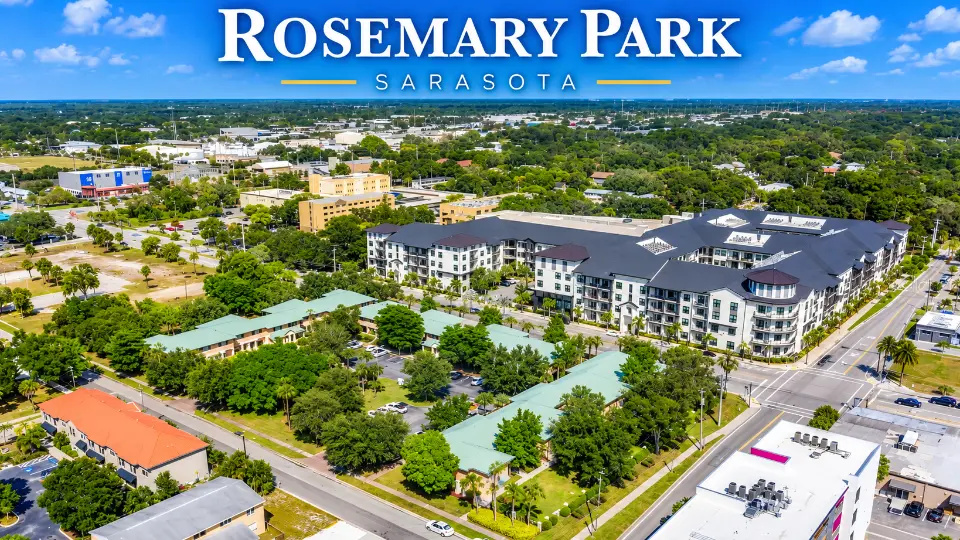
Rosemary Park Condominiums offer a smaller-scale residential option inside Sarasota’s Rosemary District, immediately north of the traditional downtown core. The community is located along Cohen Way and consists of low-rise, two-story residences rather than a high-rise tower. That makes Rosemary Park worth comparing for buyers who want condominium ownership, a private residential entrance and an urban neighborhood setting near Downtown Sarasota. Buyers should distinguish Rosemary Park Condominiums from the nearby City-owned Rosemary District Park, and they should evaluate the individual residence, association finances, insurance, maintenance responsibilities and current condominium documents before purchasing.
Quick Answers About Rosemary Park Sarasota
What is Rosemary Park in Sarasota?
Rosemary Park is a condominium community on Cohen Way in Sarasota’s Rosemary District. The residences have a lower-rise, row-house or townhome-like form that differs from the larger condominium towers found elsewhere around Downtown Sarasota.
Is Rosemary Park in the Rosemary District?
Yes. The Rosemary District Association includes Rosemary Park Condominiums among the residential properties within the district. The broader neighborhood is bounded generally by U.S. 41, 10th Street, Orange Avenue and Fruitville Road.
Is Rosemary Park the same as Rosemary District Park?
No. Rosemary Park Condominiums are residences on Cohen Way. Rosemary District Park is a separate City of Sarasota public-space project near Boulevard of the Arts and Central Avenue. Buyers searching for Rosemary Park real estate should make sure they are looking at the condominium community rather than the public park.
What type of homes are at Rosemary Park?
Public property records identify Rosemary Park residences as condominiums, including row-house condominium units. Individual records show two-story layouts, but square footage, bedroom configuration, renovations and other features vary by residence.
Does Rosemary Park have a condominium association?
Yes. Florida corporate records identify Rosemary Park Condominium Association, Inc. as an active Florida not-for-profit corporation. Buyers should obtain the current condominium documents, financial information, insurance information, rules and other association records applicable to a prospective purchase.
Is Rosemary Park walkable to Downtown Sarasota?
Its Rosemary District location places Rosemary Park immediately north of Sarasota’s traditional downtown core. Buyers who consider walkability important should personally test the routes from the property to Main Street, the bayfront, restaurants, cultural destinations and other places they expect to use regularly.
Who should consider Rosemary Park?
Rosemary Park may be worth comparing for buyers who want a smaller-scale condominium residence in an urban neighborhood rather than a large amenity-oriented high-rise. The individual unit, association structure and exact location should ultimately determine whether it fits a buyer’s priorities.
Where Is Rosemary Park in Downtown Sarasota?
Rosemary Park Condominiums are located on Cohen Way inside the Rosemary District, a compact urban neighborhood immediately north of Downtown Sarasota. The Rosemary District Association describes the district as approximately 130 acres bounded by Fruitville Road to the south, U.S. 41 to the west, 10th Street to the north and Orange Avenue to the east.
That location places Rosemary Park within a mixed residential and commercial part of Sarasota rather than a conventional suburban condominium complex. The neighborhood contains residences alongside restaurants, businesses, galleries, studios and other urban uses.
For buyers deciding where the neighborhood fits within the larger Sarasota market, Hunt Brothers Realty’s guide to communities near Downtown Sarasota compares the Rosemary District with Laurel Park, Gillespie Park, Golden Gate Point and other nearby residential areas.
Is Rosemary Park the Condominium Community or the Public Park?
Rosemary Park Condominiums and Rosemary District Park are two different places. This distinction is important because both names can appear in searches about the Rosemary District.
Rosemary Park Condominiums are the residential community on Cohen Way. The Rosemary District Association’s neighborhood map specifically identifies Rosemary Park Condominiums among the district’s residential and mixed-use properties.
Separately, City of Sarasota planning documents identify a City-owned parcel at 1836 Boulevard of the Arts for the Rosemary District Park project. That public-space site is west of Central Avenue and is not the same property as the condominium community.
What Are the Residences at Rosemary Park Like?
Rosemary Park provides a lower-scale form of condominium living. Public property records for individual Cohen Way residences describe condominium or row-house condominium ownership, with two-story configurations appearing in the community.
That physical format is one of the community’s most useful distinctions. Buyers comparing Rosemary Park with a traditional downtown tower are comparing two substantially different residential experiences. Rosemary Park has a more ground-oriented, townhome-like appearance, while much of the broader downtown condominium market consists of multi-story buildings with shared interior circulation and larger common-amenity programs.
Individual Rosemary Park residences should still be compared separately. Public records show differences in recorded living area and construction history, and previous renovations can create additional variation. Buyers should verify the exact square footage, bedroom and bathroom configuration, parking rights, improvements and legal description for the unit they are considering.
How Is Rosemary Park Different From a Downtown Sarasota High-Rise?
Rosemary Park is better understood as a small-scale urban condominium community than as a full-service downtown tower. Its two-story residential form creates a different ownership experience from buildings designed around elevators, staffed lobbies, elevated residences and extensive shared amenities.
Neither format is automatically better. Buyers who prioritize a large pool deck, concierge environment, water views or a substantial amenity package may prefer another building. Buyers who prioritize a lower-rise residence in the Rosemary District may find Rosemary Park more relevant to their search.
Hunt Brothers Realty’s Downtown Sarasota condominium buyer guide provides a broader comparison of locations and building types throughout the downtown market.
What Is the Rosemary District Like Around the Community?
The Rosemary District is a mixed urban neighborhood with an important place in Sarasota’s history. The Rosemary District Association explains that the area was historically known as Overtown and developed as an African American live, work and community center beginning in Sarasota’s early history.
Today, the district combines residential development with restaurants, artist studios, galleries, businesses, boutiques and other commercial uses. That mixed-use setting is central to understanding Rosemary Park. It is not a residential enclave separated from downtown activity, but a condominium community located within an urban neighborhood.
The City of Sarasota’s Downtown Master Plan similarly describes the Rosemary neighborhood as containing a balance of residential and commercial uses. Buyers should therefore evaluate both the residence and the surrounding blocks when deciding whether the location matches their preferred daily routine.
What Is Near Rosemary Park?
Rosemary Park’s primary location advantage is its position between the Rosemary District’s own businesses and the broader Downtown Sarasota environment. From this part of the city, residents can connect toward Main Street, the northern downtown area, Sarasota Bay and other central Sarasota destinations.
The Rosemary District itself contains restaurants, businesses and arts-oriented uses. Downtown expands the choices to additional dining, shopping, galleries, cultural institutions and public waterfront spaces.
Buyers should avoid relying only on a map’s walking-distance estimate. Walk the actual route from Rosemary Park to the places that matter to you, preferably at the times you expect to use them. Sidewalks, intersections, weather exposure and the exact destination can all affect how practical a short mapped distance feels in everyday use.
How Does Rosemary Park Compare With Newer Rosemary District Residences?
Rosemary Park is useful to compare with the district’s newer boutique developments because the communities represent different periods and styles of urban Sarasota housing. Buyers should not assume every Rosemary District property provides the same architecture, amenities or ownership structure.
Zahrada II in the Rosemary District, for example, is a newer boutique mixed-use condominium combining residences with commercial space. Its vertical, contemporary format creates a different comparison from Rosemary Park’s lower-rise residential setting.
Valencia at Rosemary Place provides another useful comparison. Valencia combines multi-level townhomes and private garages with fee-simple ownership, making its legal ownership structure different from Rosemary Park condominium ownership.
These differences demonstrate why buyers should choose a Rosemary District residence based on more than location. Building age, ownership type, parking, stairs, association obligations, amenities and the individual floor plan can matter as much as being within the same neighborhood.
Does Rosemary Park Have a Condominium Association?
Yes. Florida Division of Corporations records identify Rosemary Park Condominium Association, Inc. as an active Florida not-for-profit corporation. The association was originally filed in March 2003.
That association structure makes condominium due diligence a central part of purchasing at Rosemary Park. Buyers are acquiring an individual residence together with the rights and obligations created by the condominium declaration and other governing documents.
Do not rely on an old listing to determine current fees, maintenance coverage, insurance arrangements, reserves, assessments, pet policies, leasing restrictions or approval requirements. Those items can change and should be verified through current association documents and appropriate professionals before a purchase decision.
What Should Buyers Review Before Purchasing at Rosemary Park?
Buyers should evaluate both the individual residence and the condominium association. A renovated interior does not answer questions about shared building components, insurance, association finances or future expenses.
- Current declaration, bylaws and rules
- Current association budget and financial statements
- Reserve information and applicable reserve requirements
- Current or proposed special assessments
- Association insurance and unit-owner insurance responsibilities
- Maintenance responsibilities for roofs, exterior components and common areas
- Available inspection, engineering or structural information when applicable
- Parking rights and guest-parking rules
- Pet restrictions
- Leasing restrictions
- Owner or tenant approval requirements
- The individual residence’s condition and renovation history
Condominium documents and financial information should be reviewed in their current form. Questions involving legal rights, reserves, assessments, maintenance obligations or interpretation of condominium documents should be directed to the association, an appropriate condominium professional or a qualified Florida real estate attorney.
Why Does the Construction History Matter at Rosemary Park?
Public records for Rosemary Park units reflect a construction history that should be investigated at the individual-property level. Several Cohen Way records identify original construction dating to 1971, while other residence records and prior listings reflect later construction or renovation information.
Rather than applying one construction date or renovation history to the entire community, buyers should verify the public record, permit history and physical condition for the exact unit. This is particularly important when evaluating roofs, electrical and plumbing systems, HVAC, windows, doors, previous remodeling and other building components.
Age alone does not establish condition. Inspection findings should be evaluated with the appropriate licensed inspector, contractor, engineer or other qualified professional before the buyer makes a decision.
What Should Buyers Know About Insurance at Rosemary Park?
Condominium insurance should be evaluated at both the association and individual-unit levels. Buyers need to understand what the association’s policy covers, what the unit owner is responsible for insuring and how deductibles or other obligations may affect owners.
The age, construction and condition of the specific residence can also matter to an insurer. Do not assume that an insurance quote for another Rosemary Park unit will apply to the property you are considering.
Insurance availability, coverage, deductibles and premiums can vary substantially by property and insurer. Buyers should obtain property-specific quotes and review both association and unit-owner coverage with a qualified insurance professional before making a purchasing decision.
Should Buyers Investigate Flood Information?
Yes. Flood information should be evaluated for the specific property rather than inferred from the broader downtown location. A prior listing or neighboring property’s flood designation should not replace current property-specific research.
Buyers should distinguish FEMA flood mapping from hurricane evacuation information because the two systems address different questions. Current official information, building characteristics and insurance considerations should be reviewed for the exact residence.
Property-specific flood and insurance questions should be verified with the appropriate government resources, insurance professional, surveyor, lender or other qualified professional when those issues could affect the purchase.
Is Rosemary Park a Good Alternative to Living Directly on Main Street?
It can be for buyers who want the Rosemary District’s urban setting without choosing a condominium directly in the traditional Main Street core. The tradeoff is that Rosemary Park provides a different version of downtown living.
A Main Street condominium can put restaurants, shops and downtown activity immediately outside the building. Rosemary Park sits farther north within a neighborhood that mixes residences with businesses, arts-oriented uses and ongoing urban development.
Neither location is objectively better. Buyers should walk both areas, visit at different times and decide whether their priority is being directly in the traditional downtown grid or living within the Rosemary District while keeping downtown destinations nearby.
Does Rosemary Park Offer a Typical Resort-Style Amenity Package?
Buyers should not approach Rosemary Park expecting the same amenity model as a large luxury condominium tower. The community’s primary distinctions are its lower-rise residential form and Rosemary District location rather than an extensive list of shared resort facilities.
Amenity information should be confirmed through current association materials instead of older listing descriptions. This is particularly important when comparing the value of association fees across different downtown properties because the services, insurance, reserves and maintenance responsibilities included in those fees can differ substantially.
Who Might Put Rosemary Park on a Sarasota Home Search?
Rosemary Park may deserve consideration when a buyer’s property criteria include a smaller-scale condominium, two-story residential format and Rosemary District location. It can also be useful to compare for buyers who like downtown proximity but do not specifically want a high-rise residence.
A practical Rosemary Park shortlist might prioritize:
- Rosemary District location
- Lower-rise condominium living
- Two-story layouts
- Access toward Downtown Sarasota
- A neighborhood setting with residential and commercial uses
- An alternative to a large downtown tower
Buyers who prioritize direct Sarasota Bay views, extensive building amenities, elevators or high-rise living may find other Downtown Sarasota condominiums better aligned with those requirements.
What Is the Bottom Line on Rosemary Park Sarasota?
Rosemary Park offers a distinctive lower-rise condominium option within Sarasota’s Rosemary District, giving buyers an alternative to the larger towers associated with much of the downtown condominium market. Its Cohen Way location places the community within a compact urban district containing residences, restaurants, businesses and cultural uses immediately north of the traditional downtown core.
The community should be evaluated for what it is rather than compared solely by amenity count. Residence layout, stairs, parking, association finances, insurance, maintenance responsibilities, building condition and the surrounding neighborhood can all matter more than whether another downtown building has a longer amenity list.
For a buyer who likes the Rosemary District and prefers a smaller-scale residential format, Rosemary Park belongs on the comparison list alongside both established downtown condominiums and newer boutique Rosemary District developments.
Compare Rosemary Park and Downtown Sarasota Residences With Hunt Brothers Realty
Hunt Brothers Realty can help buyers compare Rosemary Park with other condominium, townhome and residential options throughout the Rosemary District and Downtown Sarasota. Review the Downtown Sarasota condominium buyer guide, compare communities near Downtown Sarasota, explore Zahrada II in the Rosemary District, or contact Hunt Brothers Realty to discuss current Sarasota real estate opportunities.
Informational notice: This article provides general real estate and educational information only. It is not individualized legal, financial, tax, insurance, lending, inspection, engineering, construction, title, association or other professional advice. Condominium fees, reserves, assessments, insurance, maintenance responsibilities, leasing restrictions, pet rules, parking rights, building condition and other ownership matters can change and should be verified for the specific residence. Buyers should review current association documents and property information and consult the appropriate licensed real estate professional, Florida real estate attorney, insurance professional, lender, inspector, engineer, tax professional, association or other qualified professional before making a purchasing decision.
Sources
- Rosemary District Association, Rosemary District Map
- Rosemary District Association, Our Neighborhood
- Rosemary District Association, Neighborhood Resources and Boundaries
- Florida Division of Corporations, Rosemary Park Condominium Association Records
- City of Sarasota, Planning Department
- Hunt Brothers Realty, Best Communities Near Downtown Sarasota
- Hunt Brothers Realty, Downtown Sarasota Condominium Buyer Guide
Hunt Brothers Realty
46 N. Washington Blvd, Ste 3, Sarasota, FL 34236
Phone: (941) 388-7017
Email: info@huntbrothersrealty.com
Website: HuntBrothersRealty.com
Categories
- All Blogs 2694
- Anna Maria Island 93
- Bird Key 6
- Bradenton 242
- Buying a Home 1708
- Casey Key 3
- Clearwater 16
- Condos & HOA Living 1643
- Ellenton 9
- Englewood 16
- First Time Homebuyers 1832
- Foreclosures 4
- Home Selling 12
- Homeownership 1878
- Lakewood Ranch 37
- Lido Key 29
- Longboat Key 81
- Luxury/Waterfront Properties 1821
- Market Updates & Trends 1321
- Mortgages & Financing 88
- Move-Up Buyers 24
- Neighborhood Guides 1449
- New Construction 47
- Palmetto 4
- Parrish 39
- Port Charlotte 36
- Punta Gorda 165
- Real Estate Investing 1734
- Relocation to Florida 1762
- Safety Harbor 4
- Sarasota 163
- Sarasota - Downtown 175
- Selling a Home 149
- Siesta Key 95
- St. Petersburg 11
- Taxes and Homestead 5
- Tierra Verde 7
- Vacation & Second Homes 1927
- Venice 225
- Wellen Park 24
Recent Posts