The Value of Staying Informed

Staying informed in real estate means knowing which information matters to your specific decision, not reacting to every housing headline. Sarasota buyers and sellers benefit from following current inventory, recent sales, time to contract, price changes, competing properties, financing conditions, and property-specific ownership costs. Just as important, they need to understand the limits of that data. A statewide trend may provide context, but the conditions affecting a Sarasota single-family home, downtown condominium, waterfront property, or individual neighborhood can be very different.
Quick Answers About Staying Informed in Real Estate
Why is staying informed important when buying or selling a home?
Current information helps buyers and sellers understand available choices, competition, market pace, pricing context, and changing ownership costs. It does not eliminate uncertainty, but it can replace assumptions with evidence that is more relevant to the decision.
Should I make a real estate decision based on national housing news?
National housing news can provide useful context, but it should not be the only basis for a local decision. Sarasota conditions can differ from national trends, and individual property types, neighborhoods, buildings, and price ranges can behave differently within Sarasota itself.
Which real estate numbers are worth watching?
Useful indicators include active inventory, months of supply, new and pending sales, recent closed sales, time to contract, price reductions, sale-to-list relationships, mortgage conditions, and the competition within the specific property category you are considering.
Does the median sale price tell me what a specific home is worth?
No. A median sale price describes the midpoint of a group of completed sales. It does not establish the market value of an individual property, which depends on factors such as location, condition, size, features, competing listings, and relevant comparable sales.
How often should buyers watch the market?
Buyers actively preparing to purchase should monitor new listings, price changes, pending properties, and recent comparable sales regularly enough to recognize changes in their target market. The useful frequency depends on the buyer's timeline and how quickly that particular segment is moving.
What should sellers monitor after their home is listed?
Sellers should watch new competing listings, comparable homes going under contract, recent closings, price changes, showing activity, buyer feedback, and their own listing's response. New information can change the competitive picture after a property enters the market.
Can staying informed tell me exactly when to buy or sell?
No. Market information can clarify current conditions and possible tradeoffs, but it cannot predict future prices, interest rates, inventory, or an individual property's outcome with certainty. Personal timing and property-specific facts remain important.
What Does Staying Informed Actually Mean in Real Estate?
Staying informed means following information that can materially change your understanding of the market or a particular property. It is different from consuming a constant stream of predictions, social media commentary, and national headlines.
For a Sarasota buyer, useful information might include a new comparable listing, a price reduction on a home under consideration, a change in mortgage terms, an insurance quote, or new association information. For a seller, it could be a competing property going under contract, a new comparable sale, changing inventory, or consistent feedback from prospective buyers.
The objective is not to know everything. It is to identify the information that is relevant enough to improve the decision in front of you.
Why Can National Housing Headlines Be Misleading Locally?
National housing data describes a very large collection of different real estate markets. It can help explain broader economic and housing trends, but it cannot tell a Sarasota buyer how much competition exists for a particular home or tell a Sarasota seller how their property compares with nearby alternatives.
The National Association of Realtors has emphasized the value of combining national context with state and local information because local conditions do not always mirror national trends. The same principle applies within a local market. Countywide data can still hide substantial differences among neighborhoods, property types, buildings, and price ranges.
That is why Hunt Brothers Realty's analysis of Sarasota months of supply looks beyond a single market label and distinguishes between single-family homes and condos or townhomes.
What Do Current Sarasota Market Conditions Show About Local Differences?
Recent Sarasota data provides a useful example of why market segments should be evaluated separately. In August 2026, Sarasota County had 3.7 months of supply for single-family homes and 5.2 months for condos and townhomes. Single-family homes reached contract in a median 47 days, compared with 83 days for condos and townhomes.
Those figures do not mean every single-family home was highly competitive or every condominium favored buyers. They show that the two broad property categories were operating under different countywide conditions. Individual properties could still perform very differently according to price, location, condition, ownership costs, and competition.
Hunt Brothers Realty's October 2026 Sarasota real estate market update provides additional context on these differences and explains why a countywide statistic should be the beginning of a property analysis rather than the end.
Which Market Indicators Are Worth Following?
No single statistic provides a complete picture of a housing market. Buyers and sellers can develop better context by looking at several indicators together and understanding what each one measures.
- Active inventory: How many properties are currently available?
- Months of supply: How does available inventory compare with the recent pace of sales?
- New listings: Is additional competition or buyer choice entering the market?
- Pending sales: Which properties are attracting buyers now?
- Closed sales: What have buyers recently paid for relevant properties?
- Time to contract: How quickly are properties finding buyers?
- Price reductions: Are sellers adjusting asking prices?
- Sale-to-list relationships: How do completed sale prices compare with listing history?
- Ownership costs: How are insurance, taxes, association expenses, financing, and maintenance affecting affordability?
The value comes from interpreting these indicators together. Falling inventory may mean something different when pending sales are increasing than when buyer activity is weakening at the same time.
What Can Months of Supply Tell Buyers and Sellers?
Months of supply helps show the relationship between available homes and the recent pace of sales. Lower supply generally means fewer choices relative to demand, while higher supply generally means buyers have more alternatives and sellers face more competition.
It should not be treated as a rule that automatically determines negotiating leverage, future prices, or whether a market is favorable to every buyer or seller. Hunt Brothers Realty's Sarasota months-of-supply guide explains why the direction of inventory and differences among property categories are important when interpreting the number.
Why Should Buyers Watch New Listings and Pending Sales?
New listings show what buyers can choose today, while pending sales can provide clues about which properties are attracting buyers under current conditions. Together, they can be more useful to an active buyer than relying exclusively on closed sales from earlier months.
Suppose several comparable homes enter the market within a short period. A buyer may suddenly have more alternatives. If several strong comparable properties instead go under contract, the remaining choices may become more limited.
Neither development automatically dictates what a buyer should offer. The individual property's condition, listing history, comparable sales, financing, ownership costs, and the buyer's priorities still matter.
Why Should Sellers Keep Watching the Market After Listing?
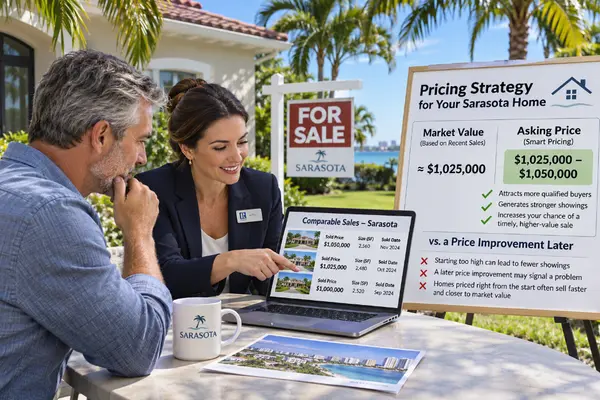
The competitive market can change after a seller chooses an asking price. New listings can appear, comparable properties can reduce their prices, competing homes can go under contract, and new sales can provide additional evidence about what buyers are accepting.
Buyer response to the listing also becomes new information. Showings, feedback, online engagement, repeat visits, and offers can help a seller and real estate professional evaluate how the market is responding to the home's price and presentation.
This is why pricing is not necessarily a one-time conversation. Current competition and buyer response can provide evidence that deserves review while the home is actively marketed.
Why Doesn't a Median Price Tell the Whole Story?
A median price is useful for describing the midpoint of completed sales in a defined market, but it does not tell you what every home gained or lost in value. Changes in the types and price ranges of properties selling can influence the median from one period to another.
For an individual home, recent comparable sales, active competition, condition, location, property characteristics, and buyer demand are more relevant than simply applying a countywide percentage change to the property.
A licensed real estate professional can help buyers and sellers evaluate relevant market evidence. Formal appraisal questions should be directed to a qualified appraiser when an appraisal or independent valuation is required.
Why Does Property Type Matter So Much?
Single-family homes, condominiums, townhomes, waterfront residences, new construction, and other property categories can have different inventory, buyer pools, ownership costs, and transaction considerations. Combining them into one headline can hide those differences.
Condominium buyers, for example, may evaluate association assessments, reserves, insurance, building information, and maintenance responsibilities that are different from those associated with a detached home. Waterfront properties can introduce additional questions involving flood exposure, seawalls, docks, elevation, insurance, and maintenance.
Market data becomes more useful as the comparison becomes more relevant to the property under consideration.
How Can Buyers Stay Informed Without Becoming Overwhelmed?
Buyers do not need to monitor every housing statistic. Focus on the information that can affect the homes you are realistically considering and the budget you are prepared to use.
- New listings within the target property type and area
- Price changes on relevant properties
- Comparable homes going under contract
- Recent comparable closed sales
- Current financing scenarios when borrowing
- Property-specific insurance information
- Property taxes and applicable association or district expenses
- Inspection and property-condition information
Hunt Brothers Realty's Florida Gulf Coast community resources can also help buyers narrow the geographic part of the search before comparing individual properties.
How Can Sellers Separate Useful Feedback From Noise?
Look for patterns rather than overreacting to one comment or one showing. Repeated feedback about price, condition, presentation, or a property feature can become more meaningful when it aligns with what competing listings and recent sales are showing.
Likewise, limited activity does not automatically prove that one specific factor is responsible. Price, photography, condition, showing access, competition, seasonal patterns, financing conditions, and property-specific ownership costs can all affect buyer response.
The useful question is whether the available evidence supports maintaining the current strategy or considering an adjustment.
Should Buyers and Sellers Try to Predict the Market?
Market forecasts can help people understand possible scenarios, but they should not be mistaken for certainty. Mortgage rates can change, inventory can rise or fall, buyer activity can shift, and individual circumstances can change before a forecast period ends.
Hunt Brothers Realty's Sarasota real estate trends to watch in 2026 and 2027 focuses on indicators such as inventory, mortgage rates, pending sales, time to contract, price reductions, insurance, new construction, and submarket differences rather than predicting one guaranteed outcome.
For most buyers and sellers, the more useful objective is not predicting the exact future. It is understanding current conditions well enough to evaluate the tradeoffs of acting now versus waiting.
Why Is Property-Specific Information as Important as Market Data?
Market data tells you about groups of properties. A purchase or sale ultimately involves one property, which means property-specific information can become more important as the decision gets closer.
A buyer may like the broader market conditions but discover that a particular home's insurance cost, inspection findings, association obligations, taxes, financing requirements, or maintenance needs change the decision. A seller may see favorable countywide inventory but still compete against several properties that buyers consider stronger values.
Staying informed therefore means moving from broad context toward increasingly specific information as the decision progresses.
Which Sources Should Real Estate Consumers Trust?
Use sources that are appropriate for the question being answered. Official market reports and MLS-based statistics are useful for housing activity, while property-specific financial, legal, insurance, inspection, tax, association, and title questions require information from the professionals or organizations responsible for those subjects.
A real estate professional can help interpret listings, comparable properties, local market conditions, and the real estate transaction. A lender should verify mortgage qualification and loan terms. An insurance professional should address coverage and premiums, while inspectors, engineers, contractors, attorneys, tax professionals, associations, title professionals, surveyors, and government authorities should address questions within their respective areas of expertise.
The source should become more specialized as the question becomes more specialized.
What Is the Real Value of Staying Informed?
The value of staying informed is not that information guarantees the right outcome. Its value is that buyers and sellers can make decisions with a clearer understanding of current choices, competition, costs, and tradeoffs.
For a buyer, that may mean recognizing when a well-positioned property deserves closer attention without feeling pressured by a broad market headline. For a seller, it may mean understanding how new competition or buyer response affects the home's position after it enters the market.
Good information does not make the decision for you. It gives you a stronger foundation for making it.
Stay Current With Hunt Brothers Realty
Hunt Brothers Realty helps buyers and sellers interpret Sarasota and Florida Gulf Coast real estate conditions in the context of the properties and communities that matter to them. Review the latest Sarasota real estate market update, learn what Sarasota months of supply can tell buyers and sellers, explore Florida Gulf Coast communities, or contact Hunt Brothers Realty for help evaluating the market surrounding a specific real estate goal.
Informational notice: This article provides general real estate information for educational purposes and is not individualized legal, financial, tax, insurance, lending, appraisal, inspection, engineering, construction, title, association, survey, permitting, or other professional advice. Market statistics and trends do not establish the value, future price, negotiating position, financing terms, insurance availability, tax consequences, or suitability of a specific property. Buyers and sellers should work with a licensed real estate professional for property-specific real estate guidance and verify decisions requiring specialized expertise with the appropriate qualified lender, appraiser, insurance professional, attorney, tax professional or CPA, inspector, contractor, engineer, title or closing professional, surveyor, association, government authority, or other qualified professional.
Sources
- Hunt Brothers Realty, Sarasota Months of Supply: What It Tells Buyers and Sellers
- Hunt Brothers Realty, October 2026 Sarasota Real Estate Market Update
- Hunt Brothers Realty, Sarasota Real Estate Trends to Watch in 2026 and 2027
- Florida Realtors, Florida Real Estate Market Data
- National Association of Realtors, Cut Through the Headline Chaos and Build Client Trust
Hunt Brothers Realty
46 N. Washington Blvd, Ste 3, Sarasota, FL 34236
Phone: (941) 388-7017
Email: info@huntbrothersrealty.com
Website: HuntBrothersRealty.com
Categories
- All Blogs 2654
- Anna Maria Island 92
- Bird Key 5
- Bradenton 242
- Buying a Home 1675
- Casey Key 3
- Clearwater 16
- Condos & HOA Living 1603
- Ellenton 8
- Englewood 15
- First Time Homebuyers 1795
- Foreclosures 4
- Home Selling 10
- Homeownership 1840
- Lakewood Ranch 36
- Lido Key 29
- Longboat Key 81
- Luxury/Waterfront Properties 1781
- Market Updates & Trends 1283
- Mortgages & Financing 85
- Move-Up Buyers 24
- Neighborhood Guides 1410
- New Construction 46
- Palmetto 4
- Parrish 38
- Port Charlotte 36
- Punta Gorda 165
- Real Estate Investing 1694
- Relocation to Florida 1722
- Safety Harbor 4
- Sarasota 157
- Sarasota - Downtown 175
- Selling a Home 149
- Siesta Key 94
- St. Petersburg 11
- Taxes and Homestead 3
- Tierra Verde 7
- Vacation & Second Homes 1888
- Venice 225
- Wellen Park 24
Recent Posts