What Is an Encroachment and Why Should Homebuyers Care?
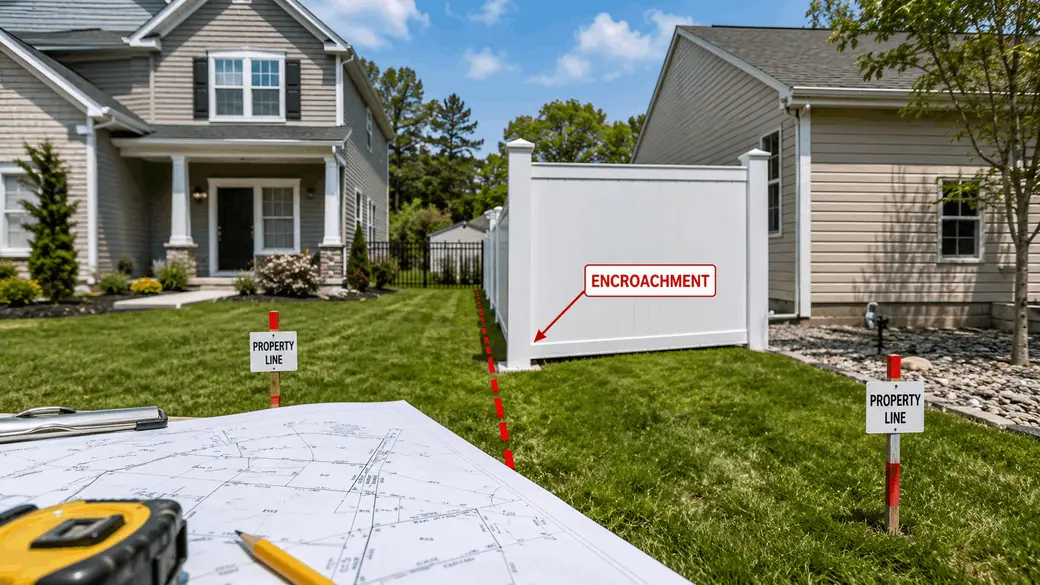
An encroachment in real estate generally involves a structure, improvement or use extending across a property boundary or into an area where it may not have the right to be. A neighbor's fence crossing the lot line, a driveway extending onto adjoining land or part of a building projecting beyond a boundary are common examples. Homebuyers should care because an encroachment can raise questions about property boundaries, title, future improvements and use of the land. A current property survey can be an important tool for identifying potential problems before closing.
Not every potential encroachment becomes a dispute, and seeing something unusual on a survey does not by itself determine ownership or legal rights. The facts, recorded documents and applicable law matter. Buyers should have significant survey or boundary concerns evaluated by the appropriate licensed surveyor, title professional and Florida real estate attorney before deciding how to proceed.
Quick Answers About Encroachments in Real Estate
What is an encroachment?
An encroachment generally occurs when a structure, improvement or use extends beyond a property boundary or into another legally significant area. Examples can include fences, walls, driveways, sheds, roof overhangs and portions of buildings.
How do buyers discover an encroachment?
A property survey is one of the principal ways a potential encroachment can be identified. Surveyors establish or retrace property boundaries and locate relevant physical improvements and evidence of occupation in relation to those boundaries.
Is a fence over the property line an encroachment?
It can be a potential encroachment. A survey may show that a fence does not follow the surveyed boundary. The legal significance of that condition depends on the facts and should not be determined from the fence's appearance alone.
Is an encroachment the same as an easement?
No. An easement generally involves a legal right to use another person's property for a particular purpose. An encroachment concerns a physical improvement or use that potentially crosses a boundary or affects another property interest. Recorded easement rights can sometimes explain why a particular use is permitted, which is one reason the survey and title documents should be reviewed together.
Can an encroachment affect a home purchase?
Potentially. Depending on its location and significance, an encroachment can raise questions involving title, boundaries, access, future improvements, financing or the buyer's intended use of the property. The effect is property-specific.
Does title insurance automatically cover an encroachment?
Buyers should not assume it does. Title policies contain terms, exclusions and exceptions, and survey-related matters can receive particular treatment. Buyers should review the actual title commitment and proposed policy with the title professional or a qualified Florida real estate attorney.
Should I buy a house with an encroachment?
The existence of a potential encroachment does not automatically answer whether a buyer should purchase the property. The location, size, legal status, title implications and possible resolution all matter. Buyers should investigate the issue before making a property-specific decision.
Who should review an encroachment problem?
A licensed surveyor can address surveying and boundary-location questions. A title professional can explain title documents and policy requirements within the scope of that professional's role. Questions involving ownership rights, contract remedies, easements, boundary disputes or other legal issues should be reviewed with a qualified Florida real estate attorney.
What Does an Encroachment Look Like?
An encroachment is often easier to understand through examples. Imagine a rectangular residential lot with a surveyed boundary separating it from the property next door. If a physical improvement crosses that line, the survey may identify it as a potential encroachment.
Examples can include:
- A neighbor's fence extending onto the property being purchased
- The home's fence extending onto the neighboring property
- A driveway crossing a property boundary
- A shed or detached garage extending beyond the lot line
- Steps, patios or other improvements crossing a boundary
- Roof eaves or other building projections extending over a boundary
- A wall constructed partly on adjoining property
- An improvement extending into an easement, right of way or setback area
These situations are not necessarily legally equivalent. For example, crossing an ownership boundary can present different questions from constructing an improvement within a setback or recorded easement. A survey identifies physical relationships, while the legal significance of those relationships may require additional professional review.
Why Should Homebuyers Care About an Encroachment?
A buyer is purchasing more than a house. The transaction also involves a legally described parcel of land and the rights associated with it. If the physical use of the property does not align with the surveyed boundaries or recorded rights, the buyer needs to understand why.
The practical importance depends on the specific condition. A potential encroachment could affect:
- The amount of land the buyer can actually use without dispute
- Future fences, additions, pools or other improvements
- Driveway or access arrangements
- Relationships with adjoining property owners
- Title insurance exceptions or requirements
- A lender's requirements
- Future resale questions
The key is not to assume that every encroachment is catastrophic or insignificant. Buyers need enough information to understand the particular issue before closing.
How Can a Property Survey Reveal an Encroachment?
A professional survey provides information that a buyer generally cannot obtain simply by looking at the yard. A fence may appear to mark a property boundary even though it does not. A driveway that has been used for years may cross onto neighboring land. Landscaping can also make the actual boundary difficult to recognize visually.
The National Society of Professional Surveyors explains that certain conditions affecting title, including encroachments, overlaps and rights arising from use or occupation, may only become apparent through an appropriate survey and physical inspection. The 2026 ALTA/NSPS Land Title Survey Standards, effective February 23, 2026, include requirements concerning boundaries, improvements and evidence of possession or occupation.
The appropriate type and scope of survey depend on the property and transaction. Buyers should discuss survey requirements with their lender, title professional, real estate professional and licensed surveyor as appropriate.
Can you rely on the seller's old survey?
An older survey can be useful, but buyers should determine whether it accurately reflects current property conditions and whether it satisfies the requirements of the transaction, lender and title insurer. Fences, pools, additions, sheds, driveways and other improvements may have changed since an earlier survey was prepared.
Whether an existing survey can be accepted or updated is a transaction-specific question. Buyers should confirm that issue with the professionals handling the survey, title and financing rather than assuming an old survey is sufficient.
What Is the Difference Between an Encroachment and an Easement?
Encroachments and easements can both involve one person's use of land associated with another property, but they are not interchangeable terms.
An easement generally creates or recognizes a legal right to use property for a specified purpose. Common examples can involve utilities, drainage, access or shared driveways. An encroachment generally describes a physical condition in which an improvement or use potentially extends beyond the relevant property boundary or other legal limit.
The distinction becomes important when a survey shows something crossing a boundary. The next question may be whether recorded documents authorize that condition. A driveway crossing neighboring property, for example, raises a very different concern if a valid recorded access easement establishes the applicable rights.
Questions about the existence, scope or interpretation of an easement are legal matters and should be reviewed with a qualified Florida real estate attorney or other appropriate legal professional.
Why Can Fences Create Boundary Problems?
Buyers often look at a fenced yard and naturally assume the fence defines the lot. That assumption can be wrong. A fence may have been installed for privacy, convenience or landscaping without being placed precisely on the surveyed boundary.
Florida Realtors specifically advises real estate professionals to pay attention when walking property with buyers and notes that a survey showing a neighbor's fence encroaching on the listed property is a reason to recommend consultation with a real estate attorney.
A fence discrepancy can be particularly important when the buyer has plans for the yard. Someone expecting to install a swimming pool, expand a driveway, construct an addition or replace fencing may care much more about the exact usable area than a buyer with no planned exterior changes.
Can a Driveway Encroach on Another Property?
Yes. A driveway can potentially cross a boundary, and driveways are particularly important because they can involve practical access to a home or garage.
The existence of pavement on another parcel does not by itself establish the legal rights of the property owners. There may be recorded easements, agreements or other circumstances that need to be reviewed. A buyer should therefore avoid making assumptions based solely on how the driveway has historically been used.
When access depends on land outside the property's surveyed boundaries, buyers should have the relevant survey, title and legal documents evaluated before closing.
What If the House Itself Crosses a Property Line?
A potential structural encroachment deserves careful review. Examples could involve part of a building, garage, roof projection, steps or other structural components extending across a boundary or into another legally significant area.
The buyer should first understand exactly what the survey shows. From there, the title company, lender and appropriate legal professionals may need to determine what documentation or resolution is required for the particular transaction.
Buyers should not attempt to determine legal ownership, removal rights or remedies themselves. Those questions depend on facts and law and should be reviewed with a qualified Florida real estate attorney.
Can an Encroachment Affect Title Insurance?
Potentially. Survey matters and title insurance are closely connected because some physical conditions affecting property rights are not apparent from recorded documents alone.
The National Society of Professional Surveyors explains that conditions such as boundary disputes, overlaps and encroachments can be among the matters that an accurate survey and property inspection reveal. Title insurers can use survey information when determining the exceptions and coverage applicable to a policy.
That does not mean every encroachment is insured or that every survey issue will be handled the same way. Buyers should review the actual title commitment, survey and proposed owner's title insurance policy with the closing or title professional and obtain legal advice when necessary.
What Should a Buyer Do If a Survey Shows an Encroachment?
Start by understanding what the survey actually shows. The word encroachment can sound alarming, but the dimensions, location and type of improvement matter. A few inches of roof projection and a driveway substantially crossing a neighboring parcel present very different practical questions.
Depending on the situation, a buyer may want to ask:
- Exactly where is the surveyed property boundary?
- What structure or improvement crosses the boundary?
- How far does it extend across the line?
- Is the improvement on the property being purchased or on neighboring property?
- Do recorded easements or agreements relate to the condition?
- How does the title company intend to address the survey matter?
- Does the lender have requirements related to the issue?
- Could the condition interfere with the buyer's intended use or future improvements?
- Does the purchase contract provide relevant rights, deadlines or procedures?
- Should a Florida real estate attorney review the issue before the buyer proceeds?
The answers determine what happens next. Depending on the facts and contract, possible approaches may exist, but buyers should not assume that a seller must take a particular action or that a buyer automatically has a particular remedy. Contract rights and property rights are legal questions that should be evaluated using the actual transaction documents.
Why Does the Timing of the Survey Matter?
Finding a potential encroachment early gives the buyer and transaction professionals time to understand it. Discovering the same issue immediately before closing can create additional pressure when contractual deadlines are approaching.
Florida residential contracts can contain specific provisions governing surveys, title matters, notices and deadlines. The applicable rights depend on the contract being used and the circumstances of the transaction. Buyers should therefore pay attention to the survey and title deadlines in their own agreement rather than relying on a general timeline found online.
Questions about whether a survey issue constitutes a title defect, whether notice has been properly given or what remedies are available under a contract should be directed to a qualified Florida real estate attorney.
Why Isn't a Visual Inspection Enough?
Property boundaries are legal and surveying concepts, not simply visual ones. Landscaping, fences, hedges, driveways and patterns of use can make one boundary appear obvious even when the surveyed line is somewhere else.
This is especially important with larger lots, irregular parcels, waterfront property and older neighborhoods where improvements may have changed over many years. The National Society of Professional Surveyors notes that professional surveyors establish or identify property boundary markers and help identify potential property issues that buyers and other transaction professionals rely upon.
A home inspection and a property survey also serve different purposes. A home inspector generally evaluates the physical condition of the house and selected systems. A surveyor addresses boundaries and other survey matters. Buyers may need both forms of due diligence.
What Should Florida Homebuyers Review Before Closing?
A survey is most useful when considered alongside the rest of the transaction. Before closing, buyers should understand the documents and physical conditions that affect the property they are purchasing.
- The current property survey
- The legal description of the property
- The title commitment and listed exceptions
- Recorded easements affecting the property
- Visible fences, walls and boundary improvements
- Driveways and other access points
- Sheds, garages, pools, patios and other improvements near boundaries
- Applicable HOA or condominium documents when relevant
- Survey and title deadlines in the purchase contract
- Any planned addition, pool, fence or other improvement that makes boundary location particularly important
If something on the survey is unclear, buyers should ask questions before closing. A licensed surveyor can explain the survey work within the surveyor's professional scope, while legal questions involving title, ownership, easements, contract rights or boundary disputes should be addressed by a qualified Florida real estate attorney.
The Bottom Line: Don't Ignore the Property Lines
An encroachment is important because the property a buyer sees and the property legally being purchased are not always as simple as they appear. Fences, driveways, sheds, walls and even portions of buildings can create questions when their physical locations do not align with surveyed boundaries or recorded property rights.
The purpose of investigating an encroachment is not to assume the worst. It is to understand the condition before taking ownership. A survey, title review and appropriate professional guidance can help buyers determine whether a potential boundary issue is minor, requires documentation or deserves further investigation before closing.
Buying a Home on Florida's Gulf Coast?
Hunt Brothers Realty helps buyers evaluate Sarasota and Florida Gulf Coast properties with attention to the details that can matter during due diligence. Explore Hunt Brothers Realty's buyer resources or contact Hunt Brothers Realty for help with your property search and the real estate aspects of the buying process.
Informational notice: This article provides general educational information about real estate surveys and potential encroachments. It is not individualized legal, title, surveying, engineering or other professional advice. The existence and legal effect of an encroachment, easement, boundary condition or title issue depend on the specific property, survey, recorded documents, contract and applicable law. Buyers should have property-specific survey questions reviewed by a licensed surveyor and questions involving ownership, title, easements, boundaries, contract rights or legal remedies reviewed by a qualified Florida real estate attorney or other appropriate professional before making a purchasing decision.
Sources
- National Society of Professional Surveyors: 2026 ALTA/NSPS Land Title Survey Standards
- National Society of Professional Surveyors: When You Need a Surveyor
- Florida Realtors: Buyer Due Diligence and Survey Concerns
- Hunt Brothers Realty: Florida Buyer Resources
Contact Hunt Brothers Realty
46 N. Washington Blvd, Ste 3, Sarasota, FL 34236
Phone: (941) 388-7017
Email: info@huntbrothersrealty.com
Website: HuntBrothersRealty.com
Categories
- All Blogs 2090
- Anna Maria Island 86
- Bird Key 4
- Bradenton 236
- Buying a Home 1151
- Casey Key 2
- Clearwater 11
- Condos & HOA Living 1069
- Ellenton 5
- Englewood 11
- First Time Homebuyers 1260
- Foreclosures 4
- Home Selling 4
- Homeownership 1283
- Lakewood Ranch 25
- Lido Key 28
- Longboat Key 80
- Luxury/Waterfront Properties 1224
- Market Updates & Trends 747
- Mortgages & Financing 45
- Move-Up Buyers 21
- Neighborhood Guides 860
- New Construction 34
- Palmetto 3
- Parrish 6
- Port Charlotte 10
- Punta Gorda 17
- Real Estate Investing 1141
- Relocation to Florida 1181
- Safety Harbor 3
- Sarasota 79
- Sarasota - Downtown 162
- Selling a Home 144
- Siesta Key 91
- St. Petersburg 8
- Tierra Verde 5
- Vacation & Second Homes 1333
- Venice 179
- Wellen Park 17
Recent Posts