What Are the Closing Costs When Buying a Home in Florida?
When buying a home in Florida, the purchase price and down payment are only part of the financial picture. Buyers also need to prepare for closing costs, which can include mortgage lender fees, title and settlement services, government recording charges, applicable Florida mortgage taxes, prepaid homeowners insurance, and initial escrow deposits. These expenses can add thousands of dollars to the amount needed to complete a purchase. For buyers considering Sarasota and Florida Gulf Coast real estate, understanding closing costs before making an offer can help prevent unexpected expenses and make it easier to compare properties based on their total purchase costs.
The important distinction is that Florida closing costs are not one standard fee. They are a collection of charges that depend on the mortgage, property, purchase contract, closing arrangements, and other transaction details. Some expenses are paid by the buyer, some may be paid by the seller, and others are negotiable or determined by the applicable contract.
Quick Answers About Florida Buyer Closing Costs
How Much Are Closing Costs When Buying a Home in Florida?
For preliminary budgeting, buyers sometimes use a general estimate of approximately 2% to 5% of the purchase price for closing costs, excluding the down payment. On a $400,000 home, that would represent $8,000 to $20,000. However, this is only a broad planning range, not a guaranteed Florida average or an estimate for a specific transaction. Actual costs can fall outside that range, particularly when insurance, prepaid expenses, discount points, or other property-specific charges are involved.
Does the Buyer or Seller Pay Closing Costs in Florida?
Both parties may have closing expenses. Buyers commonly pay costs associated with their mortgage, appraisal, certain settlement services, prepaid expenses, and applicable mortgage taxes. Sellers commonly pay certain transfer-related expenses and their own transaction obligations. However, responsibility for many charges depends on the purchase contract, negotiated terms, and applicable law. Buyers should not assume that a customary allocation automatically controls their transaction.
Are Closing Costs Included in the Down Payment?
No. The down payment is the portion of the purchase price paid rather than financed. Closing costs are separate transaction expenses. Both generally affect the total amount of money a buyer needs to complete the purchase.
Do Florida Buyers Pay Documentary Stamp Taxes?
Florida imposes documentary stamp taxes on certain real estate transfers and mortgage-related documents. The documentary stamp tax on the deed is commonly allocated to the seller in many transactions, while taxes associated with a buyer's new mortgage are commonly allocated to the buyer. The actual allocation depends on the contract, applicable law, and transaction structure. Certain exemptions or special circumstances may apply.
Can a Seller Pay Some of the Buyer's Closing Costs?
Yes. Buyers and sellers may negotiate seller credits toward eligible buyer expenses. However, the seller must agree, and mortgage programs may limit the amount and type of costs that can be covered. Learn more in Hunt Brothers Realty's guide to seller concessions in Florida.
When Will I Know My Exact Closing Costs?
For most covered mortgage transactions, buyers receive a Loan Estimate early in the application process and a Closing Disclosure at least three business days before consummation. The Closing Disclosure provides the final loan terms, closing charges, and calculated cash-to-close amount. Buyers should review both documents with their lender and settlement professional.
Are Closing Costs Different for Cash Buyers?
Yes. Cash buyers generally avoid mortgage origination fees, lender-required appraisals, mortgage recording taxes, and certain other financing-related expenses. However, they may still have title, settlement, recording, inspection, insurance, association, and other purchase-related costs. The purchase contract determines how applicable expenses are allocated.
1. What Exactly Are Closing Costs in Florida?
Closing costs are expenses associated with transferring ownership of a property and, when applicable, obtaining the mortgage used to finance the purchase.
They may include charges for services performed before closing, government taxes and recording fees, and certain expenses collected in advance for the new homeowner.
The Consumer Financial Protection Bureau's Closing Disclosure guide explains how these expenses are organized on standard mortgage closing documents.
For budgeting purposes, it helps to divide Florida buyer closing expenses into five categories:
- Mortgage-related charges: Lender fees, appraisal expenses, credit services, and optional discount points.
- Title and settlement charges: Title searches, applicable title insurance, settlement services, and related expenses.
- Government charges: Recording fees and applicable documentary stamp or intangible taxes.
- Prepaid expenses: Items such as homeowners insurance and prepaid mortgage interest.
- Initial escrow deposits: Funds collected to establish an account for future property taxes, insurance, or other applicable expenses.
Not every transaction includes every charge. A cash purchase, for example, may involve substantially fewer financing-related expenses than a purchase involving a mortgage.
2. How Much Should Florida Buyers Budget for Closing Costs?
A broad preliminary planning range of 2% to 5% of the purchase price can help buyers understand the possible scale of closing costs before receiving a property-specific estimate.
The following table illustrates what that range represents at different purchase prices.
| Home Price | 2% Illustration | 3% Illustration | 5% Illustration |
|---|---|---|---|
| $250,000 | $5,000 | $7,500 | $12,500 |
| $300,000 | $6,000 | $9,000 | $15,000 |
| $400,000 | $8,000 | $12,000 | $20,000 |
| $500,000 | $10,000 | $15,000 | $25,000 |
| $750,000 | $15,000 | $22,500 | $37,500 |
Important: These figures are mathematical illustrations, not quotes or verified closing-cost averages for Florida properties. The actual amount depends on the loan, title and settlement arrangements, insurance, prepaid expenses, property characteristics, and contract terms. Buyers should also confirm which items are included in any estimate to avoid counting an expense twice.
For a broader discussion of purchase expenses, see The True Cost of Buying a Home in Florida: What to Budget Beyond the Mortgage.
3. Mortgage Lender Fees and Loan-Related Closing Costs
Buyers financing a Florida home typically encounter expenses associated with obtaining the mortgage.
These charges vary by lender, loan program, borrower qualifications, and financing terms.
Loan Origination Charges
Origination charges are fees associated with making the mortgage loan. They may include lender administration, processing, underwriting, or other applicable charges.
Buyers should compare these charges when reviewing mortgage proposals because lenders may structure and label fees differently.
Mortgage Discount Points
Discount points are optional upfront charges that may allow a borrower to obtain a lower mortgage interest rate.
One point generally equals 1% of the loan amount. For example, one point on a $320,000 mortgage equals $3,200.
The interest-rate reduction associated with a point is not fixed across all lenders or loans. Buyers should ask their lender to compare the upfront expense with the potential payment savings and discuss whether paying points fits their circumstances.
Appraisal Fees
A lender may require an appraisal to evaluate the property's value for mortgage underwriting purposes.
Appraisal costs vary by property type, location, complexity, and other factors. Some mortgage transactions may qualify for alternatives or appraisal waivers under applicable lender requirements.
Credit Reports and Other Lender Services
Other loan-related charges may include credit report services, flood determination services, tax monitoring, and other lender-required items.
These expenses should appear in the applicable mortgage disclosures. Buyers can use the CFPB Loan Estimate guide to understand how lender charges are presented.
4. Title Insurance, Title Searches, and Settlement Fees in Florida
Title and settlement services are another important component of Florida closing costs.
These services help facilitate the transfer of ownership, examine relevant title records, prepare settlement documents, and coordinate the handling of funds and recording requirements.
Title Search and Examination
A title search examines relevant public records for matters that may affect ownership or title, such as recorded mortgages, liens, easements, and other interests.
If an issue is identified, the appropriate title or legal professional should explain its significance and the steps required to address it.
Owner's Title Insurance
An owner's title insurance policy generally protects the insured owner's interest against certain covered title defects, subject to the policy's terms, conditions, exclusions, and exceptions.
Responsibility for the owner's title insurance premium varies according to the contract and transaction. Buyers should not assume that the seller always pays or that the buyer always pays.
Lender's Title Insurance
Mortgage lenders commonly require a lender's title insurance policy to protect their insured interest in the property.
The lender's policy and owner's policy protect different interests. Buyers should review coverage and charges with their title insurance professional.
Settlement and Closing Services
Settlement-related charges may cover document preparation, coordination, disbursement, recording services, and other administrative functions.
The services provided and amounts charged vary by provider and transaction.
For questions involving title defects, ownership rights, liens, or legal obligations, buyers should consult a qualified Florida real estate attorney or appropriate title professional.
5. Florida Documentary Stamp Taxes and Intangible Taxes Explained
Florida imposes certain taxes on documents and obligations associated with real estate transactions. These charges can be particularly important when calculating the cost of financing a home.
The following discussion summarizes general rules published by the Florida Department of Revenue. Taxability, exemptions, and the allocation of costs should be confirmed for the actual transaction.
Documentary Stamp Tax on the Deed
Florida generally imposes documentary stamp tax on documents transferring an interest in real property.
In Florida counties other than Miami-Dade, the general rate is $0.70 for each $100, or portion of $100, of taxable consideration.
For a straightforward taxable transfer with $400,000 in consideration, the calculation would be:
$400,000 ÷ $100 × $0.70 = $2,800
The deed tax is commonly allocated to the seller in many Florida transactions, but the parties should verify their contractual allocation. Miami-Dade County has different deed tax provisions, and special circumstances may change the taxable amount or applicable treatment.
Documentary Stamp Tax on the Mortgage
Florida generally imposes documentary stamp tax on taxable mortgages recorded in the state at a rate of $0.35 per $100, or portion of $100, of the secured obligation.
For example, consider a buyer financing $320,000 with a taxable mortgage.
$320,000 ÷ $100 × $0.35 = $1,120
This is a simplified illustration of the general mortgage documentary stamp tax calculation. Special rules and exemptions may apply. The title or closing professional should verify the taxable amount and final charge.
Florida Nonrecurring Intangible Tax
Florida also imposes a nonrecurring intangible tax on certain obligations secured by mortgages or liens on Florida real property.
The general rate is 0.002, or $2 per $1,000, of the applicable taxable obligation.
Using the same hypothetical $320,000 mortgage:
$320,000 × 0.002 = $640
The Florida Department of Revenue explains that the lender is the taxpayer liable for the nonrecurring intangible tax, although the lender may pass the expense to the borrower. The amount subject to tax can depend on the obligation and collateral, and exemptions or special circumstances may apply.
See the Florida Department of Revenue's nonrecurring intangible tax guidance for additional information.
Combined Mortgage Tax Example
For a hypothetical taxable $320,000 Florida mortgage, the two general calculations would be:
| Tax | Illustrative Amount |
|---|---|
| Documentary stamp tax on mortgage | $1,120 |
| Nonrecurring intangible tax | $640 |
| Combined illustrative amount | $1,760 |
This example does not include deed taxes, recording fees, title expenses, lender charges, or other closing costs. It also assumes the full mortgage amount is subject to the stated general tax rates. Buyers should obtain transaction-specific calculations from their title or closing professional and consult a qualified tax or legal professional when the applicable treatment is uncertain.
6. Prepaid Homeowners Insurance and Initial Escrow Deposits
Some of the largest cash requirements at a Florida closing may involve prepaid expenses rather than fees charged for settlement services.
Homeowners Insurance Premiums
Mortgage lenders commonly require acceptable homeowners insurance coverage to be in place by closing. The first policy premium may need to be paid in advance, depending on the insurer, lender, and transaction arrangements.
Florida premiums vary considerably based on the property, roof condition, construction characteristics, wind mitigation features, location, coverage, and deductible selections.
Buyers should obtain a property-specific quote before finalizing a purchase decision. An insurance professional should also explain coverage limitations and hurricane deductibles.
Flood Insurance
Standard homeowners insurance generally does not cover flooding. A lender may require separate flood insurance for certain properties, and buyers may choose to investigate coverage even when it is not required by the lender.
Flood insurance premiums and payment requirements depend on the property, policy, insurer, and financing circumstances.
Buyers can review mapped flood hazards through the FEMA Flood Map Service Center, but mapped flood zones do not capture every possible flood risk.
Initial Escrow Deposits
When a mortgage includes an escrow account, the lender may collect an initial deposit to help fund future property tax and insurance payments.
The required amount depends on anticipated expenses, payment due dates, escrow-account rules, and the closing date.
Buyers should distinguish an initial escrow deposit from the first insurance premium. These may appear as separate items on the Closing Disclosure and serve different purposes.
Prepaid Mortgage Interest
Depending on the mortgage and closing date, buyers may pay interest covering the period between closing and the end of the applicable interest period.
The amount depends on the loan balance, interest rate, and number of days involved.
7. Property Tax Prorations at a Florida Closing
Property tax prorations are adjustments used to allocate applicable property tax obligations between the buyer and seller under the purchase contract and closing calculations.
Depending on when closing occurs and how the relevant taxes are paid, the settlement statement may include a buyer credit, seller credit, or another adjustment.
These prorations are separate from the lender's initial escrow deposits for future property taxes.
Buyers should also understand that the seller's existing property tax bill may not accurately predict the buyer's future taxes.
A change in ownership can affect assessed value, and exemptions or assessment limitations applicable to the seller may not apply in the same way to the new owner.
Buyers should verify estimated future taxes with the applicable county property appraiser and seek qualified tax guidance when needed.
8. Are Home Inspections Included in Florida Closing Costs?
Home inspections are part of the broader purchase budget, but they are often paid before closing rather than included in the final cash-to-close amount.
Depending on the property, buyers may arrange:
- General home inspection
- Four-point inspection
- Wind mitigation inspection
- Roof evaluation
- Wood-destroying organism inspection
- Pool and equipment inspection
- Septic or well inspection
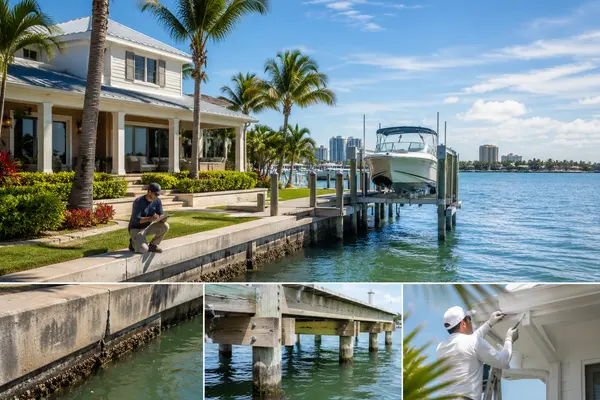
- Seawall or dock inspection
- Structural evaluation when appropriate
Not every home requires every type of inspection. The appropriate scope depends on the property's characteristics and the buyer's concerns.
Inspection findings should be reviewed with qualified inspectors and, where appropriate, contractors, engineers, or other licensed specialists before making decisions about the property.
9. HOA, Condominium, and CDD Expenses at Closing
Properties in homeowners associations or condominium communities may involve additional transaction charges.
Depending on the community and contract, these may include:
- Association application fees
- Transfer or administrative fees
- Estoppel-related charges
- Prorated association dues
- Capital contributions or other authorized charges
- Special assessment adjustments
- Other applicable community-specific expenses
Community Development District assessments may also affect ownership expenses, although they are not necessarily a separate closing fee. Some are collected through property tax bills, and applicable prorations or adjustments may arise during settlement.
Buyers should verify current fees, outstanding balances, approved assessments, and available information about future obligations with the association, district, or appropriate professional.
10. Example: Closing Costs on a $400,000 Florida Home
Consider a hypothetical buyer purchasing a $400,000 Florida home with a $320,000 mortgage and an $80,000 down payment.
The following example illustrates how closing expenses might be organized. Except for the simplified statutory mortgage tax calculations, the amounts are assumed solely for educational purposes. They are not quotes, market averages, or estimates for a particular property.
| Expense | Illustrative Amount |
|---|---|
| Mortgage origination and lender fees | $2,000 |
| Appraisal and other loan services | $800 |
| Buyer-paid title and settlement expenses | $2,000 |
| Mortgage documentary stamp tax | $1,120 |
| Nonrecurring intangible tax | $640 |
| Recording and miscellaneous government fees | $200 |
| Prepaid homeowners insurance | $3,000 |
| Initial escrow deposits | $2,000 |
| Prepaid mortgage interest | $600 |
| Illustrative closing costs and prepaid expenses | $12,360 |
Under these assumptions, the buyer would have:
- Down payment: $80,000
- Illustrative closing costs and prepaids: $12,360
- Total before deposits, credits, and adjustments: $92,360
If the buyer had already paid a $10,000 earnest money deposit that was properly credited toward the purchase, the remaining amount due under this simplified example would be $82,360, assuming no other adjustments.
This example is not a complete settlement statement. It assumes no discount points, no additional flood insurance premium, no separate association charges, no unusual property-specific expenses, and no seller credits or property tax prorations. Actual title allocations, insurance premiums, escrow requirements, taxes, and other costs could change the result substantially. Any inspections paid separately before closing and post-closing reserves would also need to be considered in the broader purchase budget.
11. Who Pays Closing Costs in Florida, the Buyer or Seller?
Florida buyers and sellers both may have expenses at closing. However, there is no universal rule assigning every charge to one party in every residential transaction.
Some allocations reflect common transaction practices, while others depend on the signed purchase contract, negotiated concessions, applicable law, or the specific financing arrangement.
Expenses Commonly Associated With the Buyer
- Mortgage lender fees
- Mortgage appraisal and applicable loan services
- Mortgage documentary stamp tax, when allocated to the buyer
- Applicable nonrecurring intangible tax passed through to the borrower
- Mortgage recording charges
- Prepaid insurance and interest
- Initial escrow deposits
- Buyer-selected inspections
- Other expenses assigned to the buyer under the contract
Expenses Commonly Associated With the Seller
- Deed documentary stamp tax, when allocated to the seller
- Certain title and settlement expenses, depending on the contract
- Mortgage and lien payoff-related expenses
- Agreed seller concessions
- Applicable prorations and adjustments
- Other obligations assigned to the seller
Brokerage compensation is negotiable and depends on the applicable agreements and transaction terms. Buyers should review any buyer-broker compensation obligations and how they are addressed in the purchase contract and settlement documents.
For additional information about the seller's side of the transaction, read Florida Seller Closing Costs in 2026: How to Estimate Net Proceeds.
12. Can You Negotiate Closing Costs When Buying a Florida Home?
Some closing expenses can be negotiated or reduced, while others are established by government rules, lender requirements, or the selected service provider.
Seller Closing-Cost Credits
A buyer may negotiate for the seller to contribute toward allowable closing expenses.
The benefit depends on the agreed credit, the buyer's actual eligible expenses, the loan program, and any applicable contribution limits.
A seller credit generally cannot simply be treated as unrestricted cash paid to the buyer at closing.
Comparing Mortgage Lenders
Buyers can compare mortgage offers to evaluate lender charges, interest rates, discount points, and credits.
A lower upfront fee does not always mean the loan will cost less over time. Buyers should compare the overall financing terms with a qualified mortgage professional.
Price Reduction Versus Closing-Cost Credit
A purchase-price reduction and an equivalent seller credit can affect a buyer's finances differently.
A price reduction may lower the amount financed, while a permitted closing-cost credit may reduce the immediate cash required for eligible expenses.
For a more detailed comparison, see Should You Ask for a Price Reduction or Closing-Cost Credit When Buying a Florida Home?.
13. How Do Closing Costs Differ for Sarasota and Gulf Coast Properties?
The same general categories of Florida closing expenses apply throughout Sarasota, Manatee County, and nearby Gulf Coast communities.
However, the property's location, characteristics, and community obligations can materially affect the amount of money needed to complete the purchase.
Sarasota Mainland Homes
Mainland Sarasota homes vary in age, construction, condition, and association arrangements. Buyers should obtain property-specific insurance estimates and account for any specialized inspections or community charges.
Siesta Key, Lido Key, and Longboat Key
Barrier-island and coastal properties may involve additional flood insurance considerations, wind coverage questions, specialized inspections, or condominium-related charges.
Not every coastal property has the same exposure or insurance requirements. Buyers should obtain quotes and professional evaluations for the specific property.
Lakewood Ranch and Planned Communities
Some planned communities have association fees, CDD assessments, transfer charges, or other obligations that buyers should investigate before closing.
Venice, Nokomis, Osprey, and Bradenton
Buyers considering these communities should evaluate the same categories of expenses while accounting for each property's insurance, financing, association, and maintenance characteristics.
The purchase price alone does not determine the total closing expense. Two homes with similar prices can produce different cash-to-close requirements.
14. What Is the Difference Between Closing Costs and Cash to Close?
Closing costs and cash to close are related, but they are not interchangeable.
Closing costs generally refer to the charges and expenses associated with completing the transaction and obtaining financing, excluding the down payment.
Cash to close is the final amount the buyer must provide at settlement after accounting for the down payment, applicable closing expenses, deposits already paid, credits, and adjustments.
For example, consider a simplified transaction with:
- Down payment: $20,000
- Closing costs and prepaid expenses: $12,000
- Earnest money deposit already paid: $5,000
- Agreed and permitted seller credit: $3,000
Assuming the full seller credit can be applied and there are no other adjustments, the calculation would be:
$20,000 + $12,000 - $5,000 - $3,000 = $24,000 cash to close
This example illustrates why the amount required at settlement may differ from both the down payment and the total closing expenses.
The lender and closing professional should provide the actual transaction-specific figures.
15. When Do Florida Buyers Receive Their Final Closing-Cost Figures?
For most covered mortgage transactions, buyers receive two important documents during the financing process.
The Loan Estimate
The lender generally must provide a Loan Estimate within three business days after receiving a mortgage application containing the required information.
This document includes estimated loan terms, mortgage payments, closing costs, and cash-to-close information.
The Closing Disclosure
For covered mortgages, the lender must ensure the borrower receives the Closing Disclosure at least three business days before consummation.
The document provides the final loan terms, closing charges, and cash-to-close calculation. Certain changes may require additional disclosures or timing adjustments.
The Consumer Financial Protection Bureau explains the Closing Disclosure and why buyers should review it carefully before completing their mortgage transaction.
What Should You Check Before Closing?
- Purchase price and loan amount
- Interest rate and loan terms
- Lender fees and discount points
- Title and settlement charges
- Applicable government taxes and recording fees
- Prepaid homeowners and flood insurance
- Initial escrow deposits
- Earnest money deposit credits
- Seller concessions
- Property tax and association prorations
- Final cash-to-close amount
Buyers should promptly raise questions about unexpected charges or discrepancies with their lender and closing professional.
16. How Do You Safely Pay Closing Costs in Florida?
The title or settlement company will provide instructions for delivering the required closing funds.
Depending on the transaction, accepted payment methods may include a wire transfer or another form of verified funds approved by the settlement provider.
Buyers should be especially careful about wire transfer fraud. Criminals may impersonate real estate agents, lenders, or title companies and send fraudulent payment instructions.
Before sending funds, independently verify the instructions by calling the settlement company using a trusted telephone number obtained separately from the payment message. Do not rely solely on contact information supplied in an unexpected email or text.
Buyers should confirm the approved payment method, exact amount, recipient, and timing directly with their closing professional.
17. Florida Closing-Cost Checklist for Homebuyers
Before completing a Florida home purchase, buyers can use the following checklist to organize the information needed for an accurate closing budget.
- Obtain a current mortgage Loan Estimate from your lender.
- Identify all lender origination fees and optional discount points.
- Confirm appraisal and other lender-required service charges.
- Request a title and settlement cost estimate.
- Review the purchase contract's allocation of title and closing expenses.
- Confirm applicable documentary stamp and intangible taxes.
- Obtain property-specific homeowners insurance quotes.
- Investigate flood insurance requirements and available coverage.
- Ask the lender to explain prepaid interest and escrow deposits.
- Review anticipated property tax prorations.
- Verify association fees, transfer charges, and assessments.
- Account for inspections and other expenses paid before closing.
- Confirm any agreed seller credits and lender limitations.
- Review the Closing Disclosure and settlement figures carefully.
- Independently verify closing-fund delivery instructions.
- Consider appropriate financial reserves for expenses after closing.
For additional information about Florida purchase contracts and transaction obligations, visit Hunt Brothers Realty's Florida Real Estate Contract Essentials.
Frequently Asked Questions About Florida Closing Costs
How Much Are Closing Costs on a $300,000 House in Florida?
Using a broad 2% to 5% planning assumption, closing costs on a $300,000 home would equal approximately $6,000 to $15,000, excluding the down payment. Actual charges depend on financing, title and settlement arrangements, prepaid expenses, and the property. Buyers should request a transaction-specific estimate rather than relying on this illustrative range.
How Much Are Closing Costs on a $500,000 Florida Home?
A 2% to 5% illustration produces a range of $10,000 to $25,000. This is not a verified Florida average, and actual expenses may fall outside the range. The buyer's lender and closing professional should calculate the applicable charges.
Do First-Time Homebuyers Pay Closing Costs in Florida?
Yes. First-time homebuyers generally encounter applicable transaction and financing expenses. Some eligible buyers may qualify for assistance programs or negotiate seller contributions that reduce certain upfront costs. Availability and eligibility should be verified with a participating lender or appropriate housing agency.
Can Florida Closing Costs Be Rolled Into a Mortgage?
Some financing arrangements may allow certain costs to be financed or offset through permitted credits, but this depends on the loan program, property value, underwriting requirements, and transaction structure. Buyers should not assume that all closing expenses can be added to the mortgage balance.
Does a Cash Buyer Pay Closing Costs in Florida?
Yes. Cash buyers may still pay title, settlement, recording, inspection, insurance, association, and other applicable expenses. However, they generally avoid charges associated specifically with obtaining a new mortgage.
Are Florida Closing Costs Tax-Deductible?
The tax treatment of closing expenses depends on the type of charge, how the property is used, and the buyer's individual tax circumstances. Buyers should consult a qualified tax professional or CPA rather than assuming that all closing costs are deductible.
Do Closing Costs Change If I Buy a Condo in Florida?
They can. Condominium transactions may involve association application charges, transfer fees, estoppel-related expenses, prorated dues, and assessment adjustments. Mortgage and insurance requirements may also differ from those for a detached home. Buyers should review the actual association documents and financing requirements.
Final Thoughts: Understanding Closing Costs Before Buying a Florida Home
Closing costs are an important part of the financial preparation involved in purchasing a Florida home.
While a broad percentage estimate can help buyers begin planning, the actual amount depends on the mortgage, title and settlement arrangements, applicable taxes, insurance requirements, purchase contract, and property-specific expenses.
Buyers should distinguish closing costs from the down payment, understand which expenses are paid before settlement, and carefully review the final cash-to-close calculation.
For buyers exploring Sarasota and Florida's Gulf Coast, obtaining accurate insurance estimates, reviewing association obligations, and confirming contract-specific closing allocations can be especially valuable.
A qualified mortgage lender and title or closing professional can provide the transaction-specific figures needed to determine how much money must be available at settlement.
Buying a Home in Sarasota or Florida's Gulf Coast?
At Hunt Brothers Realty, we help buyers explore residential properties throughout Sarasota and Florida Gulf Coast real estate,
Whether you are purchasing your first Florida home, relocating from another state, searching for a waterfront residence, or comparing condominium communities, understanding the purchase process and associated expenses is an important part of planning your home search.
Our team can help you explore available properties, understand real estate transaction considerations, and coordinate with the appropriate mortgage, title, insurance, inspection, and other professionals involved in your purchase.
Visit Hunt Brothers Realty to begin your Sarasota-area home search.
Important Professional Verification Information
This article is provided for general informational and educational purposes only. It does not constitute individualized legal, financial, tax, insurance, lending, title, inspection, engineering, construction, association, or other professional advice. Closing costs, tax treatment, financing requirements, insurance premiums, settlement charges, and contractual obligations vary by property and transaction. All numerical examples are illustrative and should not be interpreted as quotes or guarantees. Buyers should obtain property-specific closing estimates from their mortgage lender and title or closing professional, review insurance costs and coverage with a qualified insurance professional, and consult a qualified tax professional regarding tax consequences. Questions involving contract rights, title, ownership, tax liability, or other legal matters should be reviewed with a qualified Florida real estate attorney or other appropriate legal professional. Inspection findings and property conditions should be evaluated with qualified inspectors, contractors, engineers, or other appropriate specialists before making a purchasing decision.
Sources
- Consumer Financial Protection Bureau, Loan Estimate Explainer
- Consumer Financial Protection Bureau, Closing Disclosure Explainer
- Consumer Financial Protection Bureau, Mortgage Closing Fees and Charges
- Florida Department of Revenue, Documentary Stamp Tax
- Florida Department of Revenue, Nonrecurring Intangible Tax
- Federal Emergency Management Agency, Flood Map Service Center
- Hunt Brothers Realty, The True Cost of Buying a Home in Florida
- Hunt Brothers Realty, Florida Seller Closing Costs in 2026
- Hunt Brothers Realty, Seller Concessions in Florida
- Hunt Brothers Realty, Florida Real Estate Contract Essentials
Contact Hunt Brothers Realty
Hunt Brothers Realty
46 N. Washington Blvd, Ste 3
Sarasota, FL 34236
Phone: (941) 388-7017
Email: info@huntbrothersrealty.com
Website: www.huntbrothersrealty.com
Categories
- All Blogs 1950
- Anna Maria Island 83
- Bird Key 4
- Bradenton 234
- Buying a Home 1020
- Casey Key 2
- Clearwater 9
- Condos & HOA Living 931
- Ellenton 5
- Englewood 9
- First Time Homebuyers 1124
- Foreclosures 3
- Home Selling 1
- Homeownership 1144
- Lakewood Ranch 20
- Lido Key 27
- Longboat Key 78
- Luxury/Waterfront Properties 1085
- Market Updates & Trends 614
- Mortgages & Financing 42
- Move-Up Buyers 20
- Neighborhood Guides 737
- New Construction 32
- Palmetto 3
- Parrish 6
- Port Charlotte 10
- Punta Gorda 15
- Real Estate Investing 1002
- Relocation to Florida 1046
- Safety Harbor 2
- Sarasota 71
- Sarasota - Downtown 157
- Selling a Home 143
- Siesta Key 89
- St. Petersburg 6
- Tierra Verde 5
- Vacation & Second Homes 1193
- Venice 96
- Wellen Park 10
Recent Posts