How Much Down Payment Do I Need to Buy a Home in Florida?
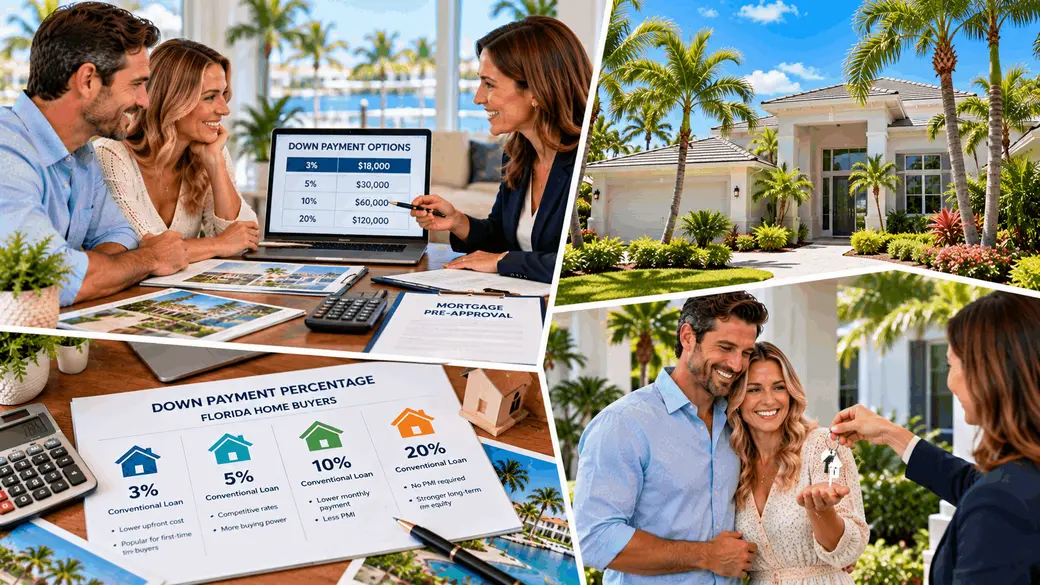
You do not automatically need 20% down to buy a home in Florida. Qualified buyers may have conventional mortgage options requiring as little as 3% down, FHA financing can permit 3.5% down for eligible borrowers, and qualified VA or USDA borrowers may have zero-down-payment options. The right amount depends on the mortgage program, credit and financial profile, property type, occupancy, lender requirements and how much cash you want to preserve after closing. Florida buyers should also budget separately for closing costs, inspections, insurance, moving expenses and post-closing reserves.
Quick Answers About Down Payments for Buying a Home in Florida
Do I Need 20% Down to Buy a House in Florida?
No. Twenty percent is not a universal requirement for buying a Florida home. Qualified buyers can have conventional options starting around 3% down, FHA financing at 3.5% for eligible borrowers, and VA or USDA options that can provide 100% financing when program requirements are satisfied.
Can I Buy a Florida Home With 3% Down?
Potentially. Certain conventional mortgage programs permit qualified borrowers to finance up to 97% of an eligible property's value or purchase price under applicable program rules. Eligibility, property type, occupancy, underwriting and lender requirements still apply.
How Much Down Does an FHA Loan Require?
FHA rules can permit a minimum required investment of 3.5% for an otherwise eligible borrower with an applicable decision credit score of 580 or higher. Under FHA's established framework, borrowers with scores from 500 through 579 generally need at least 10% down. Individual lenders can impose additional underwriting requirements.
Can I Buy a Florida Home With No Down Payment?
Some buyers can. Eligible Veterans, service members and qualifying survivors may have access to a VA-backed home loan with no required down payment in qualifying circumstances. Eligible borrowers purchasing eligible properties may also have access to 100% financing through the USDA rural housing program.
Is the Down Payment the Same as Closing Costs?
No. Your down payment is the portion of the purchase price you pay rather than finance. Closing costs are separate transaction expenses. Hunt Brothers Realty's Florida buyer closing-cost guide uses approximately 2% to 5% of the purchase price as a broad preliminary planning range, excluding the down payment, while emphasizing that actual costs vary by transaction.
Is Earnest Money Part of My Down Payment?
Earnest money and the down payment are different, but the deposit is generally credited into the transaction if the purchase closes. That means buyers should not automatically add the earnest-money deposit to the down payment as though the same money must be paid twice. Read Hunt Brothers Realty's guide to earnest money versus a down payment for a detailed explanation.
Is a Bigger Down Payment Always Better?
Not automatically. A larger down payment reduces the amount borrowed and can reduce the monthly principal and interest payment, but it also uses cash that could otherwise remain available for closing costs, repairs, moving expenses and financial reserves. Buyers should compare actual loan scenarios rather than assuming the largest possible down payment is always preferable.
What Does a Down Payment Actually Mean?
A down payment is the portion of a home's purchase price that you pay rather than finance through your mortgage.
Suppose you buy a Florida home for $400,000 and make a 10% down payment. Ten percent of $400,000 is $40,000. Before accounting for financing adjustments and other transaction details, the remaining $360,000 would represent the amount to be financed.
The basic arithmetic is simple:
Purchase price × down-payment percentage = down payment
The more complicated question is how much you are required to put down and how much you should choose to put down. Those are not necessarily the same number.
How Much Is 3%, 5%, 10% or 20% Down on a Florida Home?
Seeing down-payment percentages converted into dollars makes the differences much easier to understand.
| Home Price | 3% Down | 5% Down | 10% Down | 20% Down |
|---|---|---|---|---|
| $250,000 | $7,500 | $12,500 | $25,000 | $50,000 |
| $300,000 | $9,000 | $15,000 | $30,000 | $60,000 |
| $400,000 | $12,000 | $20,000 | $40,000 | $80,000 |
| $500,000 | $15,000 | $25,000 | $50,000 | $100,000 |
| $750,000 | $22,500 | $37,500 | $75,000 | $150,000 |
These figures show only the down payment. They do not include closing costs, prepaid expenses, inspections, moving costs or money you may want to retain after closing.
Can a Conventional Loan Require Only 3% Down?
Yes, certain conventional financing options can allow qualified borrowers to purchase with approximately 3% down. Eligibility depends on the mortgage program, occupancy, property, borrower qualifications and underwriting.
For example, Fannie Mae's HomeReady program provides financing up to 97% loan-to-value for eligible transactions, meaning the borrower's minimum contribution can be approximately 3% under qualifying circumstances. Freddie Mac also offers low-down-payment conventional financing through eligible programs.
Other conventional borrowers may use 5%, 10%, 15%, 20% or another amount depending on the available loan and their financial strategy.
A 3% conventional option should not be interpreted as a guarantee that every buyer, property or lender will qualify for that structure. A qualified mortgage professional should determine the actual financing available to the individual buyer.
How Much Down Do You Need for an FHA Loan in Florida?
FHA financing has one of the clearest relationships between credit score and the program's minimum required investment.
- Applicable decision credit score of 580 or higher: FHA rules can permit the 3.5% minimum required investment for an otherwise eligible borrower.
- Applicable decision credit score from 500 through 579: FHA rules generally require at least 10% down.
- Below 500: the borrower does not satisfy FHA's established minimum decision credit-score framework for FHA insurance.
Those are program-level rules, not a promise that every lender will approve a borrower at those thresholds. Lenders can apply additional underwriting standards.
FHA financing also involves mortgage insurance and other program requirements. Buyers should compare the complete loan, including interest rate, annual percentage rate, mortgage insurance, fees, cash to close and monthly payment rather than choosing FHA solely because of the minimum down payment.
Credit requirements are discussed in more detail in Hunt Brothers Realty's 2026 Florida homebuyer credit-score guide.
Can a VA Loan Really Require No Down Payment?
Yes, an eligible borrower can potentially purchase a qualifying home using a VA-backed mortgage without a down payment.
The U.S. Department of Veterans Affairs states that VA-backed home loans can offer eligible Veterans, service members and qualifying survivors the option to purchase with no down payment. The VA reports that nearly 90% of VA-backed loans are made without a down payment.
That does not mean every VA transaction requires zero cash. Buyers can still encounter closing costs, prepaid expenses, deposits and other transaction costs. A VA funding fee may also apply depending on the borrower's circumstances, although exemptions exist for qualifying borrowers.
Eligibility, entitlement, lender underwriting, income, credit, property requirements and appraisal considerations still apply. Buyers should confirm their Certificate of Eligibility and financing structure with a qualified VA lender.
Can USDA Financing Provide 100% Financing in Florida?
Potentially. USDA's Single Family Housing Guaranteed Loan Program can provide 100% financing for eligible borrowers purchasing eligible properties.
USDA financing is not available for every buyer or every Florida property. Household income limits, occupancy requirements, property eligibility, underwriting and other program rules apply.
A buyer interested in USDA financing should have a qualified USDA lender check both borrower eligibility and the exact property address before assuming the home qualifies for zero-down financing.
Why Do So Many Buyers Think They Need 20% Down?
Twenty percent remains an important mortgage benchmark even though it is not a universal minimum.
With many conventional mortgages, starting at 80% loan-to-value or lower can allow the borrower to avoid private mortgage insurance. A 20% down payment on a purchase can produce that 80% loan-to-value relationship when the financing and valuation support it.
Putting 20% down also reduces the amount borrowed. All else being equal, that produces a smaller principal-and-interest payment than financing 90%, 95% or 97% of the same purchase price.
But avoiding mortgage insurance is not the only consideration. Using an additional $50,000 or $100,000 for the down payment means that cash is no longer available for other purposes. The decision should therefore be evaluated as part of the buyer's complete financial plan.
What Is the Difference Between 5% and 20% Down on a $400,000 Florida Home?
Consider a simplified $400,000 purchase.
| Down Payment | Cash Down | Illustrative Loan Amount |
|---|---|---|
| 3% | $12,000 | $388,000 |
| 5% | $20,000 | $380,000 |
| 10% | $40,000 | $360,000 |
| 20% | $80,000 | $320,000 |
Moving from 5% to 20% down in this example requires another $60,000 in cash but reduces the illustrative mortgage balance by the same $60,000.
Whether that tradeoff is attractive depends on the actual mortgage rate, mortgage insurance, loan pricing, monthly-payment target, available savings and the buyer's broader financial circumstances.
How Much Cash Do You Need Beyond the Down Payment?
This is where many homebuying budgets become unrealistic. The down payment is not the same as the total amount of money needed to purchase a home.
Depending on the property and transaction, buyers may need funds for:
- Down payment
- Mortgage lender and origination charges
- Discount points if selected
- Appraisal and applicable loan services
- Title and settlement expenses
- Recording and applicable mortgage taxes
- Prepaid homeowners insurance
- Flood insurance when applicable
- Initial tax and insurance escrow funding when applicable
- Prepaid mortgage interest
- Home and specialized inspections
- Association application or other applicable charges
- Moving expenses
- Immediate repairs or maintenance
- Post-closing financial reserves
For preliminary planning, Hunt Brothers Realty's 2026 Florida closing-cost guide uses approximately 2% to 5% of the purchase price as a broad illustration for closing costs, excluding the down payment. Actual costs can fall outside that range.
How Much Cash Might a Buyer Need on a $400,000 Florida Home?
Suppose a buyer purchases a $400,000 home using a conventional mortgage with 5% down.
- Purchase price: $400,000
- 5% down payment: $20,000
- Illustrative 2% to 5% closing-cost range: $8,000 to $20,000
Under those simplified assumptions, the down payment plus the illustrative closing-cost range would equal approximately $28,000 to $40,000 before separately paid inspections, moving costs, immediate repairs and post-closing reserves.
That is an educational illustration, not an estimate for a specific transaction. The actual cash to close can be affected by deposits already paid, seller credits, lender credits, prepaid expenses, tax prorations, insurance, discount points, association charges and other adjustments.
Does Earnest Money Increase the Down Payment I Need?
Not simply because it is called earnest money. Earnest money is a contractual deposit, while the down payment is part of the financing structure.
If the purchase closes and the deposit is properly credited, the money already deposited is generally reflected in the closing calculation. It does not simply disappear and require the buyer to contribute the same funds a second time.
For example, imagine a buyer purchasing a $500,000 home with 10% down. The total down payment is $50,000. If the buyer previously delivered a $10,000 earnest-money deposit that receives the expected credit at closing, that $10,000 is already part of the funds contributed to the transaction.
The actual remaining cash to close would also account for closing costs, prepaid expenses, credits and other transaction adjustments. Read Earnest Money vs. Down Payment for a complete explanation.
Can Seller Concessions Reduce the Cash You Need?
Potentially. A negotiated seller concession can sometimes be applied toward allowable buyer closing costs, prepaid expenses, mortgage discount points or other eligible expenses, subject to the mortgage program and transaction.
A seller concession does not normally mean the seller simply gives the buyer unrestricted cash. Mortgage programs impose limits and rules governing what the seller can pay and how credits may be used.
In an appropriate transaction, however, a negotiated credit can reduce the amount of the buyer's own cash needed for eligible closing expenses. That can allow the buyer to preserve more savings while still satisfying the required down payment.
Hunt Brothers Realty's 2026 Florida seller-concession guide explains how these credits can work with conventional, FHA and VA financing.
Should You Put More Down to Lower Your Monthly Payment?
A larger down payment reduces the mortgage balance. If the other loan terms remain the same, borrowing less reduces the monthly principal-and-interest payment.
It can also change mortgage insurance, loan pricing or qualification depending on the financing. But the relationship is not always simple enough to evaluate using the down-payment percentage alone.
Ask your lender to price multiple scenarios using the same property and financial profile. For example:
- 3% down
- 5% down
- 10% down
- 20% down
Compare the interest rate, annual percentage rate, loan amount, mortgage insurance, lender fees, cash to close and total monthly payment under each structure.
Why Should Florida Buyers Avoid Using Every Dollar for the Down Payment?
Closing on the home does not end the need for cash. It begins the period when the buyer becomes responsible for the property.
Florida ownership can involve expenses such as:
- Homeowners insurance deductibles
- Flood insurance when applicable
- Air-conditioning repairs
- Roof maintenance
- Plumbing and electrical repairs
- Appliance replacement
- Pool maintenance
- Landscaping
- HOA or condominium assessments
- Unexpected special assessments for condominium owners
- Immediate repairs identified during inspection
That is why the question should not simply be, "How much can I put down?" It should also be, "How much cash will I have left after I buy the home?"
Hunt Brothers Realty's guide to how much savings to keep after buying a house explains why emergency savings and property-specific reserves should be considered separately from lender minimums.
Does Your Down Payment Affect Mortgage Insurance?
It can. Mortgage insurance rules differ by financing program.
With many conventional mortgages, private mortgage insurance may apply when the loan begins above 80% loan-to-value. The premium can depend on factors such as credit, loan-to-value and other loan characteristics.
FHA uses its own mortgage-insurance structure rather than conventional private mortgage insurance. VA and USDA financing also have their own program fees and requirements.
Ask the lender to show mortgage-insurance costs and program fees in each proposed financing scenario. Comparing only the interest rate or down payment can hide meaningful differences in the complete monthly cost.
Does Your Credit Score Affect the Down Payment?
Credit can affect both the mortgage options available and the economics of those options. FHA provides the clearest example because its minimum required investment changes under its established credit-score framework.
Conventional underwriting is more nuanced. Credit can influence approval, interest rate, mortgage insurance and other pricing, while the actual result depends on the complete loan file.
VA and USDA programs do not establish one universal program-level minimum credit score in the same way many buyers expect, but individual lenders can impose their own standards.
Before trying to change credit accounts or pay down specific debts solely to improve mortgage qualification, ask a qualified mortgage professional how those actions could affect the actual loan application.
Does Property Type Affect How Much You Need Down?
It can. Minimum down-payment requirements and underwriting can change based on the property and intended occupancy.
A buyer purchasing a primary single-family residence may have financing options that differ from someone buying:
- A second home
- An investment property
- A multi-unit property
- A condominium
- Another property subject to program-specific eligibility requirements
Condominium financing can also involve review of the condominium project itself. Association finances, insurance, litigation, building condition and other project characteristics can affect financing eligibility even when the buyer personally qualifies for the mortgage.
Should First-Time Florida Buyers Wait Until They Have 20%?
Not solely because they believe 20% is mandatory. It usually is not.
Waiting can still make sense when additional time would materially improve credit, reduce debt, increase emergency savings or make the complete monthly payment more comfortable. But the decision should be based on the buyer's finances and actual mortgage options rather than a mistaken belief that every lender requires 20% down.
A qualified lender can compare a lower-down-payment purchase today with a larger-down-payment scenario later. That comparison should include mortgage insurance, interest rate, closing costs, monthly payment and the amount of savings remaining after closing.
How Should You Choose Your Florida Down Payment?
Instead of choosing a percentage first, work backward from the complete purchase budget.
Ask your mortgage professional to compare:
- Minimum down payment for each available program
- Interest rate and annual percentage rate
- Monthly principal and interest
- Mortgage insurance or applicable program fees
- Estimated property taxes
- Property-specific homeowners insurance
- Flood insurance when applicable
- HOA or condominium assessments
- Closing costs and prepaid expenses
- Estimated cash to close
- Cash remaining after closing
Then compare those numbers with the complete ownership cost of the homes you are considering. Hunt Brothers Realty's guide to the true cost of buying a home in Florida explains why taxes, insurance, associations, maintenance and future property expenses belong in the affordability calculation.
What Should You Ask a Mortgage Lender About the Down Payment?
A useful lender conversation goes beyond asking for the minimum percentage. Consider asking:
- What is the lowest down payment available to me?
- What changes if I put 5%, 10% or 20% down instead?
- How does each option affect my interest rate?
- How does it affect mortgage insurance?
- What is the complete estimated monthly housing payment?
- What closing costs should I expect?
- What cash reserves does underwriting require?
- Can gift funds or approved assistance be used under this program?
- Are seller concessions permitted and what is the applicable limit?
- Does the property type affect my loan?
- What would my estimated cash to close be under each scenario?
Mortgage eligibility, rates, mortgage insurance, underwriting and cash requirements are borrower-specific. Buyers should obtain actual scenarios and a Loan Estimate from a qualified mortgage lender or loan professional before making a financing decision.
The Bottom Line: You Probably Do Not Need 20% Down
The amount needed to buy a Florida home depends on the buyer and the financing, not on a universal Florida down-payment percentage.
Qualified buyers may have conventional options around 3% down. FHA can permit 3.5% down for eligible borrowers under its applicable credit framework. Eligible VA and USDA borrowers can potentially purchase with no down payment.
But the lowest possible down payment is not automatically the best down payment. The stronger decision considers the mortgage payment, mortgage insurance, closing costs, property-specific insurance, taxes, association expenses, repairs and the amount of savings remaining after closing.
Start with your lender's actual financing scenarios, then evaluate homes based on the complete cost of purchasing and owning the property.
Plan Your Florida Home Purchase With Hunt Brothers Realty
Hunt Brothers Realty helps buyers compare Florida Gulf Coast properties while considering the real estate factors that can affect the complete ownership budget, including property type, association costs, condition, insurance considerations and location.
Before starting your search, review Florida buyer closing costs, learn how much savings to consider keeping after closing, and explore Florida Gulf Coast communities.
When you are ready to compare properties, contact Hunt Brothers Realty to discuss your home search.
This article provides general real estate and educational information only and is not individualized mortgage, lending, financial, tax, legal or insurance advice. Mortgage programs, underwriting requirements, rates, fees, mortgage insurance and eligibility can change and vary by borrower, lender and property. Buyers should verify their available financing, required down payment, closing costs and estimated cash to close with a qualified mortgage lender or loan professional. Property-specific insurance should be reviewed with a qualified insurance professional, tax questions with an appropriate tax professional, and legal or contractual questions with a qualified Florida real estate attorney or other appropriate legal professional.
Sources
- U.S. Department of Veterans Affairs, VA-Backed Home Loans
- U.S. Department of Veterans Affairs, Buying a Home With a VA-Backed Loan
- Fannie Mae Selling Guide
- USDA Rural Development, Single Family Housing Guaranteed Loan Program
- Hunt Brothers Realty, How Much Should You Put Down on a House?
- Hunt Brothers Realty, Florida Buyer Closing Costs in 2026
- Hunt Brothers Realty, Earnest Money vs. Down Payment
- Hunt Brothers Realty, Seller Concessions in Florida
- Hunt Brothers Realty, How Much Savings Should You Keep After Buying a House?
- Hunt Brothers Realty, The True Cost of Buying a Home in Florida
Contact Hunt Brothers Realty
46 N. Washington Blvd, Ste 3, Sarasota, FL 34236
Phone: (941) 388-7017
Email: info@huntbrothersrealty.com
Website: HuntBrothersRealty.com
Categories
- All Blogs 2090
- Anna Maria Island 86
- Bird Key 4
- Bradenton 236
- Buying a Home 1151
- Casey Key 2
- Clearwater 11
- Condos & HOA Living 1069
- Ellenton 5
- Englewood 11
- First Time Homebuyers 1260
- Foreclosures 4
- Home Selling 4
- Homeownership 1283
- Lakewood Ranch 25
- Lido Key 28
- Longboat Key 80
- Luxury/Waterfront Properties 1224
- Market Updates & Trends 747
- Mortgages & Financing 45
- Move-Up Buyers 21
- Neighborhood Guides 860
- New Construction 34
- Palmetto 3
- Parrish 6
- Port Charlotte 10
- Punta Gorda 17
- Real Estate Investing 1141
- Relocation to Florida 1181
- Safety Harbor 3
- Sarasota 79
- Sarasota - Downtown 162
- Selling a Home 144
- Siesta Key 91
- St. Petersburg 8
- Tierra Verde 5
- Vacation & Second Homes 1333
- Venice 179
- Wellen Park 17
Recent Posts