What Should I Know Before Buying a Home With a Dock?
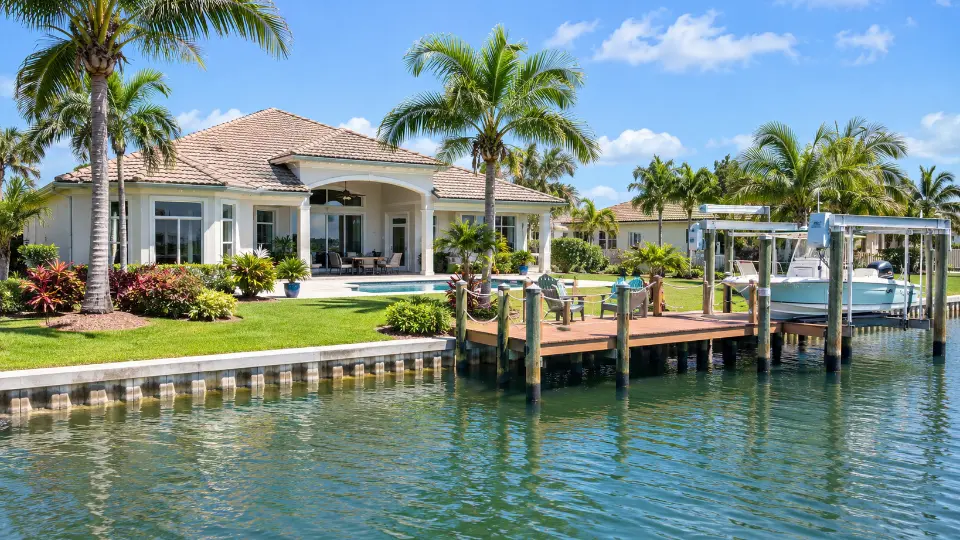
Before buying a Florida home with a dock, verify much more than whether the dock looks usable. Confirm your legal ownership or use rights, available permits, dock and boat-lift condition, lift capacity, water depth, tidal variation, canal width, bridge clearance and the complete boating route. Also investigate the seawall or shoreline, flood exposure, insurance, association restrictions and whether future dock, lift or dredging work is actually feasible. A waterfront home can have a beautiful private dock and still be unsuitable for your particular boat or long-term ownership plans.
Quick Answers About Buying a Home With a Dock
Does having a dock mean I can keep my boat at the house?
No. The boat must work with the dock, lift, water depth, canal or waterway, bridges and complete navigation route. You should also verify legal use rights and any governmental or association restrictions affecting the vessel or dock.
How do I know if a dock is properly permitted?
Ask for permit and construction records and compare the approved configuration with what physically exists. Depending on the location and project, Florida Department of Environmental Protection, local government, submerged-land and other requirements may apply. A dock's age or physical presence does not by itself prove that its current configuration is authorized.
Can I enlarge or replace the dock after I buy the home?
Possibly, but never make the purchase dependent on that assumption without investigating it first. Dock construction, replacement, boat lifts and other waterfront work can require different authorizations depending on the project's size, location, environmental conditions and applicable local rules.
How do I know whether the water is deep enough for my boat?
Evaluate depth at the dock and along the entire route you intend to navigate, including relevant tidal conditions. A deep area immediately behind the house does not help if a shallow canal entrance, channel or other restriction prevents your vessel from reaching open water.
What should I check about a boat lift?
Verify the lift's documented capacity, cradle configuration, dimensions, piling condition, motors, cables, electrical equipment and overall condition. Do not assume a lift works for your vessel simply because the boat appears to fit between the pilings.
Should the seawall be inspected too?
Yes, when the property has a seawall or similar shoreline structure. Its material, age, condition, previous repairs and maintenance responsibility can materially affect future ownership costs. Significant concerns should be evaluated by an appropriate marine contractor, engineer or other qualified waterfront professional.
Does homeowners insurance cover flooding at a waterfront home?
Standard homeowners insurance generally does not cover flooding from rising water. Waterfront buyers should obtain property-specific homeowners and flood insurance information and review appropriate coverage, exclusions and deductibles with a qualified insurance professional.
Can I assume I will be able to dredge if the water is too shallow?
No. Never buy a waterfront property on the assumption that dredging will automatically be allowed or practical. Environmental, governmental, ownership and association restrictions may apply, and feasibility should be verified with the appropriate authorities and qualified professionals before it affects your purchasing decision.
The Most Important Question Is Not, "Does It Have a Dock?"
For a boating buyer, the better question is, "Can I legally and practically keep and use my specific boat here?"
That distinction matters because the dock is only one component of a complete waterfront system. Your boat has to work with the lift, available depth, tides, canal width, bridges and navigation route.
Hunt Brothers Realty's guide to keeping a boat at a Florida home provides a detailed framework for evaluating these interconnected issues.
1. Verify Your Legal Rights to the Dock and Waterfront
Do not assume that buying a waterfront parcel automatically gives you every right you expect over the adjacent water or submerged land.
Florida recognizes riparian rights associated with qualifying waterfront property, including qualified rights involving access to navigable water and docks. However, those rights exist within a larger legal and regulatory framework and should not be confused with unrestricted ownership of the adjacent water bottom.
The situation can become even more important when a dock, boat slip, easement or access area is shared, assigned through an association or located separately from the residential parcel.
Have the current survey, title information, deed, easements and applicable association documents reviewed by the appropriate qualified professionals when dock ownership or waterfront rights are material to your purchase. Questions involving title, riparian rights, easements or other legal rights should be addressed with a qualified Florida real estate attorney or other appropriate legal professional.
2. Confirm the Dock and Lift Are Properly Documented
An existing dock should be treated as a waterfront structure that deserves its own document review. Ask for available permits, exemption verifications, construction records, repair records and documentation for the boat lift and other waterfront improvements.
The Florida Department of Environmental Protection Environmental Resource Permitting program regulates many activities involving Florida surface waters, wetlands and submerged lands. DEP currently provides a self-certification process for certain qualifying single-family dock projects that are exempt from requiring a DEP permit, including qualifying new docks, dock repairs or replacements and boat-lift additions.
Other projects may require a general or individual Environmental Resource Permit. State authorization also does not necessarily eliminate applicable local permitting, submerged-land, environmental or association requirements.
Do not assume an old dock is automatically legal because it has been there for years. If permit documentation is incomplete, investigate the discrepancy before closing.
3. Inspect the Dock as a Structure
A dock may look fine from the house while having deterioration underneath or below the waterline. Saltwater, sun, marine organisms, storms and ordinary age can affect waterfront structures differently from the house itself.
Depending on the dock, an evaluation may include:
- Pilings and structural supports
- Decking
- Joists and connections
- Fasteners and hardware
- Corrosion and deterioration
- Storm-related damage
- Ladders and accessories
- Boat-lift structure
- Electrical service
- Water service
A qualified marine contractor or other appropriate waterfront specialist should evaluate structural concerns. Electrical equipment near water deserves particular care and should be evaluated by an appropriately qualified electrical professional when necessary.
4. Make Sure the Boat Lift Fits Your Boat
A boat lift is not a universal piece of equipment. Capacity and configuration matter.
Know the specifications of the vessel you own or realistically intend to own. Then compare them with the documented lift specifications.
- Loaded vessel weight
- Overall length
- Beam
- Draft
- Cradle or bunk configuration
- Lift's documented capacity
- Piling spacing and condition
- Motors, cables and controls
- Water depth below the lift
Leave appropriate capacity and compatibility decisions to the lift manufacturer, marine contractor or other qualified professional. Do not rely on a visual estimate or an unsupported statement that the lift "should be fine."
5. Measure the Water, Not Just the Dock
For a boating buyer, usable water can be more important than the dock itself.
Ask about water depth at the dock under relevant tidal conditions, but do not stop there. Investigate the shallowest controlling point along the entire route from the house to the bay, Intracoastal Waterway, Gulf, river or other destination you intend to use.
A property advertised as having "deep-water access" should be independently evaluated for your vessel. That marketing phrase does not tell you the guaranteed depth available to a particular boat at every stage of the tide.
Hunt Brothers Realty's guide to deep-water access in Sarasota explains why depth, tides and the complete route deserve separate investigation.
6. Follow the Entire Boating Route Before You Buy
A private dock can be minutes from open water on a map and still present practical limitations for your boat.
Investigate the entire route for:
- Fixed bridges
- Movable bridges
- Bridge clearance
- Shallow areas
- Tidal restrictions
- Canal width
- Turning and maneuvering space
- Marked channels
- Speed or wake restrictions
- Realistic travel time to your destination
A buyer with a center-console boat can have different requirements from someone with a sailboat, larger cruiser or vessel with substantial vertical clearance requirements.
7. Do Not Assume You Can Dredge Shallow Water
One of the riskiest assumptions a waterfront buyer can make is, "If it is too shallow, I will just dredge it."
Dredging can involve environmental permitting, submerged-land issues, disposal requirements, protected resources, local approvals and other regulatory considerations. You may also have little or no control over shallow conditions beyond your own waterfront area.
If dredging is necessary for the property to work for you, investigate feasibility and required approvals before making your purchasing decision. Do not treat future approval as guaranteed.
8. Inspect the Seawall and Shoreline
For many waterfront homes, the seawall is major infrastructure rather than a landscaping feature. Its condition can affect shoreline stability, the dock area and future ownership expenses.
Ask:
- What type of seawall is present?
- Approximately when was it installed?
- Has it been repaired or reinforced?
- Are permits and invoices available?
- Are there visible cracks, leaning or separation?
- Is soil washing out behind the wall?
- Who is responsible for maintenance?
- Are neighboring seawalls affecting the property?
A general home inspection may not provide the specialized assessment needed for marine infrastructure. Significant seawall concerns should be reviewed by an appropriate marine contractor, structural engineer or other qualified specialist before the buyer makes a decision.
9. Check for Mangroves and Other Shoreline Restrictions
Mangroves can be an important part of Florida's coastal environment, and trimming or altering them is regulated under Florida law.
The Florida Department of Environmental Protection's mangrove guidance explains that some qualifying homeowner trimming may be exempt, while other work requires a professional mangrove trimmer, permit or other authorization.
If your plan involves creating a view, widening waterfront access, modifying a dock or altering shoreline vegetation, investigate what is legally permissible before buying. Do not assume vegetation can simply be removed after closing.
10. Review HOA and Deed Restrictions
Government approval is not the only potential restriction on waterfront improvements. A homeowners association or deed restriction may regulate docks, lifts, canopies, vessel types, boat dimensions, waterfront lighting or other improvements.
Review the current governing documents and any architectural standards that apply to waterfront structures. If a larger lift, dock extension or other modification is essential to your plans, determine whether association approval is required and whether the proposal appears permissible before relying on it.
Questions about the legal interpretation or enforceability of association documents should be reviewed with a qualified Florida real estate attorney or other appropriate legal professional.
11. Understand Flood Exposure and Elevation
A dock tells you that the property is close to water. It does not tell you the home's elevation, flood history or how the structure may perform during a coastal storm.
Investigate:
- Current FEMA flood-zone information
- Available elevation documentation
- Known previous flooding or water intrusion
- Drainage around the home
- Storm-related repairs
- Permits for previous repair work
- How docks, lifts and waterfront equipment are prepared for storms
A flood-zone designation is only one part of the risk picture. Elevation, construction, drainage, storm surge exposure and the property's history can provide additional context.
12. Obtain Insurance Quotes Before You Commit to the Numbers
Waterfront insurance should be investigated early enough to influence the purchasing decision if necessary.
Do not use the seller's current premium as your expected cost. Your homeowners premium, flood premium, coverage, deductibles and underwriting options can differ from the seller's.
Standard homeowners insurance generally does not cover flood damage from rising water. Read Hunt Brothers Realty's guide to questions to ask before buying a home near Florida's coast for a broader discussion of flood, elevation, insurance, wind protection and waterfront infrastructure.
Insurance availability, coverage and premiums can vary substantially by property. Obtain property-specific quotes and review coverage, deductibles and exclusions with a qualified insurance professional before making a purchasing decision.
13. Understand What the Dock Will Cost to Maintain
The dock can reduce marina dependence and put your boat steps from the house, but it also becomes infrastructure you may need to maintain.
Potential ownership expenses can include:
- Decking repairs or replacement
- Piling work
- Hardware replacement
- Lift motors and cables
- Electrical repairs
- Water-line repairs
- Storm-related repairs
- Seawall or shoreline work
- Permitting and professional services for future improvements
Costs vary substantially by structure, location and scope of work. Obtain property-specific evaluations and contractor estimates when significant repairs are anticipated rather than relying on generalized cost estimates.
14. Know What You Want to Change Before You Buy
If the existing waterfront setup works exactly as it is, future modification may be a secondary issue. If the property only works for you after substantial changes, those changes should become part of due diligence before closing.
Examples include:
- Extending the dock
- Widening the terminal platform
- Installing a larger boat lift
- Adding a second lift
- Adding a dock roof or canopy
- Adding electricity or water
- Replacing a seawall
- Removing or trimming shoreline vegetation
- Dredging
Florida DEP currently distinguishes among dock projects that may qualify for an exemption, projects eligible for general permitting and projects requiring individual Environmental Resource Permits. Location and environmental conditions can affect which process applies.
Verify your proposed work with the applicable governmental authorities, association and qualified marine professionals rather than purchasing first and asking permission later.
15. Waterfront Does Not Always Mean Navigable
Florida real estate descriptions can use "waterfront" for very different properties. A home can front a lake, pond, freshwater canal, tidal canal, river, bay or Gulf shoreline.
Those settings do not provide the same boating opportunities.
If Gulf or bay boating is the goal, determine exactly how the property's water connects to the places you want to go. Hunt Brothers Realty's guide to Sarasota's waterfront areas explains why canal-front, bayfront and other waterfront locations should be evaluated differently.
What Documents Should You Request for a Home With a Dock?
Not every property will have every document, but useful records may include:
- Current survey
- Title information
- Dock permits or exemption documentation
- Boat-lift permits
- Dock construction plans
- Lift specifications and rated capacity
- Marine contractor invoices
- Seawall permits and repair records
- Seller disclosures
- Available flood and elevation documentation
- Records of storm-related repairs
- HOA or condominium documents where applicable
- Property-specific insurance quotes
Missing documentation does not automatically mean there is a problem, but it can identify an issue that deserves further investigation before the purchase proceeds.
Florida Home With a Dock Buyer Checklist
- Confirm the exact type of waterfront.
- Verify legal ownership or use rights for the dock.
- Review a current survey and relevant title information.
- Verify available dock and boat-lift permits or other authorization.
- Inspect pilings, decking and structural components.
- Inspect dock electrical and water service.
- Verify boat-lift capacity and configuration.
- Measure relevant vessel length, beam, draft, weight and height.
- Verify usable depth at the dock.
- Investigate depth along the complete boating route.
- Understand tidal variation.
- Check canal width and maneuvering space.
- Identify fixed and movable bridges.
- Verify relevant bridge clearances.
- Estimate realistic travel time to open water.
- Inspect the seawall or shoreline infrastructure.
- Check for regulated mangroves or shoreline features.
- Review HOA or deed restrictions.
- Review current flood information and available elevation documentation.
- Ask about known previous flooding and storm damage.
- Obtain property-specific homeowners and flood insurance information.
- Investigate permits before assuming you can modify the dock.
- Do not assume dredging will be available.
- Budget for long-term dock, lift and seawall maintenance.
Should You Buy a Florida Home With a Dock?
A private dock can be one of the most useful features of a Florida waterfront home, particularly when boating is central to the lifestyle you want. The key is understanding exactly what you are buying.
Do not evaluate the dock independently from the boat. The property has to work as a complete system: legal rights, dock, lift, depth, tides, canal, bridges, route, shoreline, permits, insurance and maintenance.
For a broader waterfront due-diligence framework, read Hunt Brothers Realty's 2026 guide to buying a waterfront home in Florida and 12 questions to ask before making an offer on a waterfront home.
If boating access is part of your Florida home search, contact Hunt Brothers Realty to compare waterfront properties and boating locations throughout Sarasota and Florida's Gulf Coast. You can also explore Gulf Coast communities and additional buyer resources at Hunt Brothers Realty.
Informational notice: This article provides general real estate and educational information only. Hunt Brothers Realty is not providing individualized legal, title, surveying, environmental, engineering, construction, insurance, financial or other professional advice. Dock rights, riparian rights, permits, submerged-land matters, dredging, shoreline regulations, association restrictions, flood conditions, insurance and the suitability of waterfront infrastructure are property-specific. Buyers should verify material issues with the applicable governmental authorities and the appropriate qualified Florida real estate attorney, title professional, surveyor, marine contractor, engineer, inspector, electrician, insurance professional or other specialist before making a purchasing decision.
Sources
- Florida Department of Environmental Protection, Environmental Resource Permitting and Single-Family Dock Self-Certification
- Florida Department of Environmental Protection, Submitting an Environmental Resource Permit
- Florida Department of Environmental Protection, Dock Permitting in Florida
- Florida Department of Environmental Protection, Mangrove Frequently Asked Questions
- Hunt Brothers Realty, Buying a Waterfront Home in Florida
- Hunt Brothers Realty, Can You Keep a Boat at Your Florida Home?
- Hunt Brothers Realty, 12 Questions to Ask Before Buying a Waterfront Home
- Hunt Brothers Realty, Deep-Water Access in Sarasota
- Hunt Brothers Realty, Questions to Ask Before Buying a Home Near the Coast
- Hunt Brothers Realty, Best Sarasota Areas for Waterfront Living
Hunt Brothers Realty
Hunt Brothers Realty
46 N. Washington Blvd, Ste 3, Sarasota, FL 34236
Phone: (941) 388-7017
Email: info@huntbrothersrealty.com
Website: HuntBrothersRealty.com
Categories
- All Blogs 2513
- Anna Maria Island 90
- Bird Key 4
- Bradenton 240
- Buying a Home 1548
- Casey Key 2
- Clearwater 15
- Condos & HOA Living 1473
- Ellenton 6
- Englewood 14
- First Time Homebuyers 1664
- Foreclosures 4
- Home Selling 7
- Homeownership 1699
- Lakewood Ranch 32
- Lido Key 29
- Longboat Key 80
- Luxury/Waterfront Properties 1641
- Market Updates & Trends 1149
- Mortgages & Financing 77
- Move-Up Buyers 24
- Neighborhood Guides 1271
- New Construction 43
- Palmetto 4
- Parrish 33
- Port Charlotte 36
- Punta Gorda 164
- Real Estate Investing 1554
- Relocation to Florida 1587
- Safety Harbor 4
- Sarasota 119
- Sarasota - Downtown 168
- Selling a Home 146
- Siesta Key 93
- St. Petersburg 9
- Taxes and Homestead 3
- Tierra Verde 7
- Vacation & Second Homes 1747
- Venice 217
- Wellen Park 23
Recent Posts