How Do Flood Zones Work in Florida?
Florida flood zones are mapped areas that describe different types and levels of flood hazard. FEMA's Flood Insurance Rate Maps identify higher-risk Special Flood Hazard Areas, including many A and V zones, as well as areas such as Zone X with lower mapped risk. A flood zone can affect floodplain regulations and whether a lender requires flood insurance, but it does not predict whether an individual home will flood. Buyers should investigate the exact property's zone, elevation, flood history, drainage, storm-surge exposure and insurance options rather than relying on the flood-zone letter alone.
Quick Answers About Florida Flood Zones
What is a Florida flood zone?
A flood zone is a geographic designation shown on FEMA flood maps that identifies a particular level or type of mapped flood hazard. These maps are used for floodplain management, insurance-related purposes and other planning decisions.
What does Flood Zone AE mean in Florida?
Zone AE is within FEMA's Special Flood Hazard Area and is subject to the 1-percent-annual-chance flood. Base Flood Elevations have been established for Zone AE, and flood insurance requirements commonly apply when a building in this zone is financed through a federally regulated or insured lender.
What does Flood Zone VE mean?
Zone VE is a coastal Special Flood Hazard Area with additional hazards associated with storm waves. Buyers considering VE properties should pay particular attention to elevation, foundation and lower-level construction, insurance and applicable coastal floodplain requirements.
Does Flood Zone X mean a Florida home cannot flood?
No. Zone X indicates lower mapped flood risk than FEMA's Special Flood Hazard Areas, but it does not mean zero risk. Heavy rain, overwhelmed drainage, storm surge, waterways and other conditions can cause flooding outside the higher-risk mapped zones.
Is flood insurance required for every Florida home?
No. A lender's flood-insurance requirement depends on the property's flood determination, financing and lender requirements. Properties outside a mandatory-purchase area can still flood, and buyers can investigate flood insurance even when their lender does not require it.
Is a flood zone the same as a hurricane evacuation zone?
No. FEMA flood zones describe mapped flood hazards, while local hurricane evacuation zones or levels help emergency-management officials plan evacuations, particularly for storm surge. A property can have a lower-risk FEMA flood designation and still be within an evacuation zone.
How do I check a Florida home's flood zone?
Search the exact address through the FEMA Flood Map Service Center and check the appropriate county or municipal floodplain resources. Confirm where the actual structure sits relative to flood-zone boundaries rather than relying only on a real estate listing.
Does homeowners insurance cover flooding?
Standard homeowners insurance generally does not provide coverage for flood damage. Florida's statutory residential flood disclosure specifically tells buyers that homeowners insurance policies do not include flood-damage coverage and encourages discussion of separate flood insurance with an insurance agent.
What Does a FEMA Flood Zone Actually Tell You?
A FEMA flood zone describes mapped flood hazard for a geographic area. FEMA publishes this information on Flood Insurance Rate Maps, commonly called FIRMs.
These maps identify areas with different flood hazards, including the Special Flood Hazard Area, commonly abbreviated SFHA. The SFHA is generally the area subject to the flood that has a 1-percent chance of being equaled or exceeded in any given year.
This is sometimes called the "100-year flood," but that phrase can be misleading. It does not mean an area floods only once every 100 years. It describes an annual probability.
What Do the Most Common Florida Flood Zones Mean?
Florida buyers frequently encounter A, AE, V, VE and X designations. The exact designation matters because the zones represent different mapped conditions.
Flood Zone A
Zone A is within the 1-percent-annual-chance floodplain and is a Special Flood Hazard Area. Unlike Zone AE, detailed analysis has not established Base Flood Elevations on the map for a basic Zone A designation.
Flood Zone AE
Zone AE is also within the 1-percent-annual-chance floodplain, but detailed flood analysis has established a Base Flood Elevation, commonly called the BFE.
AE is common in low-lying and coastal Florida areas. Buyers should compare the mapped information with reliable elevation information for the specific building.
Flood Zones AH and AO
AH and AO are also Special Flood Hazard Areas. Zone AH generally identifies shallow ponding with specified flood depths, while AO generally identifies shallow flooding such as sheet flow with mapped average depths.
Flood Zones V and VE
V zones apply to exposed coastal areas where the 1-percent-annual-chance flood also involves wave hazards. Zone VE includes Base Flood Elevations derived from detailed coastal analysis.
These zones deserve particular attention when buying beachfront or exposed coastal property because wave action can create structural considerations beyond rising water alone.
Flood Zone X
Zone X is outside FEMA's Special Flood Hazard Area, but buyers should distinguish between shaded and unshaded Zone X.
- Unshaded Zone X: Generally identifies minimal mapped flood hazard.
- Shaded Zone X or X500: Generally identifies moderate mapped flood hazard, including areas associated with the 0.2-percent-annual-chance flood.
Neither means flooding is impossible. Hunt Brothers Realty's guide to Flood Zone X in Florida explains why lower mapped risk should not be interpreted as no flood risk.
What Is a Base Flood Elevation?
The Base Flood Elevation is the computed elevation to which floodwater is anticipated to rise during the base flood, the flood with a 1-percent annual chance of occurring or being exceeded.
This is different from the elevation of the individual home. A buyer evaluating an AE or VE property may therefore need to understand both the applicable BFE and reliable elevation information for the structure.
Why Does the Home's Actual Elevation Matter?
Two Florida homes on the same street can have the same FEMA flood zone but very different physical relationships to floodwater. One structure may sit substantially higher than another, and individual lots can have different grading, drainage and finished-floor elevations.
An Elevation Certificate may provide useful building-specific elevation information. If an existing certificate is available, buyers should determine whether it is current and applicable to the structure being purchased.
When elevation could materially affect insurance, construction plans or the purchasing decision, the information should be interpreted by the appropriate qualified surveyor, engineer, insurance professional or local floodplain authority.
How Do You Find a Florida Home's Flood Zone?
Start with the FEMA Flood Map Service Center. Search the property's exact street address and confirm that you are viewing the correct parcel.
Then look at where the actual building sits. Flood-zone boundaries do not necessarily follow property lines, and a parcel can potentially contain more than one mapped designation.
Local government resources can add important context. Sarasota County, for example, maintains its own flood map resources explaining the FEMA maps affecting county properties.
Hunt Brothers Realty also provides a step-by-step guide explaining how to check whether a Florida home is in a flood zone.
Do Florida Flood Maps Change?
Yes. Flood maps can change as FEMA and local communities incorporate updated flood studies, topography, development, environmental conditions and watershed information.
This is why buyers should not rely on the flood zone shown in an old MLS listing, previous appraisal or years-old insurance document.
What happened with Sarasota County's flood maps?
Sarasota County states that FEMA issued new flood maps affecting county property owners on March 27, 2024. The county also specifically notes that those flood-map changes do not change hurricane evacuation levels, reinforcing the distinction between the two mapping systems.
When Is Flood Insurance Required in Florida?
Flood insurance requirements depend on the building's flood determination and financing. For buildings in a Special Flood Hazard Area, mandatory flood insurance purchase requirements generally apply to loans from federally regulated or insured lenders.
A lender can also have requirements that extend beyond the minimum federal framework. Buyers should therefore ask their mortgage professional what flood determination applies to the exact property and what coverage the proposed loan requires.
A cash purchase removes a mortgage lender's insurance requirement, but it does not remove the physical possibility of flooding. Whether and how a cash buyer chooses flood coverage is an individualized insurance and financial decision that should be discussed with a qualified insurance professional.
For additional context, read Hunt Brothers Realty's guide to flood insurance for Sarasota home buyers.
Does the Flood Zone Determine the Insurance Premium?
Not by itself. FEMA's current National Flood Insurance Program rating methodology, Risk Rating 2.0, uses multiple property-specific characteristics to evaluate risk and establish premiums.
FEMA identifies considerations such as the property's distance from flooding sources, ground elevation relative to surrounding conditions and characteristics of the building itself. The flood-zone designation remains important for floodplain management and mandatory-purchase requirements, but buyers should not try to calculate an insurance premium from the zone letter alone.
The seller's current premium is not a reliable prediction of what a buyer will pay either. Obtain property-specific quotes and have a qualified insurance professional explain coverage, deductibles, limits and exclusions before making a purchasing decision.
Does Homeowners Insurance Cover Flooding?
Buyers should not assume that a standard homeowners policy covers flooding. Flood insurance is a separate insurance consideration.
This distinction is important because hurricane-related property damage can involve different causes. Wind damage and flooding from rising water are not necessarily handled by the same coverage.
Coverage questions are policy-specific. A qualified Florida insurance professional should review the proposed homeowners, wind and flood coverage for the exact property.
Can a Zone X Home Still Flood?
Yes. A Zone X designation should never be translated into "this home cannot flood."
Flooding can result from conditions that include:
- Extreme rainfall
- Overwhelmed drainage systems
- Ponding and surface-water accumulation
- Overflowing rivers, creeks or canals
- Storm surge
- Changes in surrounding development or drainage
The useful distinction is therefore between different levels of mapped risk, not between homes that can flood and homes that cannot.
What Is the Difference Between a Flood Zone and an Evacuation Zone?
This is one of the most important distinctions for Florida Gulf Coast buyers.
- FEMA flood zone: Describes mapped flood hazards and is used for purposes including floodplain management and flood-insurance requirements.
- Hurricane evacuation zone or level: Helps emergency-management officials identify areas that may need evacuation, particularly because of storm surge.
Similar letters can create confusion. FEMA Flood Zone A and a local Hurricane Evacuation Zone A are not the same designation.
The Florida Division of Emergency Management provides evacuation-zone and preparedness maps, while local emergency-management agencies issue evacuation instructions during actual emergencies.
For a deeper comparison, see Hunt Brothers Realty's guide to flood zones versus evacuation zones in Florida.
What Does Florida Require Sellers to Disclose About Flooding?
Florida now has a specific statutory residential flood disclosure. Under Florida Statute 689.302, a seller must complete and provide the required flood disclosure to a purchaser of residential real property at or before the sales contract is executed.
The current statutory form addresses whether the seller has knowledge of flooding that damaged the property during the seller's ownership, whether the seller filed an insurance claim related to flood damage and whether the seller received specified flood assistance.
The disclosure is useful, but it should not replace independent buyer research. Questions about a seller's legal disclosure obligations, contract rights or the legal effect of disclosed information should be reviewed with a qualified Florida real estate attorney.
Should You Research Previous Flooding Even if the Home Is in Zone X?
Yes. The FEMA zone describes mapped hazard, not the complete history of the individual house.
Depending on the property, buyers may want to investigate:
- Known previous flooding
- Water intrusion
- Flood-related insurance claims disclosed by the seller
- Storm repairs
- Permit records
- Remediation or reconstruction
- Standing water on the lot or street
- Drainage improvements
Hunt Brothers Realty's Sarasota flood-risk research guide explains how flood-zone research fits with elevation, drainage, property history, storm surge and insurance.
Why Should Buyers Look at Drainage?
Flood maps are not a substitute for understanding what happens around the individual house during heavy rain.
Look at the home's grading, surrounding streets, drainage features, ponds, canals and nearby low areas. When practical, seeing the property following substantial rainfall can raise useful questions about how water moves through the site.
Visible observations alone cannot establish flood risk. Significant grading, drainage or engineering concerns should be evaluated by the appropriate qualified inspector, engineer, contractor, drainage professional or local authority.
How Does Storm Surge Fit Into Flood-Zone Research?
Florida Gulf Coast buyers should investigate storm surge separately rather than assuming the FEMA flood-zone letter tells the complete story.
Storm surge can affect beachfront property, barrier islands, bays, canals, rivers and some inland areas connected to coastal waterways. Distance from the Gulf by itself is therefore not a complete measure of exposure.
Buyers considering Siesta Key, Longboat Key, Anna Maria Island, Venice, Nokomis, Englewood or other coastal locations should check both current flood information and current local evacuation information for the exact address.
What Should Waterfront Buyers Check?
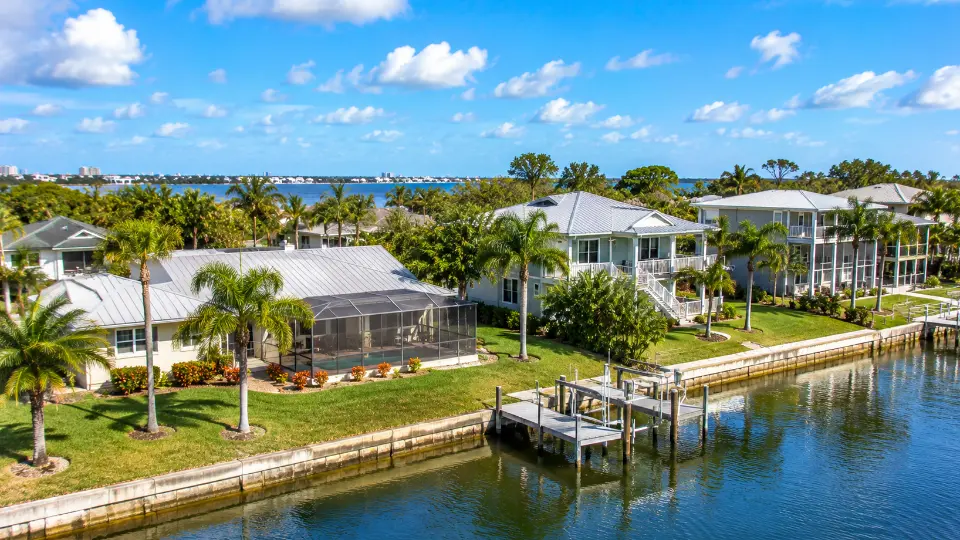
Waterfront property adds another layer of due diligence. A canal-front, bayfront or beachfront address does not by itself tell you the home's FEMA flood zone, elevation or insurance cost.
Waterfront buyers may need to investigate:
- FEMA flood zone
- Base Flood Elevation
- Finished-floor elevation
- Elevation Certificate
- Previous flooding
- Storm-surge exposure
- Lower-level enclosures
- Mechanical equipment elevation
- Seawall or shoreline condition
- Property-specific flood insurance
Hunt Brothers Realty's questions to ask before buying near the Florida coast covers additional coastal due diligence.
What About Condos and Flood Zones?
Condominium buyers should investigate both the building and the individual unit's insurance situation. Being on an upper floor does not mean flood-related issues at the building level are irrelevant.
Flooding can affect parking, elevators, electrical or mechanical equipment, common areas and access even when the living space is well above ground level. Association insurance and the unit owner's insurance also cover different interests and should be reviewed separately.
Condo buyers should review association insurance information with a qualified insurance professional and direct questions about association responsibilities and governing documents to the association and, when appropriate, a qualified Florida real estate attorney.
Can New Construction Be in a Flood Zone?
Yes. New construction can be located in a FEMA Special Flood Hazard Area.
A newer home may have been designed under more recent building and floodplain standards, but new construction does not mean zero flood exposure. Buyers should still investigate the flood zone, elevation, drainage, lender requirements and property-specific insurance.
What if a Flood Map Appears to Be Wrong?
FEMA has formal procedures for certain map changes and determinations when appropriate technical information supports a change. Depending on the circumstances, these may involve a Letter of Map Amendment or another Letter of Map Change process.
A buyer should not assume that a home sitting visibly higher than neighboring property automatically changes its official flood determination. FEMA, the local floodplain administrator, a qualified surveyor or engineer, the lender and the insurance professional may each have a role depending on the question involved.
Florida Flood-Zone Checklist for Home Buyers
Before completing a Florida home purchase, consider verifying the following for the exact property:
- Current FEMA flood-zone designation
- Whether the structure is in a Special Flood Hazard Area
- Where the building sits relative to flood-zone boundaries
- Applicable Base Flood Elevation
- Available Elevation Certificate or other reliable elevation information
- Seller's statutory Florida flood disclosure
- Known previous flooding or water intrusion
- Flood or storm-related repair history
- Lot and street drainage
- Storm-surge exposure
- Current hurricane evacuation designation
- Lender flood-insurance requirements
- Property-specific flood insurance quote
- Property-specific homeowners insurance quote
- Floodplain restrictions affecting planned renovations or additions
Should You Avoid Every Florida Home in a Flood Zone?
A flood-zone letter by itself cannot answer whether a particular property is appropriate for a buyer. Florida contains coastal, waterfront and inland communities with many different combinations of mapped flood risk, elevation, construction and insurance considerations.
A more useful question is: What is the flood and insurance profile of this specific property?
Understanding that profile may require the FEMA map, elevation information, property history, drainage observations, insurance quotes, lender requirements and input from qualified professionals. A lower-risk designation is not a guarantee against flooding, while a higher-risk designation does not tell you everything about an individual building's elevation or construction.
Research Florida Flood Risk Before You Buy
Hunt Brothers Realty helps buyers compare homes and communities throughout Florida's Gulf Coast while identifying property-specific questions that deserve investigation during due diligence.
Start with Hunt Brothers Realty's guide on how to find a Florida home's flood zone, learn how to research flood risk before buying a Sarasota-area home, review flood insurance considerations for Sarasota buyers, or contact Hunt Brothers Realty to discuss a property you are considering.
Informational notice: This article provides general real estate and educational information only and is not individualized insurance, legal, financial, lending, engineering, surveying, inspection, construction, floodplain, permitting or other professional advice. Flood maps, flood-zone designations, insurance requirements and local regulations can change. Buyers should verify current property-specific flood information with FEMA and the applicable local floodplain authority, confirm loan requirements with their mortgage professional, obtain coverage and quotes from a qualified insurance professional, and have elevation, drainage, structural, surveying, permitting and legal questions evaluated by the appropriate qualified professionals before making a purchasing decision.
Sources
- FEMA Flood Map Service Center
- Federal Emergency Management Agency, Flood Maps
- FEMA, National Flood Insurance Program Risk Rating 2.0
- Florida Statute 689.302, Disclosure of Flood Risks to Prospective Purchaser
- Florida Division of Emergency Management, Disaster Preparedness and Evacuation Maps
- Sarasota County, FEMA Flood Maps and Flood Hazard Zones
- Hunt Brothers Realty, How to Check a Florida Home's Flood Zone
- Hunt Brothers Realty, How to Research Flood Risk Before Buying a Sarasota Home
- Hunt Brothers Realty, Flood Zone vs. Evacuation Zone in Florida
- Hunt Brothers Realty, Do You Need Flood Insurance in Sarasota?
Hunt Brothers Realty
Hunt Brothers Realty
46 N. Washington Blvd, Ste 3, Sarasota, FL 34236
Phone: (941) 388-7017
Email: info@huntbrothersrealty.com
Website: HuntBrothersRealty.com
Categories
- All Blogs 2533
- Anna Maria Island 90
- Bird Key 4
- Bradenton 241
- Buying a Home 1567
- Casey Key 2
- Clearwater 15
- Condos & HOA Living 1492
- Ellenton 6
- Englewood 14
- First Time Homebuyers 1683
- Foreclosures 4
- Home Selling 7
- Homeownership 1719
- Lakewood Ranch 32
- Lido Key 29
- Longboat Key 80
- Luxury/Waterfront Properties 1661
- Market Updates & Trends 1169
- Mortgages & Financing 78
- Move-Up Buyers 24
- Neighborhood Guides 1291
- New Construction 43
- Palmetto 4
- Parrish 34
- Port Charlotte 36
- Punta Gorda 164
- Real Estate Investing 1574
- Relocation to Florida 1606
- Safety Harbor 4
- Sarasota 125
- Sarasota - Downtown 170
- Selling a Home 146
- Siesta Key 94
- St. Petersburg 9
- Taxes and Homestead 3
- Tierra Verde 7
- Vacation & Second Homes 1767
- Venice 219
- Wellen Park 24
Recent Posts