Should I Buy a House With an Old Air Conditioner?
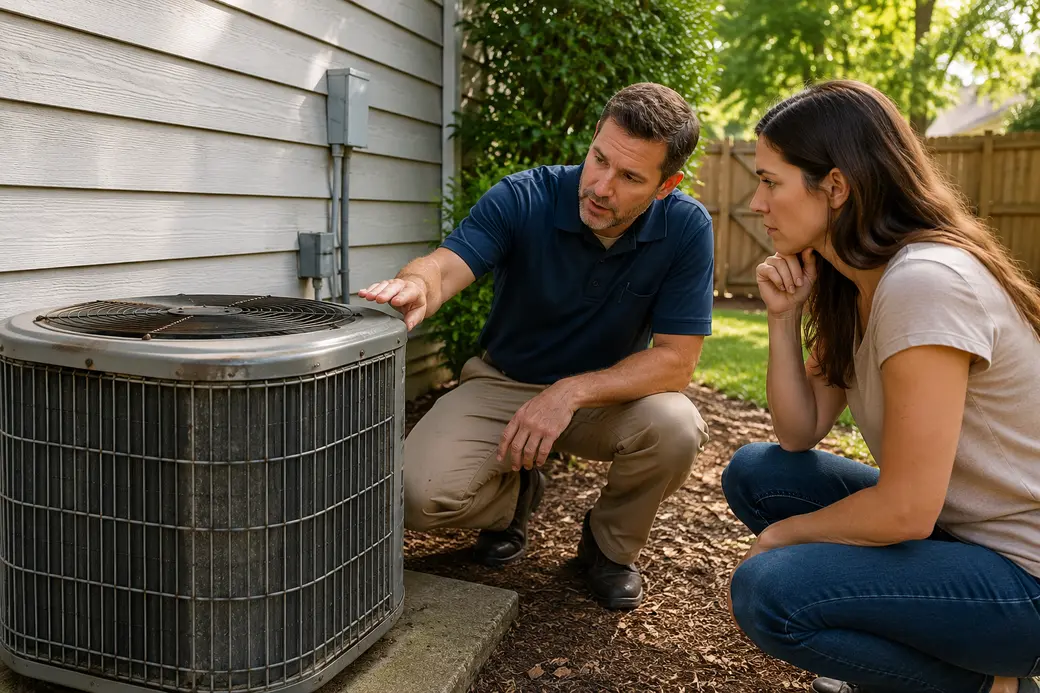
Yes, a house with an old air conditioner can still be a good purchase. The age of the HVAC system should be treated as a due-diligence and budgeting issue, not an automatic reason to reject the property. A well-maintained older system may still be operating adequately, while a newer system can have installation or performance problems. Before buying, determine the equipment's age, condition, refrigerant, maintenance history and current performance, then consider what replacement would cost if it becomes necessary during your ownership.
This is particularly relevant for Florida buyers because air conditioning is used extensively. If an older HVAC system could materially affect your purchasing decision, have it evaluated by an appropriately qualified HVAC professional and obtain property-specific replacement estimates rather than relying solely on its age.
Quick Answers About Buying a House With an Old Air Conditioner
How old is too old for a home air conditioner?
There is no exact age at which every air conditioner becomes unusable. U.S. Department of Energy consumer materials use approximately 15 to 20 years as a central air-conditioning lifespan benchmark. ENERGY STAR recommends considering professional evaluation or replacement when equipment is more than 10 years old, especially when repairs, comfort problems or rising energy use are also present.
Should I walk away from a house with a 15-year-old AC?
Not based on age alone. A 15-year-old system deserves careful evaluation and replacement planning, but the house may still make sense if its price, location, overall condition and other characteristics work for you. The condition of the specific HVAC equipment matters more than an age cutoff by itself.
Can a home inspector inspect the air conditioner?
A general home inspection commonly includes observations about the HVAC system within the inspector's scope, but a specialized HVAC evaluation can provide additional information about an older or questionable system. If HVAC condition could change your purchasing decision, consider having an appropriately qualified HVAC professional evaluate it.
Does an old air conditioner have to be replaced immediately?
No. Age by itself does not create an automatic federal replacement requirement. EPA specifically states that owners may continue using and repairing existing legacy air-conditioning systems throughout their useful lives, subject to applicable servicing requirements.
What if the air conditioner uses R-22 refrigerant?
An R-22 system can still be used and serviced, but the United States ended production and import of new R-22 in 2020. Existing systems can be serviced using recovered, recycled, reclaimed or previously produced supplies. Buyers should ask an HVAC professional how the refrigerant type affects practical repair and replacement decisions for the particular equipment.
Can I ask the seller to replace an old AC?
Buyers can potentially negotiate repairs, replacement, credits or other terms depending on the contract, inspection findings, property and negotiating circumstances. A seller is not automatically required to replace an air conditioner simply because it is old. Contract rights and obligations should be evaluated using the actual purchase agreement.
Should I budget for replacement even if the AC works?
If the system is already well into its expected service life, including eventual replacement in your ownership budget can be prudent. That does not mean failure is imminent. It means you are recognizing that major mechanical equipment does not last indefinitely.
Is a newer AC always better?
Not necessarily. Age is only one factor. Equipment sizing, installation quality, ductwork, maintenance, efficiency, operating condition and compatibility among system components all matter. Buyers should evaluate the actual system rather than treating the installation year as the complete answer.
How Long Does a Central Air Conditioner Usually Last?
The U.S. Department of Energy's Energy Saver materials use a 15 to 20 year lifespan estimate for central air-conditioning equipment. That is useful for planning, but it should not be interpreted as an expiration date.
ENERGY STAR takes a more proactive approach to replacement planning. It recommends considering replacement when an air conditioner or heat pump is more than 10 years old, particularly if the equipment also needs frequent repairs, energy costs are increasing or parts of the house are difficult to keep comfortable.
Those two benchmarks are not contradictory. A system can operate for 15 to 20 years while still reaching an age at which efficiency, repair frequency and replacement planning deserve closer attention.
Why can two AC systems of the same age be in very different condition?
Maintenance, installation, operating hours, equipment sizing, environmental exposure and previous repairs can all influence condition. A system that has received consistent professional maintenance can present differently from equipment of the same age with a history of neglected filters, dirty coils or recurring problems.
This is why Hunt Brothers Realty's guide to older Florida homes versus new construction recommends evaluating each major system individually. A house can be decades old while its roof, air conditioner, plumbing and electrical components have all been replaced at different times.
Why Does AC Age Matter So Much When Buying a Florida Home?
Air conditioning plays an unusually important role in Florida homeownership because cooling and humidity control are needed for substantial portions of the year. A system approaching replacement therefore deserves more attention than an appliance the homeowner rarely uses.
For a buyer, an older system can affect several practical considerations:
- Potential near-term replacement expenses
- Repair frequency
- Cooling performance
- Humidity control and indoor comfort
- Energy efficiency
- Refrigerant and parts considerations
- The amount of cash a buyer may want to retain after closing
None of these automatically makes an older system unacceptable. They simply become part of the property's overall condition and cost of ownership.
How Can You Find Out How Old the Air Conditioner Is?
Start with the equipment itself. The outdoor condenser normally has a manufacturer's data plate showing the model and serial number. Depending on the manufacturer, the serial number can be used to determine the production date.
Buyers can also ask for:
- Installation invoices
- Permit information when available
- Manufacturer and model information
- Maintenance records
- Repair invoices
- Warranty documentation
Do not assume that the indoor air handler and outdoor condenser were installed at the same time. An HVAC professional can identify the components and determine whether the system should be evaluated as a matched configuration.
What Should You Look for During a Home Showing?
A showing is not a substitute for an HVAC inspection, but it can help identify questions worth investigating. When touring a home, pay attention to whether the interior feels consistently comfortable and whether anything about the system appears unusual.
Possible observations include:
- Rooms that feel noticeably warmer or more humid than others
- Unusual noises when the system operates
- Visible corrosion or deterioration around equipment
- Water staining around the air handler or condensate equipment
- Dirty or heavily neglected filters
- A thermostat set unusually low while the house still feels warm
- Outdoor equipment crowded by vegetation or debris
These observations do not diagnose the system. They are reasons to ask additional questions. The Hunt Brothers Realty home-showing guide similarly recommends using a showing to look beyond finishes and consider visible condition and future maintenance issues.
Should You Have an Older AC Professionally Evaluated?
If the HVAC system's condition could materially influence whether you buy the home or what you are willing to pay, a specialized evaluation can provide useful property-specific information.
A qualified HVAC professional can evaluate issues within that professional's scope, potentially including:
- Equipment identification and approximate age
- General operating condition
- Heating and cooling performance
- Refrigerant type
- Visible component condition
- Condensate drainage
- Signs of previous repairs or leakage
- Ductwork concerns that are accessible for evaluation
- Whether further repair or replacement should be considered
The appropriate scope depends on the property and equipment. Inspection findings and estimates should be evaluated with qualified HVAC professionals before a buyer makes a decision based on expected system life or repair cost.
What Does It Mean If the AC Uses R-22?
R-22, also known as HCFC-22, was widely used in older residential air-conditioning equipment. EPA explains that the United States ended production and import of new R-22 on January 1, 2020 as part of the phaseout of ozone-depleting substances.
That does not mean an existing R-22 air conditioner became illegal or had to be removed. EPA states that homeowners can continue using existing R-22 equipment. Recovered, recycled, reclaimed and previously produced R-22 can be used for servicing existing systems.
Why should a buyer still care about R-22?
Refrigerant type becomes relevant when evaluating the practicality and economics of future repairs. EPA specifically encourages consumers with older equipment to consider factors such as efficiency, performance, reliability, cost and refrigerant when deciding whether to continue repairing or replace a system.
An HVAC professional can identify the refrigerant from the equipment nameplate and explain available repair or replacement options for the particular system. Refrigerant work should be performed by appropriately certified technicians.
What About Older R-410A Air Conditioners?
Buyers may also encounter older systems using R-410A. Federal refrigerant policy has continued to evolve, but that does not mean an existing R-410A system must automatically be replaced.
EPA's current guidance on the HFC phasedown states that existing air-conditioning and heat-pump systems can continue to be used and repaired throughout their useful lives. The federal transition primarily affects new equipment and products rather than requiring homeowners to discard functioning legacy systems.
For a homebuyer, the practical question remains the same: What equipment is installed, what condition is it in and what would servicing or replacing that particular system involve?
Does an Old Air Conditioner Mean High Electric Bills?
Older equipment can be less efficient than newer equipment, but age alone does not tell you what the home's future electric bills will be. Energy use depends on the air-conditioning equipment as well as square footage, insulation, windows, ductwork, thermostat settings, occupancy, pool equipment and household behavior.
ENERGY STAR notes that aging cooling equipment, particularly equipment needing frequent repairs or associated with increasing energy bills, can indicate that replacement should be considered. It also emphasizes that duct problems and inadequate insulation can contribute to uneven temperatures and poor performance.
In other words, replacing the condenser does not automatically correct every comfort or efficiency problem. The house and HVAC system should be evaluated together.
Why Does the Ductwork Matter?
The air conditioner produces conditioned air, but the duct system has to deliver it effectively throughout the home. Leaky, poorly insulated or improperly configured ducts can reduce comfort and efficiency even when the cooling equipment itself is operating.
ENERGY STAR reports that properly sealing and insulating ducts can improve heating and cooling system efficiency substantially, particularly when ducts run through attics, garages, crawlspaces or other unconditioned areas.
For a Florida buyer, accessible ductwork, insulation and signs of leakage or condensation may therefore deserve attention along with the age of the air handler and outdoor condenser.
How Much Should You Budget for AC Replacement?
There is no reliable universal replacement price because HVAC costs depend on the property and project. System capacity, efficiency, equipment type, ductwork, electrical work, installation conditions, permits and other modifications can materially change the final amount.
A large Sarasota home with multiple HVAC systems creates a different replacement question from a smaller single-system residence. Likewise, replacing equipment within an existing compatible installation can differ from a project requiring substantial duct, electrical or other work.
If replacement cost matters to your offer or purchasing decision, obtain a written estimate from an appropriately licensed HVAC contractor for the specific property. A generic online replacement-cost range should not substitute for a property-specific estimate.
Can You Negotiate Because the Air Conditioner Is Old?
An older HVAC system can be part of a buyer's evaluation and negotiating strategy, but age does not automatically entitle the buyer to a new system or a particular credit.
Negotiating leverage can depend on:
- The HVAC inspection findings
- Whether the system currently operates properly
- Documented repair needs
- The estimated replacement cost
- The home's asking price and overall condition
- Competing properties
- Other deferred maintenance
- Current market conditions
- The terms of the purchase contract
As Hunt Brothers Realty's Sarasota and Manatee buyer negotiation guide explains, property condition can create leverage in some transactions, but buyers should evaluate each property individually rather than assuming every seller will respond the same way.
Inspection rights, repair obligations, credits and other remedies depend on the contract and circumstances. Questions involving contractual rights should be reviewed with the appropriate real estate professional and, when legal interpretation is required, a qualified Florida real estate attorney.
Should You Ask the Seller to Replace the AC Before Closing?
Replacement before closing is one possible negotiating approach, but buyers should think carefully about whether they would prefer the seller to select and install the new equipment or whether another negotiated structure better fits the transaction.
A buyer choosing a replacement after closing may have more control over the contractor, equipment, efficiency level and warranty. On the other hand, paying for replacement after closing requires sufficient available cash and assumes the transaction terms permit the buyer to take on that expense.
Credits, repairs and other transaction structures can also interact with lender and contract requirements. Buyers should review any proposed arrangement with their real estate professional and mortgage lender, and obtain legal advice when contract interpretation is necessary.
What If the House Has More Than One Air Conditioner?
Larger Florida homes can have multiple HVAC systems serving different floors or zones. In that situation, buyers should document each system separately rather than describing the house as simply having an old or new AC.
For each system, determine:
- Approximate age
- Manufacturer and model
- Refrigerant type
- Area of the house it serves
- Maintenance and repair history
- Current operating condition
This can reveal a very different financial picture. A property with two older systems approaching replacement presents a different budgeting question from a home where one system was recently replaced and the second remains older but functional.
Should an Old AC Stop You From Buying an Otherwise Good House?
Usually, the more useful question is how the HVAC system fits into the property's overall condition and price. Air conditioners are replaceable components. Location, lot characteristics, neighborhood, floor plan and certain other property attributes may be considerably more difficult or impossible to change.
Suppose two similar homes are available. One has a recently installed HVAC system but needs a roof, while the other has an older AC but a newer roof, updated electrical equipment and the location you prefer. Focusing on the air conditioner's age alone could distort the comparison.
Current Hunt Brothers Realty Sarasota buyer guidance similarly recommends evaluating roof age, HVAC, windows, plumbing, electrical systems, insurance considerations and renovation needs together rather than focusing only on the purchase price or a single component.
What Should You Check Before Buying a House With an Older AC?
Before making a final decision, gather enough information to understand both current performance and future replacement exposure.
- Confirm the age of the outdoor condenser and indoor air handler
- Identify the refrigerant used
- Ask for maintenance and repair records when available
- Review the general home inspection findings
- Consider a specialized HVAC evaluation when warranted
- Ask about recurring or recent repairs
- Evaluate accessible ductwork and insulation concerns
- Check for visible condensate or moisture problems
- Determine whether multiple HVAC systems serve the home
- Obtain a property-specific replacement estimate if replacement could affect your decision
- Determine whether permits are available for previous HVAC replacement work when relevant
- Consider the HVAC expense together with the roof, plumbing, electrical systems and other major components
Questions to Ask About the Air Conditioner Before Closing
- How old are the condenser and air handler?
- What refrigerant does the system use?
- When was it last professionally serviced?
- Are maintenance records available?
- Have there been refrigerant leaks or major repairs?
- Does the system maintain appropriate temperatures throughout the house?
- Are there humidity or condensation concerns?
- What condition is the accessible ductwork in?
- Are the indoor and outdoor components properly matched?
- What repairs does the HVAC professional recommend now?
- If replacement becomes necessary, what work would the property require?
- What would a qualified contractor currently estimate for that replacement?
The Bottom Line: An Old AC Is a Cost to Understand, Not Automatically a Deal Breaker
An older air conditioner should make a homebuyer investigate, not panic. Central air-conditioning equipment has a finite service life, and a system in its later years can create a meaningful future expense. But age alone cannot tell you whether it will fail next month, continue operating for several years or make the overall property a poor purchase.
Evaluate the equipment's actual condition, maintenance history, refrigerant, efficiency and replacement implications. Then compare that information with the home's price, location, roof, electrical and plumbing systems, insurance considerations and other maintenance needs.
If the house otherwise fits your priorities, an aging air conditioner may simply be a replacement expense that needs to be understood and incorporated into your purchasing decision.
Buying a Home on Florida's Gulf Coast?
Hunt Brothers Realty helps buyers evaluate Sarasota and Florida Gulf Coast properties with attention to location, condition, comparable sales and the real estate considerations that can affect the total ownership picture. Review the Hunt Brothers Realty guide to older Florida homes versus new construction, explore the firm's home-showing guide for buyers, or contact Hunt Brothers Realty for help evaluating current properties.
Informational notice: This article provides general educational real estate information and is not individualized inspection, HVAC, engineering, construction, insurance, financial, legal or other professional advice. HVAC age does not establish remaining service life or determine whether a particular system should be repaired or replaced. Buyers should have property-specific HVAC condition, repair needs and replacement options evaluated by an appropriately qualified HVAC professional. Home inspection findings should be reviewed with the appropriate licensed inspector, contractor or other qualified professional, and buyers should consult their real estate, insurance, lending or legal professionals when those matters affect a purchasing decision.
Sources
- U.S. Department of Energy: Energy Saver 101 Home Cooling
- ENERGY STAR: When Is It Time to Replace Heating and Cooling Equipment?
- ENERGY STAR: Heat and Cool Efficiently
- U.S. Environmental Protection Agency: Homeowners and Consumers Refrigerant FAQ
- U.S. Environmental Protection Agency: Purchasing and Repairing Home Air Conditioners or Heat Pumps
- U.S. Environmental Protection Agency: HFC Phasedown Frequently Asked Questions
- Hunt Brothers Realty: Older Florida Home vs. New Construction
- Hunt Brothers Realty: What Does $500K, $1M, or $2M Buy You in Sarasota?
Contact Hunt Brothers Realty
46 N. Washington Blvd, Ste 3, Sarasota, FL 34236
Phone: (941) 388-7017
Email: info@huntbrothersrealty.com
Website: HuntBrothersRealty.com
Categories
- All Blogs 2110
- Anna Maria Island 86
- Bird Key 4
- Bradenton 236
- Buying a Home 1171
- Casey Key 2
- Clearwater 11
- Condos & HOA Living 1087
- Ellenton 5
- Englewood 11
- First Time Homebuyers 1280
- Foreclosures 5
- Home Selling 4
- Homeownership 1303
- Lakewood Ranch 25
- Lido Key 28
- Longboat Key 80
- Luxury/Waterfront Properties 1244
- Market Updates & Trends 766
- Mortgages & Financing 48
- Move-Up Buyers 22
- Neighborhood Guides 879
- New Construction 34
- Palmetto 3
- Parrish 6
- Port Charlotte 10
- Punta Gorda 17
- Real Estate Investing 1160
- Relocation to Florida 1200
- Safety Harbor 3
- Sarasota 79
- Sarasota - Downtown 162
- Selling a Home 144
- Siesta Key 91
- St. Petersburg 8
- Tierra Verde 5
- Vacation & Second Homes 1353
- Venice 193
- Wellen Park 19
Recent Posts