What Buyers Should Know About Hurricane Protection Features
When buying a home in Florida, hurricane protection deserves more attention than a quick question about whether the property has impact windows. A home's ability to resist wind and wind-borne debris can involve the roof, roof-to-wall connections, windows, exterior doors, garage door, shutters, secondary water resistance, and other construction details.
Those features can matter for more than storm preparation. Certain documented mitigation characteristics may also qualify a Florida property for insurance premium credits. But the presence of a feature does not automatically establish how well it protects the home, whether it qualifies for a particular credit, or what an insurer will charge for coverage.
For buyers exploring Florida Gulf Coast real estate with Hunt Brothers Realty, the practical approach is to identify the home's hurricane-protection features, obtain available documentation, have relevant conditions professionally evaluated, and obtain property-specific insurance information before making a purchasing decision.
Quick Answers About Florida Hurricane Protection
What hurricane protection features should Florida buyers look for?
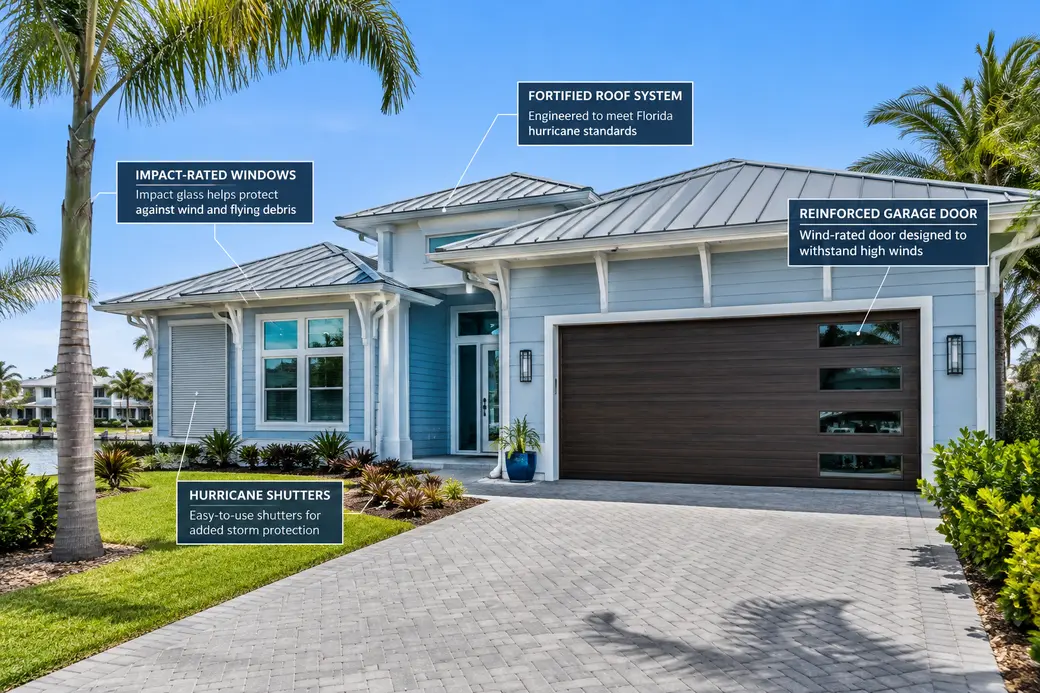
Important features can include impact-resistant windows and exterior doors, approved hurricane shutters or panels, reinforced garage doors, roof-to-wall connections such as clips or straps, qualifying roof coverings, roof geometry, and secondary water-resistance features. The relevant features and their effectiveness depend on the individual property.
Are impact windows hurricane-proof?
No building product should be treated as making a home “hurricane-proof.” Impact-resistant windows are designed and tested to meet specified impact and pressure requirements, but product ratings, sizes, installation requirements, and approved uses vary. Buyers should verify the actual product and installation rather than relying on appearance or a seller's informal description.
Are hurricane shutters as good as impact windows?
Approved shutters and impact-resistant windows can both be components of opening protection, but they work differently and individual products have different ratings and installation requirements. Shutters generally must be deployed before a storm, while qualifying impact-resistant windows provide permanent protection when properly installed and maintained. Buyers should compare documented product approvals rather than assuming one category is universally superior.
What is a Florida wind mitigation inspection?
A wind mitigation inspection documents qualifying construction characteristics used by an insurance company when evaluating hurricane-loss-mitigation credits. The inspector records applicable features and supporting photographs on Florida's Uniform Mitigation Verification Inspection Form. The insurance company reviews the completed form and determines which credits apply.
Do hurricane protection features guarantee lower insurance premiums?
No. Florida insurers are required to offer applicable hurricane-loss-mitigation discounts or credits, but the effect on a particular policy depends on the documented features, insurer, property, coverage, deductibles, underwriting, and other factors. Buyers should obtain property-specific quotes from qualified insurance professionals rather than estimating insurance costs from the presence of impact windows or shutters alone.
1. Start With Impact-Resistant Windows
Impact windows are among the most visible and frequently marketed hurricane-protection upgrades in Florida. They are designed to resist specified wind pressures and, when appropriately rated, impacts from wind-borne debris.
The important word for a buyer is documented. A window can look new, have thick glass, or be described as “hurricane glass” without that description establishing its actual approval, impact rating, design pressure, or installation compliance.
Questions to ask about impact windows
- Are the windows actually impact resistant?
- Is product-approval documentation available?
- Were permits obtained when required?
- Are all exterior openings protected or only some?
- Are sliding-glass doors impact rated?
- Are exterior doors protected?
- Are there shutters or panels for openings that are not impact rated?
- Does the wind mitigation report document qualifying opening protection?
Buyer takeaway: “New windows” and “impact windows” are not interchangeable descriptions. Verify the products and supporting documentation with the appropriate inspector, contractor, permitting authority, and insurance professional when the distinction is material to your purchase.
2. Understand the Different Types of Hurricane Shutters
Shutters can provide protection for windows, doors, and other exterior openings. Florida buyers may encounter several systems, including accordion shutters, roll-down shutters, removable metal or polycarbonate panels, and other approved products.
The Florida Department of Financial Services specifically identifies shutters among the mitigation improvements that can strengthen a home. Florida's product-approval system also demonstrates why buyers should examine the exact product: individual shutter models can have different impact ratings, design-pressure limits, approved uses, and installation requirements.
What should buyers check with hurricane shutters?
- Which openings have shutters?
- Are all required panels physically present?
- Are panels clearly labeled for their openings?
- Is the necessary installation hardware available?
- Are tracks, anchors, fasteners, and mechanisms in usable condition?
- Can roll-down or accordion shutters be operated?
- Is product or permit documentation available?
- Where are removable panels stored?
For removable systems, practicality matters too. A complete panel system stored in a garage is different from discovering shortly before a storm that panels are missing, unlabeled, inaccessible, or difficult for the owner to install.
3. Do Not Forget Sliding-Glass and Exterior Doors
A home marketed as having impact windows may still have other exterior openings that require protection. This is particularly relevant in Florida homes with large sliding-glass doors leading to lanais, pools, balconies, and patios.
Ask whether sliding doors, French doors, entry doors, sidelights, transoms, and other glazed exterior openings are impact rated or have an approved protection system. Partial protection should not be assumed to provide the same insurance treatment as qualifying protection for all relevant openings.
4. The Garage Door Can Be a Major Part of the Protection System
Garage doors create one of the largest exterior openings in many Florida homes. The Florida Department of Financial Services lists reinforced garage doors among recommended mitigation options.
Buyers should investigate whether the garage door is appropriately rated for the property, whether reinforcement is built into the door or requires separate bracing, and whether documentation is available. A newer-looking garage door should not automatically be assumed to be impact resistant or wind rated for a particular application.
Garage-door questions worth asking
- Is there a wind or impact rating?
- Is product documentation available?
- Does the door require separate bracing?
- If braces are required, are they present?
- Is the door documented on the wind mitigation report when applicable?
5. Look Beyond the Roof Covering
When buyers ask about a roof, they often focus almost entirely on age. Age and condition are important, particularly for insurance and replacement planning, but hurricane mitigation involves additional roof characteristics.
A wind mitigation evaluation can consider characteristics involving the roof covering, roof deck attachment, roof-to-wall connection, roof geometry, and qualifying secondary water resistance. These are not necessarily things a buyer can identify from the driveway.
This is one reason an attic inspection can be valuable. When accessible, the attic may allow a qualified inspector to document roof framing and connections that are invisible from the home's finished interior.
6. Understand Roof-to-Wall Connections
The roof does not simply sit on top of the walls. Connections between the roof structure and the walls help transfer wind forces through the building. Florida DFS identifies clips and straps as mitigation improvements that can strengthen this connection and reduce the risk of roof damage or removal during severe wind.
Buyers may hear terms such as clips, single wraps, double wraps, or other connection descriptions when reviewing a wind mitigation report. The exact classification depends on the construction and what the qualified inspector can document.
Do not try to determine the quality of a roof-to-wall connection from a seller's description alone. Have the condition and applicable wind-mitigation classification evaluated by a properly qualified professional.
7. Roof Geometry Can Affect Wind Mitigation
The shape of the roof is another characteristic documented during wind mitigation. Florida DFS identifies hip roofs as a wind-resistant roof configuration, but whether a particular home qualifies for an insurance mitigation classification is determined through the applicable inspection criteria rather than simply by looking at the house and calling the roof “hip.”
Roof geometry is generally an inherent characteristic of the home rather than a feature a buyer would casually change. That makes it useful information when comparing otherwise similar properties.
8. Ask About Secondary Water Resistance
Wind damage is not the only hurricane concern. If the primary roof covering is damaged, water intrusion can cause substantial additional damage inside the home.
Certain qualifying secondary water-resistance systems can be documented as part of Florida's wind mitigation process. Whether a property has a qualifying feature depends on the actual roofing assembly and available evidence.
If a roof was replaced recently, ask for the roofing contract, permit information, product documentation, and other available records. These documents may help qualified professionals determine what was installed.
9. What Exactly Does a Wind Mitigation Inspection Tell You?
A Florida wind mitigation inspection is not the same as a general home inspection. Its purpose is to document specific construction characteristics used by insurers in evaluating hurricane-loss-mitigation credits.
Florida's Uniform Mitigation Verification Inspection Form can document characteristics involving the building code applicable to the property, roof covering, roof deck attachment, roof-to-wall attachment, roof geometry, secondary water resistance, and opening protection.
Florida DFS states that admitted insurance carriers must accept a valid Uniform Mitigation Verification Inspection Form completed and signed by an appropriately qualified professional. The completed form is then provided to the insurer for review in determining applicable credits.
For a broader look at inspections during a purchase, read Hunt Brothers Realty's What to Look for During a Florida Home Inspection.
10. Do Hurricane Features Reduce Homeowners Insurance?
Potentially—but buyers should be careful with this question. Florida requires applicable hurricane-loss-mitigation discounts or credits to be offered, and Florida DFS specifically notes that improvements such as qualifying roof coverings or connections and shutters may result in premium discounts.
That does not mean a buyer can calculate the premium by counting hurricane features. Insurance pricing can depend on numerous property- and policy-specific factors in addition to mitigation credits.
Insurance availability, coverage, deductibles, exclusions, underwriting requirements, mitigation credits, and premiums can vary substantially by property and insurer. Buyers should obtain property-specific quotes and have the wind mitigation report reviewed by a qualified Florida insurance professional before making a purchasing decision.
11. Documentation Matters Almost as Much as the Feature
A recurring theme in Florida hurricane mitigation is documentation. Buyers should not assume that a visible improvement can automatically be verified for insurance or code purposes.
Useful records may include:
- Current or prior wind mitigation reports
- Building permits
- Roofing permits and contracts
- Window and door permits
- Florida product-approval information
- Manufacturer information
- Invoices and installation records
- Shutter or panel documentation
- Garage-door product information
The Florida Building Commission's product-approval records illustrate why documentation matters. Approved products can have specific limits involving impact resistance, design pressures, dimensions, installation methods, and whether they are approved for use in Florida's High Velocity Hurricane Zone.
12. “Built to Florida Code” Does Not Tell the Whole Story
Buyers sometimes hear that a home was “built to Florida code” and interpret that as a complete description of hurricane resistance. It is not.
The applicable building requirements depend on factors including when and where the home was built and the requirements in effect for that project. Homes can also be renovated over time, meaning windows, doors, roofs, additions, and other components may date from different periods.
Code compliance, wind mitigation, and present physical condition are also different questions. Buyers who need confirmation about construction requirements or permitting should verify records with the appropriate local building or permitting authority and obtain professional evaluation where necessary.
13. Hurricane Protection Is Different in Condominiums
Condominium buyers face an additional question: who is responsible for the feature?
Windows, exterior doors, shutters, roofs, exterior walls, and other building components may be subject to condominium declarations, association responsibilities, maintenance obligations, architectural rules, insurance arrangements, or unit-owner responsibilities. Those responsibilities can differ from one condominium to another.
A seller saying “the condo has impact windows” does not answer who maintains them, who replaces them, whether the association has approved the installation, or what insurance responsibilities apply. Buyers should review current condominium documents and insurance information and obtain legal or insurance guidance when those questions materially affect the purchase.
14. Waterfront and Coastal Properties Need Broader Risk Evaluation
Impact windows and hurricane straps address only part of hurricane risk. Coastal properties may also face storm surge, flooding, erosion, and damage to docks, seawalls, boat lifts, pools, landscaping, and other exterior improvements.
Wind mitigation should therefore not be confused with flood protection or a complete assessment of hurricane exposure. A house can have extensive wind-mitigation features and still have significant flood or storm-surge considerations.
Buyers considering Gulf-front, bayfront, canal-front, or other waterfront properties can read Hunt Brothers Realty's guide to buying waterfront property in Florida for additional issues involving seawalls, docks, navigation, insurance, and property-specific due diligence.
15. Hurricane Protection Features to Check Before Buying
Use this as a starting checklist when evaluating a Florida property:
- Impact-resistant windows, if present
- Sliding-glass door protection
- Exterior door protection
- Hurricane shutters or removable panels
- Complete shutter hardware and panel inventory
- Garage-door wind and impact protection
- Roof age and condition
- Roof-covering documentation
- Roof-deck attachment
- Roof-to-wall connections
- Roof geometry
- Secondary water resistance, when applicable
- Available permits and product approvals
- Current wind mitigation report
- Property-specific homeowners and flood insurance information
What Are the Biggest Mistakes Buyers Make With Hurricane Protection?
- Assuming newer windows are impact resistant
- Checking windows but forgetting sliding and exterior doors
- Assuming shutters protect every opening
- Failing to verify that removable shutter panels and hardware are complete
- Ignoring the garage door
- Looking only at roof age instead of broader roof-mitigation characteristics
- Assuming a wind mitigation report is the same as a home inspection
- Assuming mitigation features guarantee a specific insurance premium
- Treating wind protection as protection from flooding or storm surge
- Failing to obtain permits or product documentation when available
- Waiting until after the inspection period to investigate insurance
Hurricane Protection Should Be Part of the Inspection Conversation
Hurricane features should not be evaluated separately from the rest of the property's condition. Impact windows can still have installation or maintenance concerns. Shutters can be damaged or incomplete. Roof components can deteriorate. Garage doors can require repair. A wind mitigation report also serves a different purpose from a general home inspection.
Hunt Brothers Realty's Florida home inspection checklist for buyers explains additional issues involving roofs, HVAC, electrical systems, plumbing, moisture, structure, pools, and specialist evaluations.
Buyers relocating from another state may also find the Moving to Florida From Out of State home buyer checklist useful for identifying Florida-specific issues that may not be familiar from previous home purchases.
The Best Hurricane Feature Is One You Can Verify
For a Florida buyer, the most useful question is not simply, “Does this home have hurricane protection?” A better set of questions is: What features are installed, what do they protect, how are they documented, what condition are they in, and how does the insurer evaluate them?
A home with documented impact protection, roof improvements, appropriate connections, and other mitigation features may provide meaningful advantages. But no collection of features eliminates hurricane risk, and no single feature should substitute for a broader evaluation of property condition, flood exposure, insurance, maintenance, and location.
Buying a Home on Florida's Gulf Coast?
Hunt Brothers Realty helps buyers evaluate Florida Gulf Coast homes with the local questions that matter—from property condition and hurricane-protection documentation to association considerations, waterfront features, inspections, and insurance due diligence.
Browse Florida Gulf Coast homes for sale, explore communities with Hunt Brothers Realty, review the Hunt Brothers Realty Florida buyer resources, or visit HuntBrothersRealty.com to discuss your property search.
Informational notice: This article provides general educational and real estate information and is not individualized insurance, engineering, construction, inspection, legal, financial, tax, lending, permitting, or other professional advice. Hurricane-protection performance, building requirements, product approvals, insurance eligibility, mitigation credits, coverage, and premiums depend on the individual property and circumstances. Buyers should verify material features and documentation with the appropriate licensed home inspector, wind mitigation inspector, contractor, structural engineer, insurance professional, local building or permitting authority, Florida real estate attorney, or other qualified professional before making a purchasing decision.
Sources
- Florida Department of Financial Services: Hurricane Mitigation
- Florida Department of Financial Services: Mitigation Notices, Inspections and Forms
- Florida Department of Financial Services: Tips for Shopping for Homeowners Insurance
- Florida Building Commission: Florida Building Code and Product Approval
- Hunt Brothers Realty: What to Look for During a Florida Home Inspection
- Hunt Brothers Realty: Buying Waterfront Property in Florida
- Hunt Brothers Realty: Moving to Florida From Out of State — A Home Buyer Checklist
- Hunt Brothers Realty: Florida Buyer Resources
Contact Hunt Brothers Realty
46 N. Washington Blvd, Ste 3, Sarasota, FL 34236
Phone: (941) 388-7017
Email: info@huntbrothersrealty.com
Website: HuntBrothersRealty.com
Categories
- All Blogs 1929
- Anna Maria Island 83
- Bird Key 4
- Bradenton 234
- Buying a Home 1000
- Casey Key 2
- Clearwater 8
- Condos & HOA Living 911
- Ellenton 5
- Englewood 9
- First Time Homebuyers 1104
- Foreclosures 3
- Homeownership 1124
- Lakewood Ranch 20
- Lido Key 27
- Longboat Key 78
- Luxury/Waterfront Properties 1064
- Market Updates & Trends 596
- Mortgages & Financing 41
- Move-Up Buyers 20
- Neighborhood Guides 718
- New Construction 32
- Palmetto 3
- Parrish 6
- Port Charlotte 10
- Punta Gorda 15
- Real Estate Investing 982
- Relocation to Florida 1026
- Safety Harbor 2
- Sarasota 68
- Sarasota - Downtown 157
- Selling a Home 142
- Siesta Key 89
- St. Petersburg 6
- Tierra Verde 5
- Vacation & Second Homes 1174
- Venice 88
- Wellen Park 9
Recent Posts