Investor Q4 Checklist: Year-End Moves for Florida Rental Properties
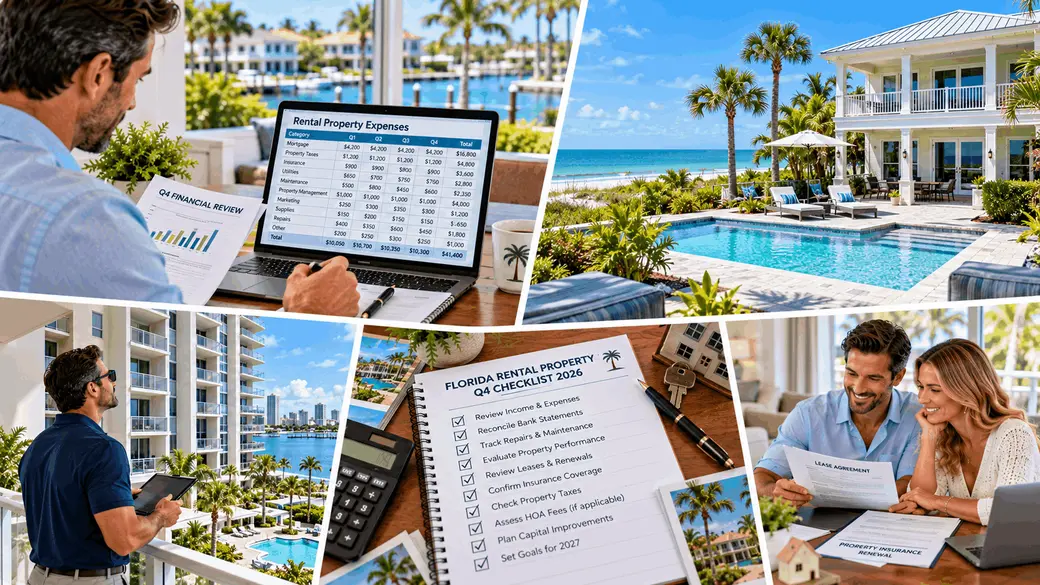
The fourth quarter is a useful time for Florida rental-property owners to review the entire investment before the calendar turns. That means reconciling 2026 income and expenses, organizing tax records, checking leases and deposits, reviewing insurance, planning maintenance, examining condo or HOA changes, confirming vacation-rental licensing and taxes when applicable, and building a realistic 2027 property budget. The objective is not to make last-minute financial moves simply because December is approaching. It is to identify missing information early enough to discuss tax, legal, insurance and property-specific decisions with the appropriate qualified professionals.
Quick Answers About Year-End Planning for Florida Rental Properties
What Should a Florida Rental-Property Owner Do Before Year-End?
Reconcile rental income and expenses, organize receipts and invoices, update improvement records, review insurance and association costs, inspect the property, confirm lease and deposit records, and prepare a realistic 2027 operating budget. Vacation-rental owners should also verify current state, county, municipal and association requirements.
Should Investors Make Repairs Before December 31 for a Tax Deduction?
Do not assume that paying for work before December 31 automatically creates a current-year deduction. Federal tax treatment can differ depending on whether work is classified as a repair, maintenance expense or capital improvement, along with other facts. Review significant projects with a qualified CPA or tax professional before making timing decisions primarily for tax reasons.
When Is the Final 2026 Federal Estimated-Tax Payment Due?
For calendar-year individual taxpayers who are required to make estimated payments, the fourth 2026 federal estimated-tax payment is generally due January 15, 2027. Exceptions and special rules can apply, so investors should confirm their individual payment requirements with a qualified tax professional and current IRS Form 1040-ES guidance.
Does Florida Tax Rental Income?
Florida does not impose an individual state personal income tax, but that does not mean rental ownership is tax-free. Federal income taxes, entity-related taxes, property taxes and other obligations may apply. Shorter-term rentals can also trigger Florida sales tax, discretionary surtax and local transient-rental taxes depending on the rental arrangement and jurisdiction.
Are Florida Vacation Rentals Subject to Sales and Tourist Taxes?
Florida Department of Revenue guidance states that rental charges for living or sleeping accommodations for rental periods of six months or less are generally subject to the state's 6% sales tax plus applicable discretionary sales surtax. Counties may also impose local-option transient-rental taxes. Collection and remittance arrangements can vary, including when a platform is involved, so owners should verify their specific obligations.
Should an Investor Review Insurance Every Year?
Yes. Rental use, vacancy, short-term occupancy, property improvements, flood exposure and liability considerations can affect appropriate coverage. Owners should review the actual property and rental arrangement with a qualified Florida insurance professional rather than assuming a prior policy remains suitable.
Should Condo Investors Review the Association Before 2027?
Absolutely. Review the next budget, assessment changes, reserves, insurance, planned projects, rental rules and recent board information when available. A condominium investment is affected by the financial and physical condition of the association as well as the performance of the individual unit.
1. Reconcile Your 2026 Rental Income Before the Books Close
Start with revenue. Compare your bank deposits, property-management statements, booking-platform reports and lease records. The goal is to identify missing payments, duplicate entries, owner-use adjustments and other discrepancies before tax preparation begins.
The IRS rental real estate guidance explains that rental income can include more than ordinary monthly rent. Advance rent, certain lease-cancellation payments, amounts retained from security deposits under applicable circumstances and other payments can require tax treatment.
Advance rent is generally included in rental income when received, even if it covers a later rental period. By contrast, the IRS generally does not treat a refundable security deposit as income when received if the owner intends to return it at the end of the lease. If a deposit is actually intended to serve as final rent, the tax treatment can be different.
These distinctions can become especially important for seasonal Florida rentals where an owner may collect substantial advance payments before a winter occupancy period. A CPA or qualified tax professional should determine the proper treatment for the owner's actual facts.
2. Categorize Expenses Instead of Keeping One Large Receipt Folder
A stack of receipts is not the same as organized financial records. Before year-end, categorize expenses so you and your tax professional can understand what actually happened at the property.
Depending on the property and tax treatment, useful recordkeeping categories can include:
- Property-management fees
- Booking and payment-processing fees
- Cleaning and turnover expenses
- Repairs and maintenance
- Landscaping and pool service
- Pest control
- Utilities
- Internet and other property services
- Property insurance
- Flood insurance when applicable
- HOA or condominium assessments
- Property taxes
- Professional accounting and legal services
- Licensing and registration expenses
- Advertising and marketing
- Furniture, appliances and equipment
- Capital improvements
- Travel and vehicle expenses potentially related to the rental activity
The category used in your bookkeeping does not by itself determine federal deductibility. Tax classification depends on applicable law and the facts of the expenditure, so final treatment should be confirmed with a qualified tax professional.
3. Separate Repairs From Improvements
This is one of the most important year-end bookkeeping distinctions for a rental-property owner.
IRS Publication 527 explains that qualifying repair or maintenance expenses may generally be deductible when they are not required to be capitalized. Expenses that improve a property generally must be capitalized and may then be recovered according to applicable depreciation rules.
The IRS describes improvements in terms that include betterments, restorations and adaptations to a new or different use. Its examples of potential improvements include items such as a new roof, central air-conditioning system, wiring upgrades, flooring, a swimming pool and significant kitchen modernization.
Do not classify a major project as a repair simply because the invoice uses that word. Keep contracts, invoices, permits, photographs and completion dates, then have your CPA or tax professional determine the appropriate treatment.
4. Update Your Capital-Improvement Records
Capital-improvement records can matter long after the contractor leaves. They may affect depreciation, adjusted basis and the eventual tax calculation when the property is sold.
Create or update a property improvement file containing documentation for major projects such as:
- Roof replacement
- HVAC replacement
- Window and exterior-door replacement
- Electrical upgrades
- Plumbing projects
- Kitchen renovations
- Bathroom renovations
- Flooring replacement
- Pool installation or substantial renovation
- Major landscaping or hardscape projects
- Other significant additions or structural work
Keep the documentation even after the current tax return is completed. IRS guidance specifically emphasizes maintaining accurate records for improvements because those costs can matter when depreciating or eventually selling the property.
5. Reconcile Your 2026 Mileage and Travel Records
If you have potentially deductible vehicle use connected with a rental activity, Q4 is a good time to make sure your mileage records are complete rather than trying to reconstruct an entire year during tax season.
The IRS standard mileage rates changed during 2026. The business rate was 72.5 cents per mile from January 1 through June 30, 2026 and increased to 76 cents per mile for July 1 through December 31, 2026.
That does not mean every trip to a Florida rental property is automatically deductible. Travel and vehicle-expense rules depend on the purpose of the trip, the taxpayer's circumstances and applicable federal tax requirements. Maintain contemporaneous records and have your tax professional determine what can properly be claimed.
6. Review Estimated Taxes Before the January Deadline
Rental income can change during the year. Occupancy may be stronger or weaker than expected, insurance or repair expenses may change substantially, or an investor may have sold another asset. Those changes can affect the overall federal tax picture.
According to IRS Publication 505, the general fourth estimated-tax payment date for calendar-year 2026 individual taxpayers is January 15, 2027. The IRS also provides exceptions and special rules, including circumstances involving an early-filed return.
Rather than guessing at the payment, give your CPA or tax professional updated year-to-date information early enough to evaluate whether additional estimated tax may be appropriate and what payment timing applies to you.
7. Do Not Accelerate Spending Just to Create a Deduction
A December invoice does not automatically make a project financially worthwhile. A rental property should not receive an unnecessary roof, appliance package or renovation simply because the owner hopes for a tax benefit.
First determine whether the work is needed for property condition, tenant experience, regulatory compliance or the owner's broader investment plan. Then ask a qualified tax professional how the expense would actually be treated and when any tax benefit may occur.
The same principle applies to deliberately accelerating or delaying rental income, purchasing equipment, selling a property or completing major capital projects. Tax consequences depend on the individual taxpayer and transaction, so investors should consult a qualified CPA or tax attorney regarding their specific circumstances before acting primarily for tax reasons.
8. Audit Security Deposits and Advance Rent
Year-end is a practical time for long-term landlords to reconcile every tenant deposit against the lease, bank records and required notices.
Florida Statute 83.49 contains specific requirements concerning security deposits and advance rent for covered residential tenancies, including permissible methods of holding the funds and disclosure requirements.
Review whether your records accurately show:
- Security deposit received
- Advance rent received
- Pet or other contractual deposits when applicable
- Where applicable funds are being held
- Required tenant notices
- Amounts previously returned or lawfully retained
- The accounting treatment reflected in your tax records
Landlord-tenant rights and deposit procedures are legal matters. Owners should have questions about statutory compliance, notices, deductions from deposits or lease provisions reviewed by a qualified Florida real estate attorney or other appropriate legal professional.
9. Review Every Lease Expiring in Early 2027
Do not wait until a lease is days from expiration to decide what happens next. Identify leases ending during the first several months of 2027 and review the notice provisions in the actual agreement together with applicable law.
For each property, consider operational questions such as:
- When does the current lease expire?
- What notice provisions apply?
- Does the owner intend to offer a renewal?
- Does the lease need updating before a new term?
- Have association rules changed?
- Are tenant applications or approvals required?
- Will maintenance be needed between occupancies?
- Is the property adequately insured for its intended rental use?
Lease drafting, renewal notices, rent changes and termination rights can involve legal requirements. Owners should have property-specific questions reviewed by a qualified Florida attorney rather than relying on a generic online lease or checklist.
10. Verify Short-Term and Vacation-Rental Compliance
Vacation rentals require a different compliance review from a conventional annual lease. State licensing, tax registration, local rules and association restrictions can overlap, and satisfying one requirement does not necessarily satisfy the others.
The Florida Department of Business and Professional Regulation maintains vacation-rental licensing for qualifying condominium operations. DBPR also maintains a separate vacation-rental dwelling licensing process for applicable houses, townhouses and similar dwellings.
Before entering 2027, verify the requirements applicable to the exact property and jurisdiction, including when relevant:
- DBPR license status
- State tax registration
- County tourist-development tax requirements
- Municipal or county registration requirements
- Required inspections when applicable
- Occupancy and operational requirements
- Association rental restrictions
- Minimum lease periods
- Maximum lease frequency
- Property-specific insurance requirements
Do not assume that an active listing on a booking platform proves a rental use is lawful. Investors should verify the property with the appropriate association, local government, DBPR, Florida Department of Revenue and qualified legal or tax professionals as applicable.
11. Reconcile Florida Sales and Tourist Taxes for Shorter-Term Rentals
Owners of shorter-term accommodations should make tax reconciliation part of the year-end process rather than assuming a booking platform handled everything.
The Florida Department of Revenue states that rentals or leases of qualifying accommodations for six months or less are subject to Florida sales and use tax and applicable discretionary sales surtax. Florida counties may also impose local-option transient-rental taxes, commonly called tourist-development taxes.
The administration of local transient-rental taxes can differ by county. In some counties the local government collects the tax directly, while state sales tax and discretionary surtax are reported to the Florida Department of Revenue.
Platform collection arrangements can also affect what the owner must personally collect, file or remit. Have a qualified Florida tax professional review the actual property, booking channels, rental periods and jurisdictions rather than assuming that a platform payment closes every tax obligation.
12. Review Homestead Status Before Assuming Rental Use Has No Effect
This issue is particularly important for an owner who converted a former primary residence into a rental, periodically rents a Florida residence or expects to change the property's use.
Florida Statute 196.061 addresses circumstances in which rental of property previously claimed as homestead can constitute abandonment of homestead for property-tax purposes. The statute was amended in 2026, with the amendment operating retroactively to January 1, 2026 for the 2026 ad valorem tax roll.
The statute contains specific timing rules and exceptions. Because homestead status can materially affect property taxation, an owner should not rely on a general summary to determine eligibility. Verify the property's actual use and circumstances with the county property appraiser and consult a qualified Florida tax or legal professional when necessary.
13. Conduct a Physical Year-End Property Review
Financial statements can look healthy while deferred maintenance quietly accumulates. Q4 is a useful time to assess the property's physical condition and identify work that should be included in the next year's budget.
Depending on the property type, a year-end review may include:
- Roof condition and remaining useful life
- HVAC service history
- Plumbing fixtures and visible supply connections
- Electrical components
- Windows, exterior doors and weather seals
- Storm shutters or other protection
- Water intrusion or moisture indicators
- Exterior drainage
- Pool and spa equipment
- Screen enclosures
- Landscaping and tree conditions
- Appliances and furnishings in furnished rentals
- Smoke alarms, carbon-monoxide alarms and other applicable safety equipment
This is not a substitute for a professional inspection. Material concerns should be evaluated by the appropriate licensed inspector, roofer, electrician, plumber, HVAC professional, contractor, structural engineer, arborist, pool specialist or other qualified professional.
14. Review Insurance Before the Next Renewal Arrives
Insurance deserves its own Q4 review because the policy should reflect how the property is actually being used.
Discuss with a qualified insurance professional whether the insurer accurately understands:
- Whether the property is tenant occupied
- Whether rentals are annual, seasonal or transient
- Periods of potential vacancy
- Recent renovations or replacements
- Roof information
- Wind-mitigation features
- Flood exposure
- Private pool, dock or other significant features
- Personal property provided with the rental
- Liability exposure associated with the rental use
Insurance availability, underwriting, coverage, exclusions, deductibles and premiums vary substantially by property and rental arrangement. Owners should obtain property-specific guidance and coverage recommendations from a qualified Florida insurance professional.
15. Condo Investors Should Review More Than the Monthly Fee
A condominium rental can have two financial systems operating at once: the economics of the individual unit and the finances of the association.
Before finalizing a 2027 rental budget, condo investors should review available information concerning:
- The adopted or proposed association budget
- Changes in regular assessments
- Current or proposed special assessments
- Reserve funding
- Association insurance and deductibles
- Major completed or planned projects
- Applicable milestone inspection information
- Applicable Structural Integrity Reserve Study information
- Rental restrictions
- Tenant approval requirements
- Rental-related application fees
- Changes to parking, renovation or occupancy rules
Hunt Brothers Realty's 2026 Florida condo due-diligence guide explains why investors should evaluate reserves, assessments, insurance, building projects and rental rules together rather than focusing only on the unit and current monthly fee.
16. Recalculate the Property's Actual 2026 Performance
Year-end is the time to replace projected numbers with actual numbers. An investment that looked strong based on gross rent may look different after insurance, maintenance, association expenses, management and vacancy are included.
Useful operating metrics can include:
- Gross rental revenue
- Vacancy or occupancy
- Average rent or average daily rate when applicable
- Management costs
- Cleaning and turnover costs
- Insurance
- Property taxes
- Association costs
- Utilities
- Routine repairs and maintenance
- Other ordinary operating costs
- Estimated net operating income for analytical purposes
For a basic investment analysis, net operating income is commonly calculated as gross operating income minus ordinary operating expenses. Mortgage principal and interest are generally excluded from a standard cap-rate calculation.
Hunt Brothers Realty's Siesta Key vacation-rental investment guide provides a practical framework for thinking about cap rate, occupancy and operating expenses. Historical performance and analytical metrics do not guarantee future income, occupancy, appreciation or investment returns.
17. Build a 2027 Budget From Actual Expenses
A useful 2027 budget should not simply copy the 2026 spreadsheet. Start with actual expenses, then update categories where you already know costs will change.
Potential 2027 budget categories include:
- Property taxes
- Property and liability insurance
- Flood insurance when applicable
- HOA or condominium assessments
- Known special assessments
- Property management
- Utilities
- Pool and landscaping services
- Pest control
- Routine maintenance
- Furniture and appliance replacement
- Turnover and cleaning
- Licensing and compliance expenses
- Accounting and legal expenses
- A property-specific reserve for future repairs and replacements
There is no universal percentage that every Florida investor should reserve for maintenance or capital expenses. A newer inland condominium and an older waterfront house with a pool, seawall and dock can have fundamentally different future-cost profiles.
18. Decide Whether Your Property Manager Still Fits the Investment
Property management should be evaluated based on more than the percentage charged. Review the entire service relationship.
Questions for the year-end review can include:
- Are financial statements timely and understandable?
- Are invoices adequately documented?
- How quickly are maintenance problems addressed?
- How are contractors selected?
- How are lease renewals managed?
- How is tenant communication handled?
- For vacation rentals, how are pricing and occupancy managed?
- Who handles licensing and tax filings?
- What fees are charged beyond the headline management rate?
- Does the management agreement still match the owner's objectives?
If you are considering changing managers, review the existing management agreement, termination provisions, tenant or guest records, deposit handling and account-transfer procedures before making a change. Contractual questions should be reviewed with the appropriate legal professional.
19. Review Whether the Property Still Fits Your Investment Plan
Not every Q4 review needs to end with a transaction. Sometimes the correct conclusion is simply to continue owning the property and execute the operating plan.
Still, year-end provides a natural point to ask whether the property continues to match the reason you bought it.
Consider questions such as:
- Has actual rental performance matched expectations?
- Have insurance or association costs materially changed?
- Are major capital projects approaching?
- Has your intended personal use changed?
- Do current rental restrictions still fit your strategy?
- Would another property type better match your objectives?
- Would paying down debt materially change the risk profile?
- Would selling create significant tax consequences that require advance planning?
A decision to hold, refinance, renovate, change rental strategy or sell can involve tax, lending, insurance, legal and investment consequences. Investors should review those consequences with the appropriate qualified professionals before acting.
20. Organize a Year-End Property File for 2027
The final Q4 task is simple but valuable: put the important information in one organized property file.
Consider retaining current copies of:
- 2026 income statements
- Expense reports
- Receipts and invoices
- Capital-improvement records
- Current leases
- Security-deposit records
- Property-management agreement
- Insurance policies
- Property-tax information
- HOA or condominium budget
- Association assessment notices
- Relevant association meeting records
- Vacation-rental licenses and registrations when applicable
- Tax registration information when applicable
- Inspection and maintenance records
- Warranties
- 2027 operating and capital budget
Good records make it easier to work with your CPA, insurance agent, property manager, attorney, contractors and real estate professional, and they can make future refinancing, due diligence or a sale more efficient.
A Practical Florida Rental Property Q4 Checklist
- Reconcile all 2026 rental income
- Reconcile booking-platform and property-manager statements
- Categorize operating expenses
- Separate potential repairs from capital improvements for professional tax review
- Update capital-improvement records
- Complete mileage and travel records
- Review estimated-tax obligations with a tax professional
- Audit security deposits and advance rent
- Review leases expiring in early 2027
- Verify vacation-rental licensing when applicable
- Reconcile applicable sales and transient-rental taxes
- Verify homestead implications if the property's use changed
- Conduct a physical property-condition review
- Review property-specific insurance
- Review condo or HOA budget changes
- Check current and proposed special assessments
- Verify current association rental rules
- Calculate actual 2026 property performance
- Build a property-specific 2027 budget
- Review property-management performance and agreement
- Confirm the property still fits your investment plan
- Organize a complete year-end property file
The Best Q4 Move Is Better Information
Year-end planning does not have to mean rushing into transactions before December 31. For many Florida rental-property owners, the more useful Q4 move is simply creating an accurate picture of the investment.
Know what the property earned. Know what it cost to operate. Understand upcoming maintenance. Review insurance. Verify rental compliance. Read the association budget. Organize tax records. Then use those facts to make deliberate decisions for 2027.
For investors considering another Florida property, the same principle applies before purchasing. Evaluate realistic rental rules, operating expenses, insurance, taxes, property condition and association obligations before relying on projected income. Hunt Brothers Realty's vacation-rental investment guide provides a framework for analyzing revenue, occupancy and expenses without treating projected returns as guaranteed.
Explore Florida Gulf Coast Investment Properties With Hunt Brothers Realty
Hunt Brothers Realty helps buyers evaluate Sarasota and Florida Gulf Coast real estate based on location, property type, current rental restrictions, association considerations and the characteristics of the individual property.
Investors considering condominiums can also review 12 questions to ask before buying a Florida condo in 2026. Buyers evaluating a seasonal property can read the Hunt Brothers Realty guide to buying a second home in Florida.
To discuss current Gulf Coast properties and the real estate considerations surrounding a potential purchase or sale, contact Hunt Brothers Realty.
This article is provided for general real estate, informational and educational purposes only. It is not individualized tax, accounting, legal, financial, investment, insurance, lending or property-management advice. Tax treatment depends on the taxpayer, ownership structure, property use, transactions and other facts. Rental regulations and association requirements vary by property and jurisdiction and can change. Property owners and investors should verify current requirements and consult the appropriate qualified CPA or tax professional, Florida real estate attorney, insurance professional, mortgage or loan professional, property manager, homeowners or condominium association, local government, Florida Department of Revenue, DBPR or other qualified professional before making decisions requiring individualized guidance.
Sources
- Internal Revenue Service, Publication 527, Residential Rental Property
- Internal Revenue Service, Rental Real Estate Income, Deductions and Recordkeeping
- Internal Revenue Service, 2026 Standard Mileage Rates
- Internal Revenue Service, Publication 505, 2026 Tax Withholding and Estimated Tax
- Internal Revenue Service, 2026 Form 1040-ES
- Florida Department of Revenue, Sales and Use Tax on Rental of Living or Sleeping Accommodations
- Florida Department of Revenue, Local Option and Transient Rental Taxes
- Florida Statutes, Section 83.49, Security Deposits and Advance Rent
- Florida Statutes, Section 196.061, Rental of Homestead
- Florida DBPR, Vacation Rental Condominium Licensing
- Florida DBPR, Vacation Rental Dwelling Licensing
- Hunt Brothers Realty, Buying a Condo in Florida in 2026
- Hunt Brothers Realty, Siesta Key Vacation Rental Investment Guide
Contact Hunt Brothers Realty
46 N. Washington Blvd, Ste 3, Sarasota, FL 34236
Phone: (941) 388-7017
Email: info@huntbrothersrealty.com
Website: HuntBrothersRealty.com
Categories
- All Blogs 2112
- Anna Maria Island 86
- Bird Key 4
- Bradenton 236
- Buying a Home 1171
- Casey Key 2
- Clearwater 11
- Condos & HOA Living 1088
- Ellenton 5
- Englewood 11
- First Time Homebuyers 1280
- Foreclosures 5
- Home Selling 6
- Homeownership 1304
- Lakewood Ranch 25
- Lido Key 28
- Longboat Key 80
- Luxury/Waterfront Properties 1244
- Market Updates & Trends 766
- Mortgages & Financing 48
- Move-Up Buyers 22
- Neighborhood Guides 879
- New Construction 34
- Palmetto 3
- Parrish 6
- Port Charlotte 10
- Punta Gorda 17
- Real Estate Investing 1160
- Relocation to Florida 1200
- Safety Harbor 3
- Sarasota 81
- Sarasota - Downtown 162
- Selling a Home 146
- Siesta Key 91
- St. Petersburg 8
- Tierra Verde 5
- Vacation & Second Homes 1353
- Venice 193
- Wellen Park 19
Recent Posts