What Does No Fixed Bridges Mean in Florida Real Estate?
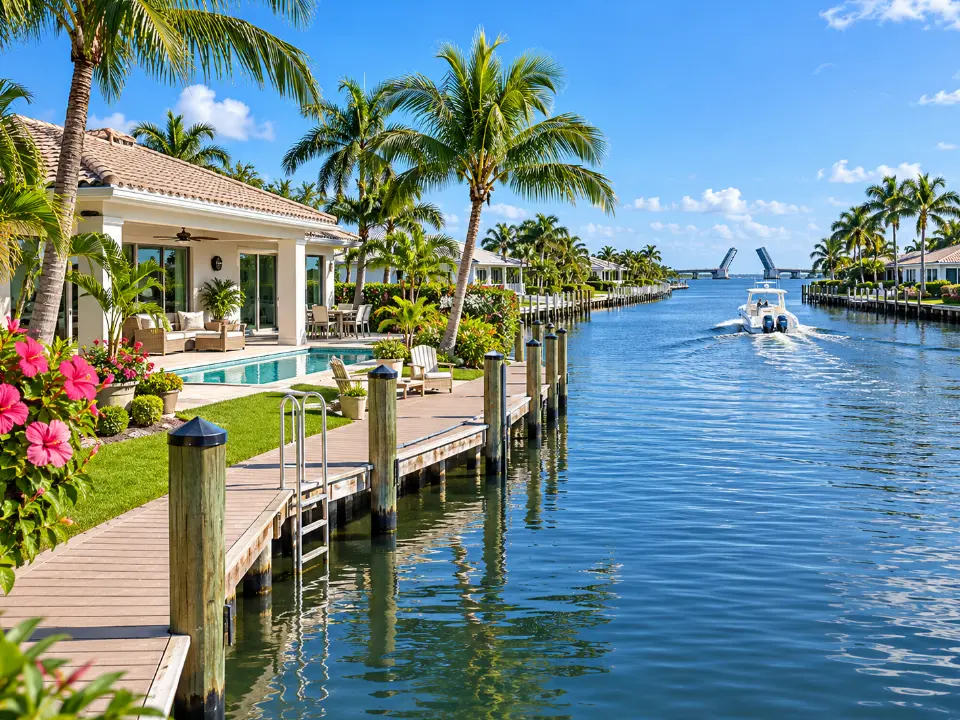
In Florida real estate, “no fixed bridges” means the boating route from a waterfront property does not pass beneath a permanently fixed bridge that creates an overhead height restriction, when the description is accurate for the intended route. This can be especially important for sailboats with tall masts and larger powerboats with towers or other equipment above the waterline. It does not mean every boat can use the property. Buyers still need to verify water depth, tides, movable bridges, channel conditions, dock and lift specifications, and the complete route to the bay, Gulf, Intracoastal Waterway or other intended destination.
Quick Answers About No Fixed Bridges in Florida Real Estate
What does “no fixed bridges” mean on a Florida real estate listing?
It generally means there is no permanently fixed bridge creating an overhead height restriction along the stated boating route from the property. Buyers should verify the exact route because the phrase does not establish suitability for a particular boat.
Does no fixed bridges mean there are no bridges at all?
No. The route can still include movable bridges, such as bascule or drawbridges, that open for marine traffic. Their schedules, operating procedures and restrictions can affect the practical boating route.
Does no fixed bridges mean a sailboat can use the property?
Not automatically. Removing a fixed overhead obstruction is important for a sailboat, but the vessel's underwater draft, mast height, channel depth, canal width, movable bridges and other navigation conditions still need to work for that specific boat.
Is no fixed bridges the same as deep-water access?
No. No fixed bridges describes an overhead-access characteristic, while deep-water access describes water depth. A route can have no fixed bridges and still be too shallow for a particular vessel.
Does no fixed bridges guarantee Gulf access?
No. The phrase describes bridge conditions along a stated route, not necessarily the destination. Buyers should determine exactly where the waterway leads and whether it provides a practical navigable route to the Gulf, a bay, river, Intracoastal Waterway or another body of water.
What boat measurement matters most for bridge clearance?
The vessel's height above the waterline is critical when evaluating overhead clearance. Buyers should account for masts, hardtops, towers, antennas and other equipment and have vessel-specific clearance evaluated when boating access is material to the purchase.
What else should a waterfront buyer verify?
Verify water depth, tides, channel width, turning space, movable bridges, speed restrictions, locks or other obstacles, dock dimensions, lift capacity, seawall condition, permits, association restrictions, flood information and property-specific insurance.
What Is a Fixed Bridge?
A fixed bridge is a bridge span that does not open to allow taller marine traffic to pass. A vessel using the waterway must physically fit beneath the available vertical clearance.
For a low-profile boat, a fixed bridge may create little or no practical problem if adequate clearance is available. For a sailboat with a tall mast or a larger powerboat with a flybridge, tower or other elevated equipment, the same bridge can make a waterfront property unsuitable for that vessel.
This is why Hunt Brothers Realty recommends tracing the complete boating route from a Florida waterfront home rather than evaluating only the dock behind the house.
Does “No Fixed Bridges” Mean There Are No Bridges?
No. A no-fixed-bridges route can still include movable bridges. The important distinction is that a movable bridge can open for marine traffic under its applicable operating rules, while a fixed bridge cannot be raised for a taller vessel.
Movable bridges can still affect boating convenience. Depending on the bridge, boaters may encounter opening schedules, restricted periods or other operating procedures. A property can therefore accurately have no fixed bridges while still requiring bridge planning during a trip.
Buyers should identify every relevant bridge between the dock and the waters they expect to use. If a particular route is essential to the purchase, current navigation information should be independently confirmed rather than relying solely on listing remarks.
Why Does No-Fixed-Bridge Access Matter for Sailboats?
Sailboats can require substantial overhead clearance because of their masts. A fixed bridge can therefore eliminate an otherwise navigable waterfront route even when the canal has plenty of water depth.
That is why Florida real estate descriptions sometimes use terms such as “sailboat access” alongside no-fixed-bridge language. Buyers should treat those phrases as descriptions requiring verification rather than guarantees that a particular sailboat will fit.
A sailboat has two important access dimensions. The mast and equipment create an overhead requirement, while the keel creates an underwater draft requirement. A route can solve one problem while failing the other.
Why Can No Fixed Bridges Matter for Powerboats Too?
Powerboats can also have significant height above the waterline. Hardtops, upper helms, towers, radar equipment, antennas and other structures can make bridge clearance relevant even when a boat has no mast.
The relevant measurement is the boat's actual operating height above the water. Buyers should not assume that a vessel fits simply because another powerboat uses the same canal. Different boats can have dramatically different dimensions.
If you already own the vessel, bring its specifications into the property search. If you expect to purchase a larger boat later, consider that future vessel when evaluating waterfront access rather than choosing a property around today's boat alone.
Is No Fixed Bridges the Same as Deep-Water Access?
No. The terms answer different boating questions. No fixed bridges concerns overhead restrictions, while deep-water access concerns the amount of navigable water beneath the vessel.
A canal can have no fixed bridges but still be too shallow for a deeper-draft vessel. The opposite can also occur: a waterway may provide ample depth but have a fixed bridge that prevents a tall vessel from reaching larger navigable water.
Hunt Brothers Realty's guide to deep-water access in Sarasota explains why buyers need to evaluate depth, tides, bridges and the vessel together rather than treating “deep water” as a standardized real estate measurement.
Does No Fixed Bridges Mean Direct Gulf Access?
No. No fixed bridges does not by itself tell you where the waterway leads or how long the boating route takes. The route might connect to a bay, river, harbor, Intracoastal Waterway or another navigable water body before reaching the Gulf or Atlantic.
A waterfront property can therefore have no fixed bridges while still requiring a lengthy trip through canals or slow-speed areas. Another property may provide a much shorter route to larger open water.
For a buyer who expects to fish offshore or boat frequently, route convenience can be nearly as important as bridge clearance. Determine where the canal actually connects and investigate realistic navigation conditions rather than relying on straight-line distance on a map.
Does No Fixed Bridges Mean Any Boat Can Reach Open Water?
No. Eliminating fixed overhead obstructions solves only one part of vessel access. The boat still needs enough water beneath it, enough width and maneuvering room around it, and a legally and practically usable navigation route.
For serious boating buyers, the better question is whether the specific vessel can safely and legally travel from the dock to the intended destination under the conditions in which the owner expects to operate it.
- Vessel height above the waterline
- Vessel draft below the waterline
- Water depth at the dock
- Water depth along the complete route
- Tidal variation and other water-level changes
- Canal and channel width
- Turning and maneuvering space
- Movable bridges and operating restrictions
- Locks, overhead utilities or other route limitations
- Speed and navigation restrictions
What Is the Difference Between Air Draft and Boat Draft?
Air draft concerns how high a vessel extends above the waterline, while draft describes how far the vessel extends below the waterline. Both can determine whether a Florida waterfront property works for a particular boat.
Air draft matters when passing beneath bridges and other overhead obstructions. The relevant height can include a mast, hardtop, tower, antennas, radar equipment and other components depending on the vessel's configuration.
Underwater draft matters when evaluating canal and channel depth. A property with excellent overhead access can still be unsuitable if the vessel cannot safely navigate the water depth at the dock or somewhere along the route.
Can Tides Affect Bridge and Waterway Access?
Yes. Changing water levels can affect both overhead clearance and underwater clearance. Higher water can reduce the available space between the water surface and an overhead structure, while lower water can reduce the depth available beneath a vessel.
This creates an important distinction for boaters. A lower tide may provide more overhead room but less water beneath the keel or hull, while higher water can create the opposite combination.
Buyers should therefore avoid treating one bridge-clearance or depth observation during a property showing as proof that the route works under all relevant conditions. When clearance is close or boating access is a major purchase consideration, the route should be evaluated with current navigation information and appropriate marine expertise.
What Does “Sailboat Access” Mean in Florida Listings?
“Sailboat access” is commonly used in Florida waterfront marketing to suggest a boating route without a fixed overhead bridge that would prevent a tall mast from passing. It should not be treated as a certified promise that every sailboat can use the property.
Sailboats can have substantial underwater draft as well as substantial air draft. A no-fixed-bridge route that is too shallow for the keel still does not work for the vessel.
When “sailboat access,” “no fixed bridges,” “deep water” or similar terminology is material to the purchase, independently verify the actual route and vessel compatibility before relying on the listing description.
Are “Waterfront,” “Gulf Access” and “No Fixed Bridges” Interchangeable?
No. These phrases describe different characteristics, and treating them as interchangeable can create expensive misunderstandings for a boating buyer.
- Waterfront: The property fronts or relates directly to water, but that alone does not establish usable boating access.
- Navigable access: The waterway may support boat travel, but vessel size and operating conditions still matter.
- Deep-water access: Generally suggests greater navigable depth, but there is no single depth that works for every vessel.
- No fixed bridges: Indicates that a stated route does not contain a permanently fixed bridge creating an overhead restriction, when accurately described.
- Gulf access: Indicates a boating route toward the Gulf, but does not by itself establish water depth, bridge conditions, travel time or suitability for a specific vessel.
- Direct access: Can suggest a relatively uncomplicated or short route, but buyers should verify exactly what “direct” means for the property.
Hunt Brothers Realty's Florida waterfront property buyer guide explains why the practical function of the waterfront should be investigated rather than inferred from a single marketing term.
Can a Property With a Fixed Bridge Still Be a Good Boating Home?
Yes. A fixed bridge does not automatically make a waterfront property unsuitable for boating. The question is whether the available clearance works for the boat the owner intends to use.
A lower-profile boat may comfortably fit beneath a bridge that prevents a tall sailboat or larger vessel from passing. For that buyer, other factors such as water depth, dock configuration, route length and location may be more important than the presence of the bridge.
This is why “no fixed bridges” should not automatically be interpreted as “better.” Its importance depends on the vessel, boating plans and property being compared.
How Should Buyers Verify a No-Fixed-Bridges Claim?
Trace the complete route from the property's dock to the body of water you actually intend to use. Do not stop the analysis when the canal reaches a larger waterway, because a bridge or other restriction farther along the route may still determine whether your boat can reach the intended destination.
Hunt Brothers Realty's boating-property research recommends identifying every fixed and movable bridge along the route and comparing relevant conditions with the vessel's dimensions. Current navigation information can also identify bridge clearances and other route considerations.
If boating access is material to the purchase, consider having the route and vessel compatibility evaluated by an appropriately qualified captain, marine professional, surveyor, dock or lift professional, or other specialist familiar with the local waterway. Real estate listing language should not substitute for vessel-specific navigation analysis.
What Should You Check About the Dock and Boat Lift?
A perfect boating route does not help if the dock or lift cannot accommodate the vessel. Buyers should evaluate the waterfront infrastructure as a separate part of property due diligence.
- Dock dimensions and configuration
- Dock pilings, decking and visible condition
- Boat-lift rated capacity
- Lift configuration and compatibility with the hull
- Available water depth around the dock and lift
- Electrical and water service where applicable
- Available permit and approval documentation
- Association or community restrictions affecting boats or waterfront improvements
A boat lift should be evaluated against the vessel's actual loaded weight, beam, hull design and other relevant specifications. When compatibility affects the purchase, obtain confirmation from the lift manufacturer or an appropriately qualified marine professional.
Does an Existing Dock Mean the Waterfront Improvements Are Permitted?
No. The existence of a dock, lift or other waterfront improvement does not by itself establish that all required permits and approvals are available or that a proposed replacement or modification will be permitted.
The Florida Department of Environmental Protection regulates many activities affecting Florida surface waters. DEP currently provides a self-certification process for certain qualifying single-family dock projects that are exempt from requiring a DEP permit, including some new docks, dock repairs or replacements, and boat-lift additions.
Other state, federal, local or association requirements may still apply depending on the property and project. Buyers planning to modify, replace, expand or add waterfront structures should verify the applicable requirements with the appropriate permitting authorities and qualified professionals before purchasing based on an assumed approval.
Why Should Buyers Inspect the Seawall Too?
The boating route may be excellent while the waterfront infrastructure at the property requires substantial work. When a seawall or other shoreline stabilization is present, its condition and maintenance responsibility can materially affect the ownership budget.
Buyers should investigate construction, visible condition, maintenance history, prior repairs and available permit or engineering information. Hunt Brothers Realty's Florida seawall buyer guide provides additional questions for evaluating shoreline infrastructure.
Seawall condition and remaining service life should be evaluated by an appropriately qualified inspector, marine contractor, engineer or other professional when those issues are material to the purchase. Buyers should also determine whether the owner or an association is responsible for future work.
Does No-Fixed-Bridge Access Tell You Anything About Flood Risk?
No. No-fixed-bridge access is a boating characteristic, not a flood-zone designation or measure of a property's overall flood exposure. Waterfront buyers should investigate flood considerations independently.
Relevant property-specific information can include the current FEMA flood zone, elevation documentation, finished-floor elevation, prior flooding information when available, drainage, coastal exposure and applicable lender requirements. Hunt Brothers Realty's Florida flood-zone guide explains why a waterfront address alone does not establish a home's flood designation.
Insurance availability, flood coverage, wind coverage, exclusions, deductibles and premiums can vary substantially by property and insurer. Buyers should obtain property-specific quotes and discuss appropriate coverage with a qualified insurance professional before making a purchasing decision based on expected insurance cost or protection.
What Should a Boater Know Before Shopping for Florida Waterfront Homes?
Start with the boat rather than the listing description. Knowing the vessel's dimensions allows a waterfront property to be evaluated against the boat you actually intend to keep and use there.
- Overall length: Helps evaluate dock space, lift configuration and maneuverability.
- Beam: Matters for dockage, lift configuration and canal maneuvering.
- Draft: Determines the underwater clearance the vessel requires.
- Height above the waterline: Helps evaluate bridges and other overhead restrictions.
- Loaded weight: Is important when evaluating boat-lift capacity.
- Intended destination: Determines which route actually needs to work.
Hunt Brothers Realty's 2026 Florida waterfront home buyer guide covers additional considerations including docks, lifts, seawalls, flood information, insurance and shoreline restrictions.
What Questions Should You Ask About a No-Fixed-Bridges Property?
A no-fixed-bridges description is a useful starting point, but it should lead to more specific questions before a waterfront buyer relies on the access.
- No fixed bridges between the dock and exactly which body of water?
- Are there movable bridges along the route?
- What are the current operating procedures for those bridges?
- What is the water depth at the dock under relevant tidal conditions?
- What is the controlling depth along the intended route?
- Are shoaling or other changing channel conditions relevant?
- Is the canal wide enough for the vessel to maneuver?
- Are there locks, overhead utilities or other restrictions?
- How long does the practical trip to the intended open water take?
- Are there slow-speed or other navigation restrictions?
- Does the dock fit the vessel?
- Is the boat lift appropriately rated and configured?
- Are permits available for the dock, lift and other waterfront improvements?
- Do HOA, condominium or deed restrictions affect boat storage or dock use?
What Is the Bottom Line on No Fixed Bridges?
No fixed bridges is an important Florida waterfront real estate term, but it answers only one question: whether a permanently fixed bridge creates an overhead restriction along the stated boating route. It does not establish unlimited boating access, sufficient depth, direct Gulf access or compatibility with a specific boat.
For some sailboat and larger powerboat owners, a fixed bridge can immediately eliminate a property from consideration. For a buyer with a lower-profile or shallow-draft boat, the same bridge may be far less important than water depth, dock configuration or travel time to open water.
The most useful approach is vessel-specific. Know your boat, trace the entire route, verify the waterfront infrastructure and investigate the restrictions that actually affect how you plan to use the property.
Explore Florida Waterfront Homes With Hunt Brothers Realty
Hunt Brothers Realty helps buyers compare Florida Gulf Coast waterfront properties based on the type of water access they actually intend to use. Review HBR's guide to keeping a boat at a Florida home, learn about deep-water access in Sarasota, read the Florida waterfront property buyer guide, or contact Hunt Brothers Realty to discuss a waterfront home search.
Informational notice: This article provides general real estate and educational information and is not individualized legal, financial, insurance, marine-navigation, engineering, inspection, surveying, construction, title, permitting or other professional advice. Boating suitability depends on the specific property, vessel, route and operating conditions. Buyers should independently verify bridge conditions, water depth, tides, navigation routes, dock and lift specifications, seawall condition, permits, ownership rights, association restrictions, flood information and insurance, and consult appropriate qualified marine professionals, surveyors, inspectors, contractors, engineers, insurance professionals, attorneys, permitting authorities and other specialists when a purchasing decision requires individualized guidance.
Sources
- Hunt Brothers Realty, Can You Keep a Boat at Your Florida Home?
- Hunt Brothers Realty, Deep-Water Access in Sarasota
- Hunt Brothers Realty, Buying Waterfront Property in Florida
- Florida Department of Environmental Protection, Environmental Resource Permitting
Hunt Brothers Realty
46 N. Washington Blvd, Ste 3, Sarasota, FL 34236
Phone: (941) 388-7017
Email: info@huntbrothersrealty.com
Website: HuntBrothersRealty.com
Categories
- All Blogs 2674
- Anna Maria Island 92
- Bird Key 6
- Bradenton 242
- Buying a Home 1692
- Casey Key 3
- Clearwater 16
- Condos & HOA Living 1623
- Ellenton 9
- Englewood 15
- First Time Homebuyers 1813
- Foreclosures 4
- Home Selling 10
- Homeownership 1860
- Lakewood Ranch 36
- Lido Key 29
- Longboat Key 81
- Luxury/Waterfront Properties 1801
- Market Updates & Trends 1302
- Mortgages & Financing 85
- Move-Up Buyers 24
- Neighborhood Guides 1429
- New Construction 47
- Palmetto 4
- Parrish 38
- Port Charlotte 36
- Punta Gorda 165
- Real Estate Investing 1714
- Relocation to Florida 1742
- Safety Harbor 4
- Sarasota 160
- Sarasota - Downtown 175
- Selling a Home 149
- Siesta Key 94
- St. Petersburg 11
- Taxes and Homestead 3
- Tierra Verde 7
- Vacation & Second Homes 1908
- Venice 225
- Wellen Park 24
Recent Posts